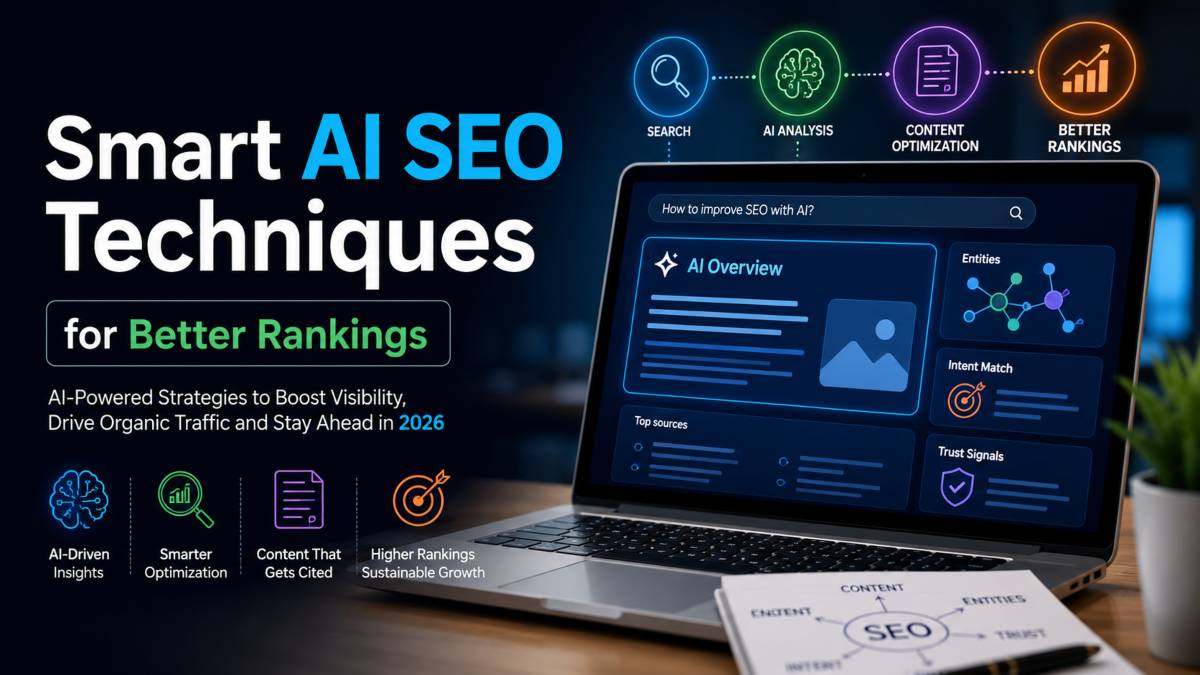
Search has changed, and the old playbook is starting to look thin. Ranking is no longer about stuffing pages with keywords and hoping for clicks. Today, search engines read meaning, context, and relationships between topics. They look at entities, intent, and how clearly your content answers real questions.
You can see this shift in AI powered results like Google summaries that pull direct answers instead of listing links. If your content is not clear, structured, and trusted, it gets ignored.
That is where smart AI SEO techniques come in. This guide focuses on practical strategies that help your content get picked, cited, and seen. You will learn how to shape content for AI systems while still keeping it useful and easy to read for real people.
How AI is Changing SEO in 2026
Search in 2026 feels less like a list of links and more like a conversation. AI systems now read pages the way people do. They look for meaning, context, and how ideas connect across your site. If your content is unclear or scattered, it slips out of view.
From Keywords to Entities and Intent
Search engines no longer rely on exact match phrases alone. They look at entities, which are clear topics, people, or concepts, and how they relate to each other. This means your content needs a strong sense of focus.
Clear topic definition matters more than repeating the same keyword. When your page answers a specific question with clarity, AI systems can understand and trust it. That is what helps your content show up in results.
Rise of AI Generated Search Results
AI driven results now sit at the top of many searches. These summaries pull direct answers from different sources and present them in a clean format. Users often get what they need without clicking through multiple pages.
This shift reduces the role of traditional click traffic. Visibility now depends on whether your content gets selected as a source. Clear answers and well structured sections increase your chances of being included.
Why Traditional SEO Alone No Longer Works
Old tactics like keyword stuffing and basic backlinks are not enough anymore. They may still help, but they do not carry the same weight on their own.
What matters now is how your content is structured and how easy it is to read. Short paragraphs, clear headings, and logical flow make it easier for AI systems to extract useful information. When your content is organized and direct, it performs better in both search results and AI summaries.
Core AI SEO Techniques That Drive Rankings
Ranking in 2026 is less about tricks and more about clarity. AI systems reward content that is easy to understand, well connected, and built around real intent. If your content answers questions in a clean and structured way, it stands a far better chance of being selected and shown.
Build Strong Entity Authority
Start by making your topic identity clear. Your site should send the same signals across every page. That means consistent wording, clear descriptions, and a focused niche.
If you write about AI SEO, stay within that lane and go deep. Define your topics clearly and repeat that clarity across your content. Over time, search systems begin to associate your site with that subject. That recognition builds trust and increases your chances of being referenced.
Create Topical Clusters That Connect Content
Single pages do not carry as much weight on their own anymore. What matters is how your content connects. A strong setup includes a main pillar page that covers a broad topic, supported by smaller pages that explore specific angles.
Link these pages together in a logical way. This creates a network of related content that helps search systems understand your site structure. It also keeps readers moving from one useful piece to another without friction.
Optimize for AI First, Not Just Search Engines
Think about how your content will be read by AI systems. They look for direct answers, not long introductions. Place your key points at the top of each section.
Use clear summaries and simple definitions where possible. When your content answers a question quickly and cleanly, it becomes easier for AI systems to pick it up and display it.
Structure Content for AI Extraction
Presentation matters as much as the information itself. Break your content into short paragraphs that are easy to scan. Use lists and tables to organize details in a clear way.
Add FAQ sections that answer common questions directly. This format helps AI systems pull information without confusion. It also improves the reading experience for users who want quick answers without digging through long blocks of text.
When your content is clean, connected, and easy to read, it becomes far more likely to rank and get noticed.
Content Optimization for AI Visibility
Good content is no longer enough. It has to be clear, structured, and easy for both people and AI systems to read. Visibility now depends on how well your content answers questions and how clearly it presents those answers.
Write for Intent, Not Just Keywords
Start with the reason behind the search. What is the user really trying to find? Your content should answer that need in a direct and simple way.
Avoid long introductions that delay the answer. Get to the point early, then expand with useful detail. Think about the next question a reader might ask and answer it before they have to search again. This keeps your content useful and complete.
Use Structured Data to Help AI Understand Content
Structured data helps search systems read your content with more clarity. It adds context that plain text alone cannot provide.
FAQ schema is especially useful. It allows your answers to appear in rich results and AI summaries. Author and article schema also help by showing who created the content and when it was published. This adds another layer of clarity that supports better visibility.
Add Trust Signals That Improve Credibility
AI systems lean toward content they can trust. That trust comes from clear signals across your page.
Citations show where your information comes from. Update dates tell readers and systems that your content is current. External mentions or references to reliable sources also add weight.
When your content is accurate, current, and backed by clear signals, it becomes easier for search systems to select and display it.
Advanced AI SEO Techniques That Give an Edge
Once the basics are in place, the next step is control. Not control in the old sense of ranking a page and waiting for clicks, but control over how your content is read, selected, and referenced by AI systems. This is where stronger strategy starts to separate one site from another.
Combine AI SEO with Generative Engine Optimization
Generative Engine Optimization focuses on how your content is picked up and used in AI responses. The goal is to shape content in a way that makes it easy to quote and reuse.
Write in a natural, conversational tone that mirrors how people ask questions. Keep answers tight and clear so they can be lifted without confusion. When your content reads like a direct response, it becomes more likely to be included in AI outputs.
Optimize for AI Mentions and Citations
Clicks are no longer the only signal that matters. Being mentioned or cited by AI systems is now a strong indicator of visibility.
Create content that is accurate, direct, and easy to reference. Use clear statements that answer specific questions. Over time, this increases the chances that your content will be selected as a source.
You can also track performance differently by watching how often your content appears in AI driven results, not just how many users visit your page.
Maintain Consistency Across Content
Consistency builds recognition. When your content follows a clear structure and uses similar language across pages, it becomes easier for AI systems to understand your site as a whole.
Keep your content updated so it stays relevant. Refresh older pages with new information and improve internal links between related topics. This keeps your site active and connected, which supports stronger visibility.
Adapt Content for Global AI Behavior
AI systems may respond differently based on region, language, and search patterns. If your audience is global, your content should reflect that.
Adjust examples, phrasing, and references to match different regions while keeping your core topic clear. Even with these variations, your main message and entity signals should stay consistent.
This balance helps your content reach a wider audience without losing clarity or focus.
Best AI SEO Tools to Improve Rankings
Smart tools do not replace strategy, but they can sharpen it. The right mix helps you plan content, refine structure, and move faster without losing quality. These tools support different parts of the workflow, from research to publishing.
Surfer SEO
Surfer SEO focuses on content scoring and SERP analysis. It compares your page against top ranking results and shows what is missing. This includes word count, structure, and key terms used across competing pages.
It works well when you want to fine tune content before publishing. You get a clear view of how your page stacks up and what needs improvement.
Clearscope
Clearscope helps with topic coverage and authority building. It suggests related terms and topics that strengthen your content without forcing repetition.
This tool is useful when you want to create deeper content that covers a subject from multiple angles. It keeps your writing focused while still expanding your reach.
Alli AI
Alli AI focuses on on page automation. It can apply changes across multiple pages without manual edits, which saves time for larger sites.
For agencies or teams managing many pages, this reduces the effort needed to update titles, meta tags, and other elements.
Semrush and Frase
Semrush and Frase work well together for research and intent analysis. Semrush provides data on search terms, competition, and trends. Frase helps turn that data into structured content that answers user questions.
This combination gives both direction and execution support, which is useful for building content that matches real search behavior.
Postaga
Postaga focuses on outreach and link building. It helps automate email campaigns and find opportunities for backlinks.
This is useful for building authority without spending hours on manual outreach. It keeps your process organized and easier to scale.
Writesonic
Writesonic supports content creation and prompt testing. It helps generate drafts, refine ideas, and test different ways to present information.
While it should not replace human editing, it can speed up the early stages of writing and help you explore different angles quickly.
Using these tools together creates a workflow that is faster, more structured, and easier to manage as your content grows.
Common Mistakes to Avoid in AI SEO
AI SEO is not about chasing systems. It is about making content clear, useful, and easy to understand. Many sites miss this and fall into patterns that limit their reach.
One common mistake is writing for algorithms instead of people. When content feels forced or unnatural, it loses clarity. AI systems are built to read meaning, so content that serves real users performs better.
Another issue is ignoring structure. Large blocks of text without clear sections make it harder for both readers and AI systems to process information. Clean headings, short paragraphs, and organized flow make a big difference.
Over relying on automation can also weaken content. Tools can assist, but they cannot replace human judgment. Without editing and refinement, content may sound generic or miss important details.
Weak internal linking is another problem. When pages are not connected, your site feels scattered. Linking related content helps build context and keeps both readers and search systems moving through your site with ease.
Avoiding these mistakes keeps your content sharp, readable, and more likely to be selected and shown.
Final Thoughts
Search is no longer a simple list of results. It is a system that reads, selects, and presents answers. That shift changes how content needs to be written and structured. Clear ideas, strong organization, and real usefulness now carry more weight than surface level tactics.
The best approach is to treat AI SEO as an ongoing process. Test different formats, adjust how you present answers, and watch how your content performs in real search results. Small changes can lead to better visibility over time.
Stay focused on clarity and intent, and your content will be easier to find, read, and used by both people and AI systems.