Search engines help people find information online within seconds. When someone types a question or keyword into Google, Bing, or Yahoo, the search engine scans its database and returns pages that best match the search. This process helps users quickly find websites, articles, products, services, and answers to their questions.
For website owners, marketers, and businesses, understanding search engine basics is an important part of building a strong online presence. Search engines determine which pages appear in search results and where they rank. The higher a page appears, the more likely it is to receive visitors.
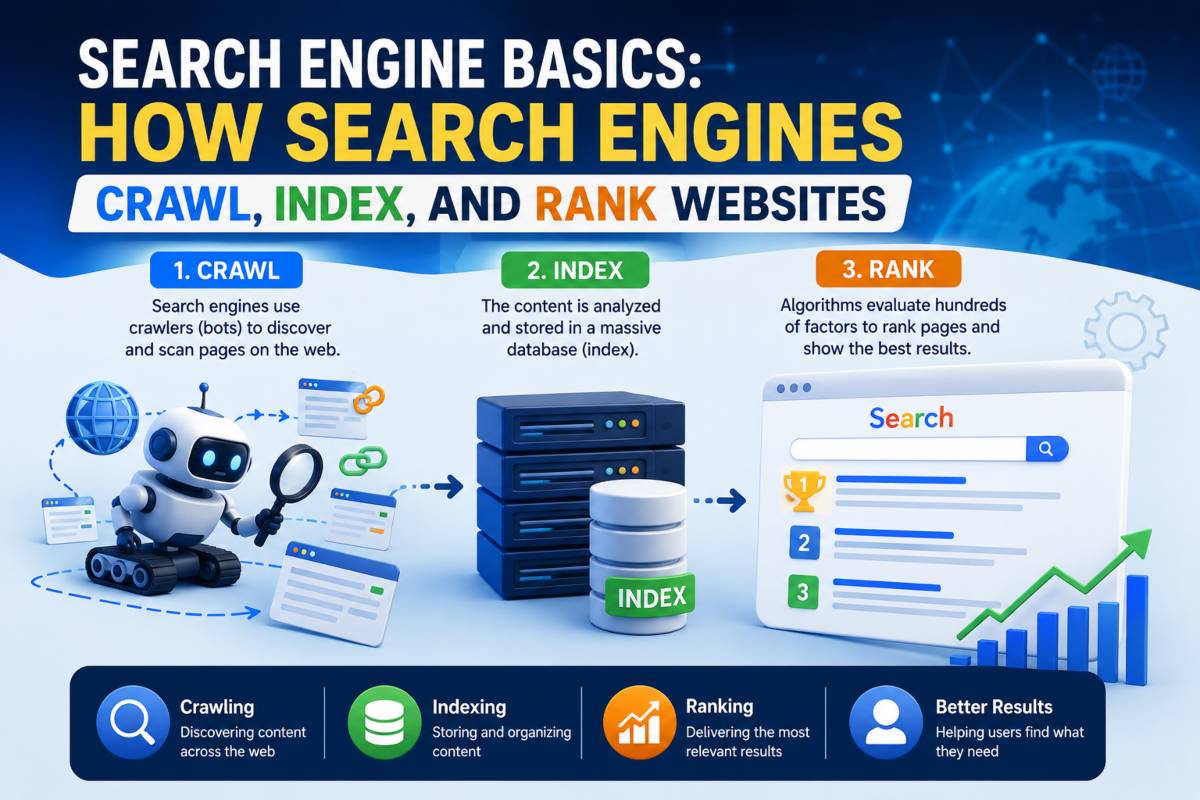
Behind every search result are three key processes. First, search engines discover web pages through crawling. Next, they store and organize information through indexing. Finally, they sort and display results through ranking. These systems work together to connect users with the most relevant content.
Learning how search engines operate can help you create better content, improve website visibility, and attract more organic traffic. Whether you are new to SEO or looking to strengthen your digital marketing knowledge, understanding these fundamentals is the first step toward achieving better search performance.
What Is a Search Engine?
A search engine is an online tool that helps people find information on the internet. Instead of visiting hundreds of websites to look for answers, users can type a word, phrase, or question into a search box and receive a list of relevant results within seconds.
Search engines collect information from billions of web pages and organize it into large databases. When someone performs a search, the search engine analyzes the query and displays pages that closely match the user’s intent. This makes it easier to find articles, products, services, images, videos, and other online content.
People interact with search engines every day. They use them to learn new skills, compare products, find local businesses, read news, or solve problems. For many users, a search engine is the starting point for almost every online activity.
Examples of Popular Search Engines
Several search engines are available today, each offering a slightly different experience.
Google is the most widely used search engine and processes billions of searches every day.
Bing is Microsoft’s search engine and is known for its visual search features and integration with Microsoft products.
Yahoo continues to provide search services and online content to users around the world.
DuckDuckGo focuses on user privacy and does not track personal search activity in the same way many other platforms do.
What Is a SERP?
SERP stands for Search Engine Results Page. It is the page users see after entering a search query into a search engine.
A SERP typically contains two main types of results. Organic results are unpaid listings that appear because the search engine considers them relevant to the search. Paid results are advertisements that businesses pay to display for specific keywords.
Understanding how a SERP works is an important part of learning search engine basics because it shows how search engines connect users with information online.
How Search Engines Work
To understand how search engines work, it helps to think of them as giant digital libraries. Just as a librarian organizes books and helps visitors find the right information, search engines organize billions of web pages and help users find the most relevant content for their searches.
The search engine process relies on three core steps: crawling, indexing, and ranking. First, search engines discover web pages by scanning websites across the internet. Next, they store and organize the collected information in a massive database. Finally, they evaluate the available pages and decide which results should appear first when someone performs a search.
These three processes work together behind the scenes every time you use Google, Bing, or another search engine. Understanding how search engines work provides a strong foundation for learning SEO and improving website visibility. In the following sections, we will take a closer look at each step and see how search engines find, store, and rank online content.
Crawling: How Search Engines Discover Content
What Is Crawling?
Crawling is the first step in the search engine process. It is the method search engines use to discover pages across the internet. Without crawling, search engines would have no way to find new websites or identify updates made to existing pages.
To perform this task, search engines use automated programs known as web crawlers, bots, or spiders. These programs continuously move from one page to another, collecting information about content, images, links, and other important page elements. Google uses a crawler called Googlebot, while other search engines have their own versions.
The information gathered during crawling helps search engines understand what a page is about before deciding whether it should be stored in their index.
How Web Crawlers Find Pages
A web crawler discovers content primarily by following links. When a crawler visits a webpage, it scans the links on that page and follows them to other pages.
Internal links connect pages within the same website. They help crawlers move through a site’s content and understand how different pages relate to each other.
External links connect one website to another. When a crawler finds a link pointing to a new site, it can visit that page and discover additional content.
Search engines also look for newly published pages and updated content. If a website regularly adds fresh information, crawlers may visit more often to check for changes. This helps search engines keep their databases current and accurate.
Tools That Help Search Engines Crawl Your Site
Website owners can make crawling easier by providing clear signals and a well organized structure.
An XML sitemap acts as a roadmap for search engines. It lists important pages and helps crawlers find content that may not be easily discovered through links alone.
A robots.txt file gives instructions about which sections of a website crawlers can access and which areas should be ignored.
A strong website structure also plays an important role. Clear navigation, logical categories, and well connected internal links help crawlers move through a site more efficiently.
Understanding Crawl Budget
Crawl budget refers to the number of pages a search engine is willing to crawl on a website during a specific period.
For small websites, crawl budget is usually not a major concern. However, for large websites with thousands of pages, it becomes more important. If crawlers spend time on low value pages, important content may not be discovered or updated as quickly.
Managing crawl budget involves improving site structure, removing unnecessary pages, fixing broken links, and maintaining a clean XML sitemap. These steps help search engines focus on the pages that matter most and keep valuable content visible in search results.
Indexing: How Search Engines Store Information
What Is Search Engine Indexing?
Once a search engine discovers a page through crawling, the next step is search engine indexing. Indexing is the process of analyzing, organizing, and storing information so it can be retrieved when someone performs a search.
Think of indexing as creating a record for each webpage. Search engines examine the page, identify its main topics, and store important details in their databases. If a page is not indexed, it cannot appear in search results, no matter how useful its content may be.
This is why indexing is such an important part of SEO. A well indexed website gives search engines the information they need to understand and display relevant pages to users.
What Information Gets Indexed?
Search engines collect and store several types of information from webpages.
The main element is the content itself. Search engines analyze the text to understand the page topic, context, and relevance to different search queries.
They also evaluate images and related image descriptions to understand visual content. Proper image optimization can help pages appear in image search results.
Another important element is metadata. This includes page titles, meta descriptions, and other information that helps search engines interpret a page.
Headings also play a key role during indexing. Structured headings help search engines understand the organization of a page and identify the most important topics being discussed.
Together, these elements help search engines build a clear understanding of each webpage.
How Search Engines Organize Data
The information collected from crawled pages is stored in a massive database known as a search index.
A search index works much like a library catalog. In a library, books are organized by subject, author, and category so visitors can quickly find what they need. Search engines use a similar approach by organizing billions of webpages based on their content and relevance.
When a user enters a search query, the search engine does not scan the entire internet in real time. Instead, it searches through its index and retrieves the most relevant pages from the stored data. This allows results to appear almost instantly.
How to Control Indexing
Not every page on a website needs to be included in search results. Website owners can control which pages become indexed pages.
One common method is using a noindex tag, which tells search engines not to include a page in their index.
A robots.txt file can also restrict crawler access to specific sections of a website. This helps prevent certain content from being processed.
Private account pages, internal dashboards, thank you pages, and other restricted content are often excluded from indexing. By controlling what gets indexed, website owners can help search engines focus on the pages that provide the most value to users.
Ranking: How Search Engines Choose the Best Results
What Is Ranking?
After a page has been crawled and indexed, the final step is search engine ranking. Ranking is the process search engines use to decide where a webpage should appear in search results for a specific query.
Every time someone searches online, thousands or even millions of pages may be relevant to that topic. Search engines evaluate these pages and arrange them in an order that they believe will best satisfy the user’s needs.
Relevance is one of the most important factors in ranking. Search engines try to understand what a user is looking for and then match that intent with the most useful content available. Pages that closely match the search query are more likely to appear near the top of the results page.
Major Ranking Factors
Search engines use hundreds of ranking factors to determine which pages deserve higher positions. While the exact formulas are not publicly disclosed, several factors are known to have a strong influence on rankings.
Content quality is a major factor. Pages that provide accurate, useful, and well organized information tend to perform better than pages with thin or outdated content.
Keyword relevance also matters. Search engines examine how closely a page matches the words and topics used in a search query. Keywords should appear naturally throughout the content, titles, and headings.
Backlinks remain an important signal of trust and authority. When reputable websites link to a page, search engines often view that page as more credible.
User experience is another key consideration. Fast loading pages, easy navigation, and clear layouts help visitors find information quickly and encourage positive engagement.
Mobile friendliness has become increasingly important because a large portion of searches now happen on smartphones and tablets. Websites that perform well on mobile devices often have an advantage in search results.
On Page vs Off Page SEO Factors
Search engine ranking relies on both on page and off page signals.
On Page Factors
On page factors are elements that website owners can directly control.
Titles help search engines understand the primary topic of a page.
Headings organize content and make it easier for both users and search engines to understand information.
Internal links connect related pages and help distribute authority throughout a website.
Alt text provides descriptions for images and helps search engines understand visual content.
Off Page Factors
Off page factors come from sources outside your website.
Backlinks from trusted websites remain one of the strongest ranking signals.
Brand mentions across the web can help search engines recognize the credibility and popularity of a business or website.
External authority is influenced by the quality and reputation of websites that reference or link to your content.
RankBrain and Modern Search Algorithms
Modern search algorithms are far more advanced than simple keyword matching systems. Search engines now use machine learning technologies such as RankBrain to better understand user behavior and search intent.
RankBrain helps Google interpret unfamiliar or complex queries and identify the content most likely to satisfy the searcher’s needs. Instead of focusing only on keywords, it evaluates context and meaning.
Search engines also consider search intent, which refers to the reason behind a query. A person searching for information may need a different result than someone looking to buy a product.
In some cases, results are also influenced by personalization factors such as location, language, and previous search activity. These systems help deliver results that are more relevant to individual users.
By understanding how ranking works and the factors that influence it, website owners can create content and experiences that have a better chance of appearing higher in search results.
Main Components of a Search Engine
Search engines rely on several key systems that work together to find, organize, and deliver information to users. Understanding these search engine components makes it easier to see how search results appear within seconds after a query is entered.
Web Crawler
A web crawler is an automated program that scans websites across the internet. Its job is to discover new pages, identify updated content, and collect information about webpages. Crawlers move from one page to another by following links and gathering data that will later be processed by the search engine.
Search Index Database
After content is discovered, the information is stored in a search index. This massive database contains details about billions of webpages. Instead of searching the entire internet every time someone enters a query, search engines look through their index to quickly find relevant results.
The search index helps organize information based on topics, keywords, page content, and other signals that help search engines understand what each page is about.
Ranking Algorithms
Ranking algorithms analyze indexed pages and determine which results should appear first for a particular search. These systems evaluate many factors, including content relevance, backlinks, user experience, and page quality.
The goal of ranking algorithms is to provide users with the most useful and accurate results for their searches.
Search Interface
The search interface is the part users interact with directly. It includes the search box, filters, and results pages displayed after a query is submitted. While it appears simple on the surface, it connects users to the complex systems working behind the scenes.
How These Components Work Together
Every search follows a similar path within the search engine architecture. The crawler discovers content, the search index stores it, ranking algorithms evaluate it, and the search interface displays the results to users.
Simple Workflow Diagram Suggestion:
User Search Query → Search Interface → Search Index → Ranking Algorithms → Search Results Page (SERP)
This coordinated process allows search engines to deliver relevant information quickly and accurately whenever someone performs a search.
Essential Search Engine Terms Every Beginner Should Know
Learning a few common search engine terms can make SEO much easier to understand. The glossary below covers some of the most important concepts you will encounter when learning how search engines work.
SERP
SERP stands for Search Engine Results Page. It is the page displayed after a user enters a search query into Google, Bing, or another search engine. A SERP may contain organic listings, paid advertisements, featured snippets, images, videos, and other search features.
Crawler or Spider
A crawler, sometimes called a spider, is an automated program used by search engines to discover webpages across the internet. Crawlers follow links, collect information, and help search engines find new or updated content.
Index
The index is a massive database where search engines store information collected during crawling. When someone performs a search, the search engine looks through its index rather than scanning the entire web in real time.
Ranking
Ranking refers to the position of a webpage in search results. Pages that appear closer to the top are usually considered more relevant to the user’s query. Search engines use many factors to determine rankings.
SEO
SEO, or Search Engine Optimization, is the practice of improving a website so it can appear higher in organic search results. SEO includes content optimization, technical improvements, keyword targeting, and link building.
Backlinks
Backlinks are links from one website to another. They act as signals of trust and authority. High quality backlinks from reputable websites can help improve search visibility and rankings.
Crawl Budget
Crawl budget is the number of pages a search engine is willing to crawl on a website within a specific period. While small websites rarely need to worry about crawl budget, it can become important for large websites with thousands of pages.
PageRank
PageRank is one of Google’s original ranking systems. It evaluates the importance of a webpage based on the quantity and quality of links pointing to it. Although search engines now use many additional signals, PageRank remains an important concept in understanding how links influence authority.
Understanding these search engine terms provides a strong foundation for learning SEO and improving website performance in search results.
A Brief History of Search Engines
The history of search engines shows how the internet evolved from a small collection of files into a vast source of information that billions of people use every day. Modern search tools can deliver highly relevant results in seconds, but the journey began with much simpler systems.
Early Search Engines
One of the earliest search tools was Archie, created in 1990. Archie was designed to help users find files stored on FTP servers. It did not search web pages as we know them today, but it laid the groundwork for future search technology.
A few years later, the World Wide Web Wanderer appeared. Developed in 1993, it was one of the first tools to crawl the web automatically. Its main purpose was to measure the size and growth of the internet. This marked an important step in the development of web crawling, which remains a core part of modern search engines.
These early systems introduced ideas that would later become essential to search engine evolution, including content discovery and data collection.
The Rise of Google
Google began as a research project called BackRub in the late 1990s. Created by Larry Page and Sergey Brin, it introduced a new way to evaluate webpages.
At the center of Google’s success was PageRank, an algorithm that measured the importance of a page based on the links pointing to it. Instead of focusing only on keywords, Google considered the authority and popularity of webpages. This approach helped deliver more relevant results and quickly set Google apart from competitors.
Google PageRank became one of the most influential developments in search technology and helped shape the future of SEO.
Search Engines Today
Modern search engines are far more advanced than their early predecessors. They use artificial intelligence, machine learning, and sophisticated ranking systems to understand queries and deliver accurate results.
Today’s platforms focus heavily on user intent, content quality, page experience, and relevance. AI driven search systems can interpret context, understand natural language, and provide results that closely match what users are looking for.
As search engine evolution continues, the goal remains the same: helping users find the most useful information as quickly as possible.
Why Search Engines Matter for SEO and Business Growth
Search engines play a central role in how people discover websites, products, services, and information online. Whether someone is researching a topic, comparing solutions, or looking for a business, search engines often serve as the starting point. For this reason, understanding search engine basics is essential for anyone interested in SEO, digital marketing, or growing an online presence.
Search Engines Drive Website Traffic
One of the biggest benefits of search engines is their ability to generate organic traffic. Studies estimate that search engines account for roughly 93% of website traffic, making them one of the most valuable sources of visitors for businesses and content creators.
Search results also have a strong influence on user behavior. Research shows that the first organic result on Google can receive around 37% of clicks, while lower positions typically attract fewer visitors. This means that ranking higher in search results can have a major impact on website traffic, lead generation, and sales.
Unlike paid advertising, organic traffic can continue bringing visitors over time without requiring ongoing advertising costs for every click.
Better Visibility Means More Opportunities
Strong website visibility helps businesses connect with people who are actively searching for information, products, or services. When a website appears prominently in search results, it gains more exposure and increases the likelihood of attracting potential customers.
Higher visibility can create several advantages:
- Increased brand awareness
- More website visits
- Higher lead generation potential
- Greater trust and credibility
- Improved customer acquisition opportunities
People often view top ranking results as more trustworthy because search engines have determined they are relevant to the search query. As a result, visibility in search results can influence both traffic and customer confidence.
How Search Engine Knowledge Supports SEO
A solid understanding of how search engines work forms the foundation of SEO basics. When website owners understand crawling, indexing, and ranking, they can make better decisions about content creation and website optimization.
Knowledge of search engines helps businesses:
- Create content that matches user intent
- Improve site structure and navigation
- Optimize pages for important keywords
- Build quality backlinks
- Enhance user experience
- Increase search marketing performance
SEO is not simply about adding keywords to a page. It involves helping search engines understand content while providing value to users. By learning how search engines discover, organize, and rank information, businesses can improve their chances of earning higher rankings, attracting more organic traffic, and achieving long term growth through search marketing.
Common Search Engine Myths
Many beginners come across outdated advice and misunderstandings when learning about SEO. These search engine myths can lead to poor decisions and unrealistic expectations. Understanding the facts helps website owners focus on strategies that actually support better search performance.
More Keywords Mean Better Rankings
One of the most common SEO myths is that adding as many keywords as possible will improve rankings. Years ago, some websites attempted to rank by repeating keywords throughout their content. Today, search engines are much smarter.
Modern algorithms focus on content quality, relevance, and user experience. Excessive keyword usage can make content difficult to read and may even hurt performance. Instead of repeating the same phrase over and over, focus on creating useful content that naturally covers the topic and answers user questions.
Google Indexes Every Page Immediately
Another misconception is that Google discovers and indexes every page as soon as it is published. In reality, indexing takes time.
Search engines must first find a page through crawling before it can be processed and added to the index. Depending on factors such as website authority, internal linking, and crawl activity, indexing may happen within hours, days, or even longer.
Submitting an XML sitemap and maintaining a clear website structure can help search engines discover content more efficiently, but there is no guarantee of instant indexing.
Backlinks Are No Longer Important
Some people believe backlinks no longer influence rankings because search algorithms have become more advanced. While search engines now consider many factors, backlinks remain an important signal of authority and trust.
When reputable websites link to your content, it helps search engines understand that others find the page valuable. However, quality matters far more than quantity. A few strong backlinks from trusted sources are often more beneficial than many low quality links.
Understanding these search engine myths can help beginners avoid common mistakes and focus on SEO practices that support long term results.
Getting Started With SEO After Learning Search Engine Basics
Now that you understand how search engines crawl, index, and rank content, the next step is applying that knowledge to improve your website. Learning search engine optimization basics can help you increase visibility, attract relevant visitors, and create a stronger online presence over time.
Create Helpful Content
The foundation of successful SEO is useful content. Focus on creating pages that answer questions, solve problems, and provide clear information for your audience. Before publishing, think about what users are searching for and how your content can meet their needs better than competing pages.
Improve Website Structure
A well organized website helps both users and search engines navigate content more easily. Use clear menus, logical page categories, and internal links that connect related topics. Strong website structure makes it easier for crawlers to discover important pages and helps visitors find information without frustration.
Build Quality Backlinks
Backlinks remain an important part of SEO for beginners. When trusted websites link to your content, search engines view those links as signals of credibility. Focus on earning links through high quality content, industry relationships, and useful resources rather than looking for quick shortcuts.
Monitor Performance
SEO is an ongoing process. Regularly monitor your website’s performance using tools such as Google Search Console and analytics platforms. Track metrics like organic traffic, keyword rankings, indexed pages, and user engagement. Reviewing this data can help you identify opportunities for improvement and make informed decisions about future content and optimization efforts.
By focusing on these core practices, beginners can build a strong SEO foundation and create steady growth through organic search.
Final Thoughts
Understanding search engine basics gives you a clearer picture of how websites appear in search results. Every search engine relies on three core processes: crawling, indexing, and ranking. Crawling helps discover content across the web, indexing organizes that information into searchable databases, and ranking determines which pages appear first for a user’s query.
For website owners, marketers, and content creators, this knowledge provides a strong foundation for building a successful online presence. When you understand how search engines process and evaluate content, it becomes easier to make informed decisions about website structure, content creation, and optimization efforts.
Search engines continue to be one of the most valuable sources of organic traffic, making SEO an essential skill for long term growth. If you are ready to improve your website’s visibility and attract more visitors, learning SEO is the natural next step. The better you understand search engines, the better prepared you will be to succeed in search results.
Read More: Interamplify SEO Agency