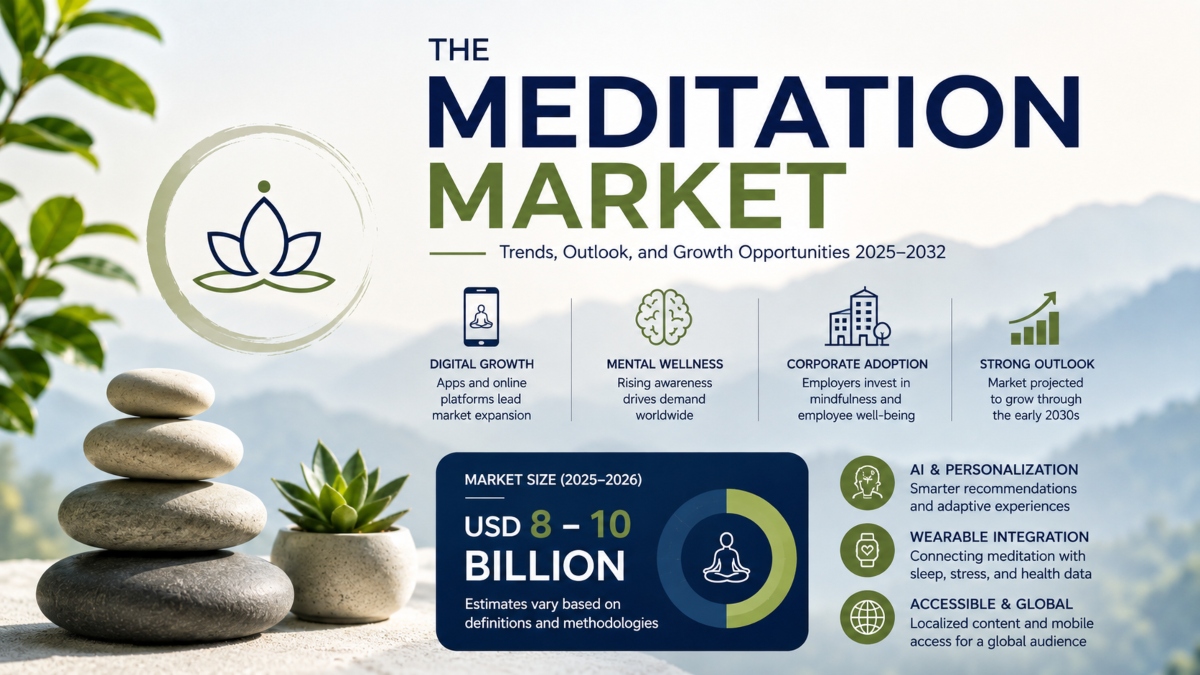
Meditation has moved beyond a personal wellness practice and become a growing commercial industry. The meditation market now includes meditation apps, online courses, guided audio, in person classes, retreats, corporate wellness programs, healthcare services, wearable devices, and other digital wellness products.
Around 2025 to 2026, the global meditation market is estimated at approximately USD 8 billion to USD 10 billion, based on the research sources reviewed for this article. Several market research firms expect the industry to expand further over the next decade as demand grows for stress management, better sleep, mindfulness, and accessible digital wellness services.
Market estimates vary, however, because research firms do not all define the meditation industry in the same way. Some focus mainly on meditation services and products, while others include apps, technology, wellness programs, or related mental wellness spending. This makes the market size best understood as a range rather than one fixed figure.
What Is the Meditation Market?
The meditation market is the business sector built around products and services that help people practice meditation, mindfulness, relaxation, stress management, and related wellness activities. What was once mainly offered through teachers, studios, books, and retreats is now available through smartphones, websites, wearable devices, and online platforms.
The meditation industry generates revenue through meditation apps, online courses, guided audio and video, classes, retreats, corporate wellness programs, healthcare services, memberships, teacher training, and wearable technology. Some businesses focus on individual consumers, while others sell meditation programs to employers, healthcare providers, schools, and wellness organizations.
The market also forms part of the wider mindfulness market, digital wellness sector, and broader wellness economy. Digital products have made meditation easier to access because users can choose a session, instructor, topic, or duration from almost anywhere.
As consumer interest in sleep, relaxation, stress management, and everyday mental wellness grows, meditation businesses have more ways to package and sell these services. The result is a market that combines traditional instruction with subscription software, online education, workplace programs, healthcare services, and connected technology.
What Products and Services Are Included?
The meditation market covers a wide range of offerings. Digital products include meditation apps, guided audio, video sessions, online courses, membership libraries, and personalized programs. Physical experiences include meditation classes, workshops, studios, and retreats.
Professional services include private instruction, coaching, teacher training, and certification programs. Businesses can also purchase workplace meditation sessions, employee programs, and corporate memberships. Healthcare organizations may use mindfulness programs for general wellness and supportive care.
Technology adds another layer through smartwatches, sensors, biofeedback tools, sleep tracking, and other connected devices. Together, these products create several revenue streams for businesses operating across the meditation industry.
Why Meditation Has Become a Commercial Market
Smartphones have made meditation available without requiring users to visit a studio or meet an instructor in person. Subscription services also give companies a steady way to sell large libraries of guided sessions, courses, and sleep content.
Workplace wellness programs have created another source of demand, while growing interest in sleep and mental wellness has encouraged consumers to seek simple tools they can use at home. Digital delivery also allows meditation companies to reach larger audiences, add new content, support multiple languages, and build services around different user needs.
How Big Is the Meditation Market?
The broader global meditation market is estimated at roughly USD 8 billion to USD 10 billion around 2025 to 2026. Several research firms expect the market to grow at a strong pace over the coming years, but their forecasts vary because each firm uses its own definition, data sources, and market boundaries.
For readers researching the meditation market size, the safest approach is to compare the figures while keeping their methodology in mind. The numbers below show why there is no single figure that can represent the entire market.
Meditation Market Size Estimates
| Research source | Current estimate | Forecast | Growth |
|---|---|---|---|
| The Business Research Company | USD 9.64B in 2025 | USD 27.51B by 2030 | 23.3% CAGR |
| Coherent Market Insights | USD 8.51B in 2026 | USD 20.39B by 2033 | 13.3% CAGR |
| Deep Market Insights | USD 9.84B in 2025 | USD 18.01B by 2031 | 10.6% CAGR |
| Phoenix Research | USD 8.6B in 2025 | USD 15.4B by 2033 | About 7.5% CAGR |
| Global Wellness Institute | USD 7.1B in 2024 | Part of mental wellness economy | 18.9% annual growth, 2019 to 2024 |
These figures should not be treated as directly interchangeable. The Global Wellness Institute uses a defined meditation and mindfulness category within the wider mental wellness economy, while commercial research firms may cover a broader group of products and services.
The difference is important when discussing the meditation market forecast. A higher forecast does not automatically mean one source is more accurate. It may simply reflect a wider market definition or a different approach to measuring revenue and future growth.
Why Meditation Market Estimates Differ
One major reason for the variation is the way research firms define the meditation market. Some reports focus on meditation products and services, while others include a wider mix of digital wellness, mindfulness, technology, or related services.
The inclusion of meditation apps can also change the total. An app focused on guided sessions may be counted as part of the meditation market, while another report may classify it under digital health or wellness technology.
There is also overlap with healthcare and wellness services. Some estimates may include corporate programs, retreats, classes, teacher training, and physical wellness experiences. Others may leave some of these categories outside their calculations.
Geographic coverage also affects market size. A report covering major consumer markets may produce a different result from one using wider global coverage.
Forecast periods matter as well. A 2030 forecast cannot be compared directly with a 2033 forecast without considering the additional years of expected growth.
Finally, reports may measure different things, such as consumer spending, company revenue, or estimated market value. Research methods, data sources, currency conversion, and assumptions about future demand can further change the results.
For this reason, the global meditation market is best presented as a range, with each estimate clearly connected to its source and definition.
What Are the Main Segments of the Meditation Market?
The meditation market covers far more than guided sessions on a smartphone. It includes digital platforms, education, retreats, workplace programs, healthcare services, memberships, and connected technology. Each segment serves different users and uses its own pricing and revenue model.
Meditation Apps and Digital Platforms
The meditation apps market is one of the most visible parts of the industry. Digital meditation platforms offer guided sessions for relaxation, sleep, breathing, stress management, focus, and daily mindfulness. Many also provide sleep stories, courses, reminders, progress tracking, online communities, and personalized recommendations.
Well known examples include Calm, Headspace, Insight Timer, Balance, Aura, Waking Up, Sattva, and Breethe. Most use subscription plans, with some offering free content alongside paid features.
Statista estimates that the global meditation app market generated about USD 5.11 billion in 2024 and expects the category to grow further. Its figures focus on the app category and should not be added directly to broader meditation market estimates because market definitions differ.
Meditation Courses and Training
Meditation courses serve users who want more structured learning than a short daily session. Providers offer self paced video courses, live online classes, workshops, membership programs, and specialized mindfulness training.
Some programs focus on sleep, stress management, focus, or personal wellness. Others offer meditation teacher training and certification for people who want to teach meditation professionally.
This segment can generate revenue through course fees, memberships, certifications, and recurring access to educational content. Compared with basic app subscriptions, structured training can support higher prices because users are paying for a deeper learning experience and direct instruction.
Meditation Retreats and In Person Experiences
Meditation retreats provide a more immersive alternative to digital products. Offerings can include silent meditation retreats, mindfulness retreats, yoga and meditation holidays, wellness resort programs, corporate retreats, and digital detox experiences.
Revenue can come from accommodation, meals, instruction, workshops, event fees, and premium packages. Some retreats are designed around traditional meditation practices, while others combine meditation with yoga, nature activities, relaxation, or broader wellness programs.
This segment also gives providers an opportunity to build communities around their services rather than relying only on digital subscriptions.
Corporate Meditation and Workplace Wellness
The corporate meditation market connects meditation with employee wellness programs. Companies may purchase enterprise app licenses, guided group sessions, stress management workshops, leadership programs, and workplace mindfulness courses.
Corporate wellness providers can reach large groups through one business contract, creating a different revenue model from direct consumer subscriptions. Employers may also include meditation services within broader benefits programs that cover stress management, sleep, focus, and general well being.
For providers, business customers can bring larger contracts, but they may also expect administrative controls, reporting, security features, and support for larger user groups.
Healthcare and Clinical Meditation Programs
Meditation is also used within healthcare and complementary wellness settings. Programs may focus on stress reduction, pain management, sleep support, and general emotional well being. It is important to separate these services from products that claim to diagnose or treat medical conditions.
Interest in meditation has grown among U.S. adults. NCCIH reports that meditation use increased from 7.5 percent in 2002 to 17.3 percent in 2022. Meditation was also the most commonly used of the seven complementary health approaches measured in the 2022 survey.
This creates opportunities for mindfulness programs within digital health and healthcare settings, while also placing greater attention on evidence, safety, qualified instruction, privacy, and responsible health claims.
Wearables and Biofeedback Technology
Wearable technology adds a technology layer to meditation. Devices can track signals such as heart rate, heart rate variability, breathing patterns, sleep, movement, and other wellness measurements.
Some specialized systems also use brain activity data to provide feedback during meditation. These tools can help users understand patterns and track sessions over time.
The segment combines hardware sales with software, subscriptions, coaching, or app features. As connected wellness products develop, meditation can become part of a broader digital wellness experience that links relaxation, sleep, breathing, and daily wellness tracking.
What Is Driving Meditation Market Growth?
The meditation market is growing as consumers, employers, and digital wellness providers look for accessible ways to support relaxation, sleep, focus, and everyday mental well being. Several factors are working together, from wider smartphone use to rising demand for sleep products and more personalized digital experiences.
Rising Demand for Stress Management
Stress has become a common reason people look for simple wellness tools they can use without changing their daily routine. Meditation can be practiced at home, during a work break, or before sleep with little equipment.
This supports the wider stress management market, including meditation for stress, breathing exercises, guided relaxation, and relaxation apps. Short sessions also make meditation easier to fit into busy schedules. For businesses, this creates room for products designed around specific situations such as work pressure, travel, study, or winding down at night.
Growing Mental Wellness Awareness
Consumers are paying more attention to mental well being and looking for everyday tools that support relaxation and emotional balance. Meditation benefits from this shift because it can be offered through apps, classes, online programs, workplaces, and healthcare settings.
However, wellness tools should not be presented as replacements for professional mental health care. A meditation app can offer relaxation exercises or mindfulness content, while diagnosis and treatment of mental health conditions require qualified healthcare professionals.
Smartphone and Internet Adoption
Smartphones have made meditation easier to access than traditional in person services. Users can open an app, select a session, and start practicing within minutes.
Cloud based delivery also gives meditation companies a way to serve users across large geographic markets without building physical locations. Coherent Market Insights estimates that cloud based solutions accounted for about 54.2 percent of the meditation market in 2026. The same research identifies meditation apps and digital platforms as a leading platform category.
This model also supports frequent content updates, personalized recommendations, multilingual libraries, and subscription services.
Rising Demand for Sleep Products
Sleep has become an important commercial use case for meditation platforms. Sleep meditation products can include sleep stories, body scans, breathing exercises, calming sounds, guided relaxation, and bedtime routines.
Meditation apps for sleep can encourage regular usage because users may return to the same service each night. This gives companies an opportunity to build recurring subscriptions around a clear and repeated consumer need.
Employer Adoption
Employers are adding meditation and mindfulness to wider corporate wellness programs. Companies can purchase enterprise app access, group meditation sessions, stress management workshops, leadership programs, and employee wellness content.
One enterprise contract can provide access to hundreds or thousands of workers. This can create a larger revenue opportunity than relying only on individual subscriptions. Business customers may also renew contracts when employees actively use the service and the program fits their wider wellness strategy.
AI and Personalization
AI is creating new possibilities for AI meditation apps and personalized wellness platforms. Apps can recommend sessions based on user goals, adjust session length based on usage patterns, suggest content for sleep or focus, and make large libraries easier to search.
AI can also support multilingual content and recommendations linked with wearable data. For example, an app could use available wellness signals to suggest a breathing session or relaxation routine.
There are limits, however. AI wellness apps should not diagnose users, claim to provide therapy without qualified support, or present automated guidance as medical care. Clear boundaries, privacy protections, and responsible product design will become increasingly important as personalization becomes more common.
Key Meditation Market Trends
The meditation market is changing as users become more selective about what they pay for and how they use wellness products. Digital subscriptions remain important, but shorter sessions, localized content, business partnerships, and stronger attention to evidence are shaping how meditation services are built and sold.
Freemium and Subscription Models
Freemium remains a common model across meditation apps. Users can access a small library for free before deciding whether to pay for additional sessions, courses, sleep content, offline access, or personalized programs.
Annual and monthly plans give businesses recurring revenue, while family plans can make premium access more attractive to households. The challenge is subscription fatigue. Consumers already pay for many digital services, so meditation companies need useful content and a clear reason for users to keep paying.
Short Form Meditation
Short sessions are becoming a practical way to fit meditation into everyday routines. Five to ten minute sessions can appeal to users who do not have time for longer programs.
Platforms can create content for specific moments, such as a work break, commute, study session, pre meeting routine, or bedtime. Short form meditation also works well on mobile devices because users can start and finish a session without setting aside a large block of time.
This format gives providers more opportunities to build content around specific needs rather than offering only general meditation sessions.
Multilingual and Localized Meditation Content
Global growth requires more than translating an English meditation app. Successful localization can involve language, voice style, cultural references, music, pricing, payment methods, and session length.
A meditation session that feels natural to one audience may not work as well for another. Voice tone, examples, background sounds, and cultural context can influence how users respond to content.
Pricing and payment options also matter. Services entering new markets may need local payment methods and plans that match local purchasing habits. These changes can make digital meditation products more accessible while helping companies build stronger connections with regional audiences.
Corporate and Healthcare Distribution
Meditation companies are moving beyond direct consumer subscriptions through corporate and healthcare partnerships. Employers can purchase meditation services for workers, while healthcare organizations may offer mindfulness programs within broader wellness or supportive care services.
This shift creates new revenue opportunities and gives providers access to larger groups of users. It also brings higher expectations around privacy, administration, security, instructor qualifications, evidence, and product claims.
Evidence Based Mindfulness
Consumers and organizations increasingly want to know whether meditation programs are credible and how their claims are supported. Providers can build trust through qualified instructors, research partnerships, clear product descriptions, transparent claims, and sensible outcome tracking.
Healthcare focused programs need additional care. They should clearly explain what a service can and cannot provide and direct users toward qualified healthcare professionals when a situation requires medical or mental health support.
For the meditation market, stronger evidence standards can help separate responsible wellness products from services that make claims without enough support.
Meditation Market Regional Outlook
The meditation market by region shows different patterns based on consumer spending, technology adoption, wellness habits, healthcare systems, and access to digital services. North America currently holds a strong position, while Asia Pacific is gaining attention for its growth potential. Europe also has a mature wellness market, while Latin America, the Middle East, and Africa offer room for new digital and community based services.
North America
The North America meditation market benefits from strong consumer spending on wellness, widespread smartphone use, established meditation brands, and growing demand for digital health products. Meditation apps have become a familiar way for consumers to access guided sessions, sleep content, breathing exercises, and mindfulness programs.
Corporate wellness is another important source of demand. Employers can purchase meditation platforms and group programs as part of broader employee benefits.
Coherent Market Insights estimates that North America will account for approximately 40.3 percent of the global meditation market in 2026. The region’s established digital infrastructure and large consumer wellness sector support its position in the market.
Europe
Europe has a strong market for wellness services, mindfulness education, digital health products, and stress management tools. Consumers can access meditation through apps, classes, online programs, retreats, and workplace wellness services.
Privacy and data protection are especially important for companies operating in European markets. Meditation platforms may handle information related to user behavior, sleep, emotions, and wellness activity, making clear consent and responsible data practices important parts of product design.
Healthcare partnerships and workplace programs can also create new routes to market as digital wellness becomes more integrated with broader health services.
Asia Pacific
Asia Pacific has significant growth potential in the global meditation market. The region combines rising smartphone use, expanding digital payments, growing wellness demand, and long standing familiarity with meditation practices across several markets.
Coherent Market Insights identifies Asia Pacific as the fastest growing regional market. Mobile first services, multilingual content, affordable subscriptions, digital communities, and locally relevant meditation programs can support this growth.
Companies entering the region may need to adapt language, pricing, payment options, content style, and cultural references rather than simply offering a translated version of an existing product.
Latin America, Middle East, and Africa
These regions are developing opportunities for digital meditation and wider wellness services. Affordable mobile subscriptions can help providers reach consumers without the cost of physical studios.
Localized content, community programs, employer wellness services, schools, healthcare organizations, and wellness centers can create additional routes to users. Mobile first products may be especially useful where smartphone access is more widespread than access to dedicated wellness facilities.
As internet access, digital payments, and consumer interest in mental wellness continue to develop, these regions could become useful growth areas for meditation businesses with flexible pricing and locally relevant content.
Competitive Landscape of the Meditation Market
Competition in the meditation market extends across digital apps, wellness studios, healthcare platforms, corporate wellness providers, independent teachers, and wearable technology companies. Each group serves a different part of the customer journey, from quick guided sessions and sleep content to professional instruction and enterprise wellness programs.
This creates a broad competitive environment where companies can compete on content quality, pricing, personalization, instructor expertise, technology, convenience, community, and brand trust.
Major Types of Meditation Market Competitors
| Competitor type | Main offering | Revenue model |
|---|---|---|
| Meditation apps | Guided sessions, sleep, courses | Subscriptions |
| Free platforms | Content and communities | Freemium, donations, upgrades |
| Wellness studios | Classes and retreats | Memberships, fees |
| Corporate wellness providers | Employee programs | Enterprise contracts |
| Healthcare platforms | Mindfulness and stress programs | Partnerships, subscriptions |
| Wearable companies | Biofeedback and tracking | Hardware plus software |
| Teachers and coaches | Personal guidance and courses | Fees, memberships |
Meditation apps compete largely through content libraries, ease of use, personalized recommendations, sleep features, and subscription plans. Free platforms can attract users with large libraries or community features before converting some users to paid services.
Wellness studios and teachers compete through personal contact and live experiences. Corporate providers focus on workplace needs, while healthcare platforms place greater attention on evidence, privacy, and responsible health related claims. Wearable companies add technology by connecting meditation with biometric and wellness tracking.
Calm, Headspace, and Other Digital Platforms
Calm and Headspace are among the most recognizable meditation app companies. Both offer guided meditation, sleep content, mindfulness programs, and other digital wellness features through subscription based services.
Other meditation platforms such as Insight Timer, Balance, Aura, Waking Up, Sattva, and Breethe compete through different combinations of free content, premium libraries, courses, personalized recommendations, communities, and specialized wellness programs.
Statista reported that Calm generated approximately USD 8 million in worldwide in app revenue during the measured period in January 2025, while Headspace generated approximately USD 4 million during the same measurement period. These figures represent app revenue for a specific period and should not be treated as total company revenue or as a measure of each company’s overall market share.
The competitive picture is therefore broader than app downloads or subscription numbers. Companies can gain an advantage through stronger retention, trusted instructors, useful content, enterprise relationships, privacy practices, personalization, or technology that gives users a reason to return.
How Do Meditation Businesses Make Money?
The meditation market uses a mixed monetization structure rather than relying on one source of income. Digital companies often combine subscriptions with free content, while studios, teachers, retreat operators, healthcare providers, and technology companies use different models based on their audiences and services.
Common Meditation Business Models
The meditation business model can include monthly and annual subscriptions for access to guided sessions, sleep content, courses, and premium features. Freemium services offer limited content at no cost and charge users for larger libraries or additional features.
Businesses can also sell individual courses, classes, workshops, and meditation retreats. Corporate licensing provides another revenue source, with employers paying for employee access to meditation and mindfulness programs.
Healthcare partnerships can generate revenue through digital wellness programs and related services. Teacher certification programs can charge fees for structured education and professional training.
Other models include advertising, donations, community memberships, and paid events. Wearable companies can combine hardware sales with software subscriptions, while white label platforms allow businesses to offer meditation services under their own brand.
Why Businesses Use Multiple Revenue Streams
A strong meditation subscription model can provide recurring income, but subscriptions alone may not suit every customer. A company can use free guided sessions to attract new users, then offer premium subscriptions for deeper content and personalized features.
The same business can sell corporate plans to employers, premium courses to individuals, and teacher training to professionals. Retreats, workshops, advertising, donations, and technology products can add further income.
This approach can make meditation business revenue less dependent on one customer group. Consumer subscriptions may support steady monthly income, while enterprise contracts can bring larger deals. Premium education and live experiences can also generate higher payments from users who want more personal or structured services.
Challenges and Risks in the Meditation Market
The meditation market has strong growth opportunities, but businesses also face several risks. Attracting users is only one part of the job. Companies need to keep people engaged, protect personal information, maintain content quality, and communicate clearly about what their products can offer.
User Churn
A meditation app download does not guarantee regular use. Some people may try a few sessions and stop using the service once the initial interest fades. Others may use an app only when they feel stressed or have trouble sleeping.
This makes retention a major concern for digital meditation businesses. Useful onboarding, fresh content, personalized recommendations, reminders, and short sessions can encourage regular use. However, companies need to build lasting value rather than relying only on notifications or promotional offers.
Subscription Fatigue
Consumers already pay for streaming services, fitness apps, productivity tools, and other digital products. A meditation subscription must compete with free podcasts, videos, websites, and community based content.
Businesses need to give users a clear reason to pay. Exclusive courses, expert instruction, personalized programs, offline access, sleep libraries, and useful progress features can help distinguish paid services from free alternatives.
Privacy and Personal Data
Meditation app privacy is becoming more important as platforms collect information about user behavior and wellness activity. Depending on the product, data may relate to sleep, stress, emotions, location, habits, voice recordings, or biometric signals.
Strong meditation data privacy practices can help protect users and build trust. Companies should explain what information they collect, why they collect it, how long they keep it, and whether it is shared with outside organizations.
Content Quality
Content quality varies across the meditation industry. Some platforms work with trained instructors and create structured programs, while others may publish content with limited background information or weak support for health related claims.
Users may also have different needs and levels of experience. Clear instructor information, well designed programs, accurate descriptions, and responsible product claims can help businesses build credibility.
Health Claims and Regulatory Issues
Meditation health claims require careful wording. A service can describe a session as supporting relaxation or general well being, but companies should avoid presenting a wellness product as a substitute for medical diagnosis or treatment.
Products connected to healthcare may face additional requirements depending on their features, claims, data practices, and market. Clear communication helps users understand the difference between general wellness content and professional healthcare.
Cultural and Ethical Concerns
Meditation has deep historical and cultural roots. Businesses should present these traditions with care rather than reducing them to marketing slogans or making unsupported promises.
Responsible companies can provide context about different practices, use respectful language, and avoid suggesting that meditation alone can solve serious mental health concerns or wider workplace problems. Ethical marketing can help build trust while giving users a more accurate understanding of what meditation services offer.
What Is the Future of the Meditation Market?
The future of the meditation market is likely to be shaped by technology, personalization, easier access, business partnerships, healthcare connections, and growing consumer expectations around privacy. As meditation services move further into digital wellness, companies will need to offer useful experiences while building trust with users.
AI Powered Meditation Experiences
AI can change how people discover and use meditation content. AI meditation tools can recommend sessions based on user goals, preferred session length, previous activity, sleep routines, or other available information.
Conversational interfaces may also help users find suitable breathing exercises, relaxation sessions, or mindfulness programs without searching through large content libraries. AI can support personalization by adapting recommendations as user preferences change.
However, clear boundaries are essential. An AI meditation service should not present itself as a therapist, diagnose a condition, or claim to replace professional mental healthcare. Responsible design will become an important part of building trust in AI based wellness products.
Wearables and Connected Wellness
Meditation wearables can connect meditation with broader wellness tracking. Smart devices may provide information about sleep, breathing, heart rate, heart rate variability, movement, and other signals.
These connections can help users view meditation as part of a wider wellness routine rather than an isolated activity. Software can use available data to recommend breathing exercises, relaxation sessions, or bedtime content.
Personalized and Localized Content
Personalization will likely extend beyond AI recommendations. Meditation platforms can adapt content based on language, cultural context, session length, user goals, and pricing preferences.
Localization can also involve voice style, music, payment options, and examples used within guided sessions. This can help digital meditation businesses serve a wider range of users without treating every market as the same.
Growth in Corporate and Healthcare Programs
Enterprise and healthcare partnerships can become larger distribution channels for meditation services. Employers may use meditation platforms as part of employee wellness programs, while healthcare organizations may offer mindfulness services within suitable wellness or supportive care settings.
These partnerships can give providers access to larger user groups while creating new revenue opportunities.
Privacy Focused Meditation Products
Privacy can become a stronger point of difference as meditation platforms collect more user information. Services that clearly explain data collection, storage, sharing, and user controls may gain greater trust.
For the meditation industry, the next stage of growth will not depend only on new technology. Companies will also need useful products, responsible claims, strong privacy practices, and experiences that users genuinely want to keep using.
Meditation Market Outlook
The meditation market outlook remains positive, although forecasts should be read with some care. Research firms place the market at different levels because they use different definitions, geographic coverage, and methods for measuring revenue. Based on the supplied research, the broader market sits at roughly USD 8 billion to USD 10 billion around 2025 to 2026, with several forecasts pointing to continued growth through the early 2030s.
Digital meditation remains a major part of the industry. Apps and online platforms give users quick access to guided sessions, mindfulness programs, relaxation content, and personalized recommendations. Sleep is another strong consumer use case, with sleep stories, breathing exercises, and bedtime programs encouraging regular use.
Corporate wellness also creates a growing business opportunity as employers purchase meditation services for their teams. Healthcare partnerships can provide another route to users when programs are designed within suitable wellness and supportive care settings.
AI is changing personalization by helping platforms recommend content based on user goals and activity. Wearables may connect meditation with sleep, breathing, heart rate, and other wellness signals. Localization can also support international growth through language, cultural context, pricing, and payment options.
As these products become more advanced, privacy and responsible health claims will become increasingly important. Companies that combine useful experiences with clear data practices and honest product claims may be better positioned for long term growth.
Conclusion
The meditation market has grown from a largely traditional practice into a broad wellness industry that includes apps, online courses, retreats, corporate programs, healthcare services, and wearable technology. Current estimates place the broader market at roughly USD 8 billion to USD 10 billion around 2025 to 2026, although figures vary because research firms use different definitions and methods.
Digital platforms remain a major part of this growth, with sleep content, short meditation sessions, personalized recommendations, and subscription services attracting consumers. Corporate wellness and healthcare partnerships also give businesses new ways to reach larger audiences.
Looking ahead, AI, meditation wearables, localized content, and personalized experiences could create new opportunities across the industry. At the same time, privacy, content quality, cultural respect, and responsible health claims will remain important.
The strongest meditation businesses will likely be those that combine useful products with clear value, responsible data practices, credible content, and experiences that encourage users to return.
Frequently Asked Questions About the Meditation Market
How big is the meditation market?
The broader meditation market is estimated at roughly USD 8 billion to USD 10 billion around 2025 to 2026. Estimates vary because research firms use different definitions, geographic coverage, data sources, and market categories. Some include apps, retreats, wellness services, and technology, while others use narrower definitions.
Is the meditation market growing?
Yes. The research reports reviewed for this article point to continued market growth through the early 2030s. Forecasts differ in size and growth rate because each report uses its own market definition and forecast period. This makes the overall direction clearer than any single forecast figure.
What is driving meditation market growth?
Several factors are supporting growth, including demand for stress management, wider mental wellness awareness, smartphone use, sleep related products, employer wellness programs, AI personalization, and easy digital access. These factors allow consumers to use meditation services at home, at work, or while traveling.
What is the largest segment of the meditation market?
Digital meditation and app based services are among the largest and most visible categories. They include guided sessions, sleep content, breathing exercises, courses, and personalized programs. Exact segment size varies because research firms classify digital products differently.
How do meditation apps make money?
Meditation apps commonly use monthly or annual subscriptions, freemium upgrades, advertising, individual content purchases, family plans, and enterprise partnerships. Some platforms also earn revenue through courses, memberships, or other premium services.
What are the biggest meditation market trends?
Major trends include short meditation sessions, subscription services, personalized recommendations, AI, sleep content, corporate wellness, localized content, and wearable integration. These trends reflect growing demand for convenient and personalized digital wellness experiences.
Which region has the largest meditation market?
Based on the supplied Coherent Market Insights research, North America holds the largest regional share in 2026, at approximately 40.3 percent of the global market. Strong wellness spending, digital health adoption, established brands, and corporate programs support the region.
Is AI changing the meditation industry?
Yes. AI can help platforms recommend sessions, personalize content, improve search and discovery, support multiple languages, and connect recommendations with available wearable data. AI can also help users find suitable content without searching through large libraries. However, AI tools should not present themselves as medical or mental health professionals.
What are the biggest challenges in the meditation market?
Key challenges include user churn, subscription fatigue, privacy concerns, inconsistent content quality, health related claims, and cultural concerns. Companies also need to protect sensitive user information and communicate clearly about what their products can and cannot provide.
What is the future of the meditation market?
The market is likely to move toward more personalized digital products, sleep services, corporate wellness programs, healthcare partnerships, AI assisted experiences, wearable technology, localized content, and privacy focused products. Companies that combine useful experiences with responsible data practices and clear claims may have stronger opportunities as the industry develops.
Read More: What Is NetizensReport.com?