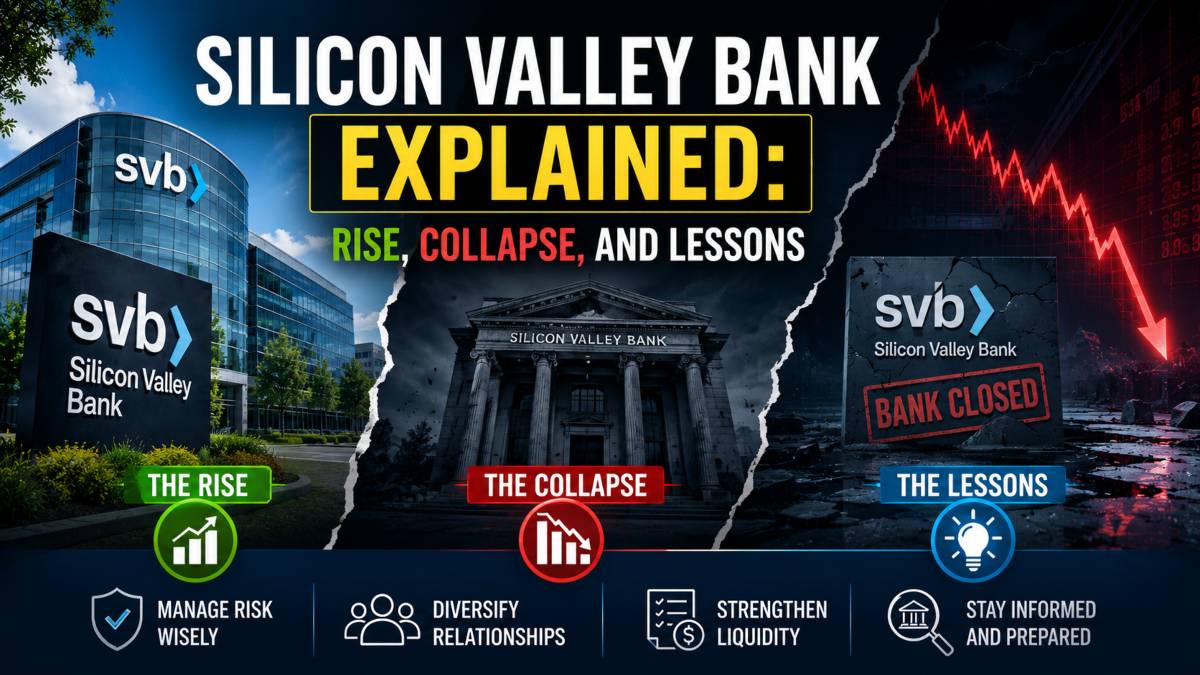
Silicon Valley Bank, often called SVB, was one of the most influential financial institutions in the United States startup world. Founded in 1983, the bank focused on serving technology companies, venture capital firms, and life sciences businesses. Unlike traditional banks that catered to a broad customer base, SVB built its reputation by supporting fast growing startups and entrepreneurs during crucial stages of their growth.
Over the years, Silicon Valley Bank became a trusted financial partner for thousands of innovative companies. At its peak, it worked with nearly half of venture capital backed technology and healthcare startups across the United States, making it a key player in the innovation economy.
However, in March 2023, the bank’s success story came to a sudden halt. A combination of rising interest rates, large investment losses, and a rapid wave of customer withdrawals triggered one of the largest bank failures in American history. The collapse sent shockwaves through the financial sector and raised serious questions about risk management, banking regulations, and the stability of startup focused institutions.
In this guide, you’ll learn what Silicon Valley Bank was, why it became so important, what caused its dramatic collapse, and how its failure continues to influence startups, investors, and the banking industry today.
This introduction is approximately 190 words, includes the target keyword naturally, and is written at a Grade 7 to 8 readability level.
What Was Silicon Valley Bank?
Silicon Valley Bank, commonly known as SVB, was a commercial bank that specialized in serving companies operating in innovation driven industries. Rather than focusing on traditional retail banking customers, SVB built its business around startups, investors, and emerging businesses that often struggled to find support from conventional financial institutions. This unique approach helped the bank become a major financial partner within the technology and venture capital ecosystem.
When and Where Was Silicon Valley Bank Founded?
Silicon Valley Bank was founded in 1983 in Santa Clara, California, at the heart of the region known for technological innovation and entrepreneurship. The bank was created to meet the financial needs of growing technology companies that were often overlooked by larger banks.
From its early years, SVB focused on building relationships with startup founders and investors. As the technology sector expanded, the bank grew alongside it, becoming a trusted source of banking services, lending, and financial guidance for businesses at different stages of development. Over time, its influence extended beyond Silicon Valley and reached startups across the United States and international markets.
Who Did Silicon Valley Bank Serve?
SVB primarily served technology startups, venture capital firms, and life sciences companies. Its customer base included software developers, biotechnology firms, healthcare innovators, and other high growth businesses.
The bank also worked closely with entrepreneurs and founders who needed access to funding, banking solutions, and industry connections. Many venture capital backed companies chose SVB because of its deep understanding of startup challenges and growth opportunities.
Why Was SVB Different From Traditional Banks?
What set SVB apart was its startup focused business model. While many traditional banks preferred established businesses with predictable revenue, SVB specialized in supporting young companies with strong growth potential.
The bank also offered venture debt services, allowing startups to secure financing without giving up additional ownership to investors. Alongside these services, SVB maintained strong relationships with venture capital firms, creating a network that connected startups with potential funding sources. This combination made the bank a central part of the startup ecosystem for decades.
How Big Was Silicon Valley Bank Before Its Collapse?
Before its dramatic collapse in March 2023, Silicon Valley Bank had grown into one of the most influential financial institutions in the United States. What began as a niche bank serving technology startups eventually became a major player in the banking industry, particularly within the venture capital and startup ecosystem.
SVB’s Market Position
By the end of 2022, Silicon Valley Bank ranked as the 16th largest bank in the United States based on total assets. The bank held approximately $209 billion in assets, reflecting decades of growth and strong connections with some of the country’s fastest growing businesses.
Unlike many large banks that served a wide range of customers, SVB concentrated heavily on companies operating in technology, healthcare, biotechnology, and innovation focused sectors. This specialized approach allowed the bank to establish a strong presence in markets that were often underserved by traditional financial institutions.
Major Companies That Banked With SVB
Silicon Valley Bank’s client list included many well known companies that later became household names. Businesses such as Airbnb, Pinterest, Roku, Roblox, and Fitbit relied on SVB for banking services during various stages of their growth.
The bank earned a reputation for supporting companies long before they reached public markets or achieved widespread success. This made SVB a preferred banking partner for ambitious startups seeking financial support and industry expertise.
SVB’s Role in the Startup Economy
SVB played a central role in the startup economy by providing banking services, financing, and strategic support to emerging companies. At its peak, the bank worked with nearly half of all venture capital backed technology and healthcare firms in the United States.
Its close relationships with founders, investors, and venture capital firms helped fuel innovation across multiple industries. As a result, Silicon Valley Bank became much more than a financial institution. It was a key part of the infrastructure that supported startup growth and business expansion.
Why Did Silicon Valley Bank Fail?
The collapse of Silicon Valley Bank in March 2023 was not caused by a single event. Instead, it resulted from several interconnected problems that developed over time. A combination of poor risk management, rising interest rates, a concentrated customer base, and a sudden loss of confidence created the conditions for one of the largest bank failures in U.S. history.
Understanding why Silicon Valley Bank failed requires looking at how the bank handled its investments, managed customer deposits, and responded to changing economic conditions.
Interest Rate Risk and Bond Losses
One of the biggest factors behind the collapse was Silicon Valley Bank’s exposure to interest rate risk.
During the low interest rate environment that followed the pandemic, startups and venture capital firms deposited large amounts of cash into the bank. Rather than keeping all of that money in short term assets, SVB invested a significant portion of those deposits in long term U.S. Treasury bonds and mortgage backed securities.
At the time, these investments appeared relatively safe. However, conditions changed rapidly when the Federal Reserve began raising interest rates to combat inflation. As interest rates increased, the market value of existing bonds declined because newer bonds offered higher returns.
As a result, Silicon Valley Bank accumulated billions of dollars in unrealized losses on its investment portfolio. These losses existed on paper and did not immediately affect the bank’s operations. However, they became a major problem when the bank needed to access cash by selling those investments.
By the end of 2022, SVB was sitting on substantial unrealized losses, leaving the bank vulnerable if customer withdrawals increased.
Heavy Dependence on Uninsured Deposits
Another major weakness was the bank’s unusual deposit structure.
Most traditional banks maintain a diverse customer base that includes individuals, families, and businesses with deposits spread across different account sizes. Silicon Valley Bank’s customer base looked very different.
The majority of its deposits came from technology startups, venture capital firms, and wealthy business clients. Many of these accounts held balances far above the Federal Deposit Insurance Corporation, or FDIC, insurance limit of $250,000.
Reports showed that a large percentage of SVB’s deposits were uninsured. This meant customers had much more at stake if the bank experienced financial trouble.
Because many depositors were sophisticated investors and business leaders, they closely monitored financial developments and could move funds quickly when concerns emerged. This created a significant risk that large numbers of customers could withdraw money at the same time.
Liquidity Problems and Cash Withdrawals
As economic conditions became more challenging, the technology sector began to slow.
Venture capital funding declined compared to the record levels seen during the pandemic era. Many startups found it harder to raise new investment capital and began relying on existing cash reserves to cover operating expenses.
Instead of depositing new money into SVB, companies started withdrawing funds to pay employees, suppliers, and other business costs.
These withdrawals steadily reduced the bank’s deposit base. To meet customer demands, Silicon Valley Bank needed access to more cash. Unfortunately, much of its money was tied up in long term investments that had lost value because of rising interest rates.
This mismatch between available cash and customer withdrawal requests created growing pressure on the bank’s financial position.
The $21 Billion Bond Sale That Triggered Panic
The situation reached a critical point in early March 2023.
On March 8, Silicon Valley Bank announced that it had sold approximately $21 billion worth of securities from its investment portfolio. The sale resulted in a realized loss of about $1.8 billion.
To strengthen its balance sheet, the bank also revealed plans to raise additional capital from investors.
Instead of reassuring the market, the announcement had the opposite effect. Investors, venture capital firms, and startup founders viewed the move as a sign that the bank was facing serious financial stress.
Confidence began to disappear almost immediately. Questions about the bank’s financial health spread throughout the startup community, creating fear that the situation could worsen rapidly.
The attempted capital raise failed to restore trust, and concerns escalated across the industry.
The Bank Run
What happened next became one of the most dramatic bank runs in modern financial history.
As concerns spread, venture capital firms advised many portfolio companies to move their money out of Silicon Valley Bank. News circulated rapidly through social media platforms, messaging apps, and online networks used by founders and investors.
Unlike traditional bank runs, where customers might line up outside branches, depositors could transfer funds electronically within minutes.
On March 9, 2023, customers attempted to withdraw approximately $42 billion in a single day. The scale and speed of these withdrawal requests overwhelmed the bank’s ability to respond.
The crisis unfolded almost entirely online, leading many observers to describe it as the first major digital era bank run. Information moved instantly, and fear spread faster than any bank could realistically manage.
By the end of the day, Silicon Valley Bank faced a severe cash shortage and could no longer operate normally.
Risk Management and Regulatory Concerns
The collapse also raised serious questions about risk management and regulatory oversight.
Regulators had reportedly identified weaknesses in Silicon Valley Bank’s risk controls before the failure. Concerns included the bank’s exposure to interest rate risk and its reliance on a concentrated group of depositors.
Critics argued that the bank failed to adequately prepare for a period of rising interest rates, despite clear signals that monetary policy was changing. Better planning and stronger safeguards might have reduced the impact of falling bond values and growing liquidity pressures.
The collapse also renewed debate about regulatory requirements introduced after the 2008 financial crisis. Changes to banking regulations in 2018 reduced certain stress testing and oversight requirements for banks below specific asset thresholds. Some experts later questioned whether stronger supervision could have identified problems earlier.
Ultimately, Silicon Valley Bank’s failure was the result of several weaknesses occurring at the same time. Rising interest rates reduced the value of its investments, uninsured deposits increased the risk of mass withdrawals, liquidity pressures intensified, and confidence evaporated almost overnight. Together, these factors transformed a growing financial concern into one of the most significant banking collapses in recent U.S. history.
Silicon Valley Bank Collapse Timeline
The collapse of Silicon Valley Bank happened with remarkable speed. What began as concerns about the bank’s financial position quickly turned into a full scale crisis that unfolded within just a few days. The events between March 8 and March 26, 2023, reshaped the banking industry and became a defining moment for the startup ecosystem.
March 8, 2023
The crisis began when Silicon Valley Bank announced that it had sold approximately $21 billion worth of securities from its investment portfolio. The sale resulted in a loss of about $1.8 billion.
At the same time, the bank revealed plans to raise more than $2 billion in new capital to strengthen its financial position. Management hoped these actions would improve confidence and reassure customers and investors.
Instead, the announcement raised concerns about the bank’s stability. Investors questioned why such a large capital raise was necessary, and doubts about SVB’s financial health began spreading throughout the startup community.
March 9, 2023
The situation worsened dramatically the following day.
Venture capital firms and prominent investors advised startup founders to move their money out of Silicon Valley Bank. As news spread across social media platforms, messaging groups, and online communities, customers rushed to withdraw funds.
Withdrawal requests reached approximately $42 billion in a single day. The sheer volume of requests overwhelmed the bank and created a severe cash shortage. Panic grew among depositors as fears of a possible collapse intensified.
By the end of the day, Silicon Valley Bank was struggling to meet customer demands and faced an uncertain future.
March 10, 2023
On March 10, California regulators stepped in and closed Silicon Valley Bank. The Federal Deposit Insurance Corporation, known as the FDIC, was appointed as receiver and took control of the bank’s assets.
The closure marked the largest U.S. bank failure since the 2008 financial crisis and sent shockwaves through financial markets. Thousands of startups and businesses suddenly faced uncertainty about access to their deposits and operating funds.
March 12 to March 26, 2023
Federal regulators moved quickly to contain the crisis and prevent broader panic across the banking sector.
On March 12, the U.S. government announced that all depositors would have access to their funds, including those with balances above standard FDIC insurance limits. Regulators also introduced measures to support liquidity across the banking system.
Soon after, Silicon Valley Bridge Bank was created to maintain operations and serve customers while a long term solution was developed.
On March 26, First Citizens BancShares acquired Silicon Valley Bank’s commercial banking business. The acquisition brought stability to the institution and marked the final chapter in one of the most significant banking failures in modern U.S. history.
What Happened to Silicon Valley Bank Customers?
When Silicon Valley Bank collapsed in March 2023, thousands of businesses and startup founders were left wondering whether they would lose access to their money. Because many companies kept large amounts of cash at SVB, the bank’s sudden closure created immediate uncertainty across the technology and startup sectors.
For a brief period, customers faced concerns about paying employees, covering operating expenses, and maintaining normal business operations. However, government agencies moved quickly to prevent a wider financial crisis and restore confidence in the banking system.
Were Depositors Protected?
Following the bank’s closure on March 10, 2023, the Federal Deposit Insurance Corporation (FDIC) took control of Silicon Valley Bank as receiver. Under normal circumstances, FDIC insurance protects deposits up to $250,000 per depositor, per insured bank.
The challenge was that most SVB customers held balances far above that limit. Many startups had millions of dollars deposited with the bank to cover payroll, rent, and other business expenses.
To address the situation, federal regulators announced a systemic risk exception. This emergency measure allowed all depositors, including those with uninsured balances, to access their funds. The decision was designed to prevent panic from spreading to other banks and to protect businesses that depended on their deposits for daily operations.
Impact on Startups and Businesses
The days immediately following the collapse were extremely stressful for many companies. Some startups worried they would be unable to pay employees on time, while others faced uncertainty about upcoming financial obligations.
Because Silicon Valley Bank served a large portion of the startup ecosystem, the disruption affected businesses across technology, healthcare, biotechnology, and other innovation focused industries. Several companies explored emergency financing options while waiting for clarity from regulators.
The situation highlighted the risks of keeping large amounts of money with a single financial institution and sparked discussions about better cash management practices.
Recovery of Funds
Fortunately, the disruption was relatively short lived. After regulators announced protections for all depositors, customers regained access to their funds through the newly established Silicon Valley Bridge Bank.
The swift response helped calm financial markets and reduced fears of broader banking instability. Regulators also introduced additional measures to support liquidity within the banking system and strengthen confidence among depositors.
As access to funds was restored, most businesses were able to resume normal operations. While the collapse created significant anxiety and temporary disruption, customers ultimately recovered their deposits and avoided the severe losses many had feared.
How Did the SVB Collapse Affect the Banking Industry?
The collapse of Silicon Valley Bank was not just a problem for one financial institution. Its failure sent shockwaves throughout the banking sector and triggered concerns about the stability of regional banks across the United States. Investors, regulators, and customers closely watched developments as fears grew that similar weaknesses could exist elsewhere.
Although government agencies acted quickly to contain the crisis, the SVB collapse exposed vulnerabilities that affected confidence in the broader financial system.
Immediate Market Reactions
Financial markets reacted almost immediately after Silicon Valley Bank’s failure became public. Investors worried that other banks might face similar challenges related to rising interest rates, unrealized investment losses, and large uninsured deposits.
Banking stocks experienced sharp declines as uncertainty spread across the market. Within days, financial institutions collectively lost billions of dollars in market value. Investors began scrutinizing bank balance sheets more closely, paying particular attention to liquidity levels and exposure to interest rate risk.
The sudden drop in confidence demonstrated how quickly concerns can spread in today’s interconnected financial environment. Even banks with stronger financial positions faced increased pressure as investors searched for signs of potential weakness.
Impact on Regional Banks
Regional banks experienced some of the most significant effects following the SVB collapse.
First Republic Bank became one of the most closely watched institutions during the crisis. Concerns about its deposit base and financial stability led to substantial customer withdrawals and declining investor confidence. Despite receiving support from major banks, First Republic later failed and was acquired by a larger institution.
Other regional lenders, including Western Alliance and PacWest, also faced intense scrutiny. Investors questioned whether these banks could withstand similar withdrawal pressures if customers became nervous about their financial health.
Although many regional banks maintained stronger fundamentals than Silicon Valley Bank, the collapse created an environment where confidence became a major concern. Depositors and investors became more cautious, leading banks to strengthen liquidity positions and communicate more actively about their financial condition.
The episode highlighted how quickly fear can spread from one institution to another, even when their circumstances differ significantly.
Federal Reserve Response
To prevent further instability, federal regulators and the Federal Reserve introduced several emergency measures aimed at restoring confidence in the banking system.
One of the most important actions was the creation of the Bank Term Funding Program. This facility allowed eligible banks to borrow money using high quality securities as collateral. By providing access to additional liquidity, the program helped banks meet customer withdrawal requests without being forced to sell investments at significant losses.
The Federal Reserve also worked alongside other regulators to reassure markets that the banking system remained resilient. These efforts were designed to reduce panic, support financial stability, and prevent additional bank failures.
The response helped calm markets and ease concerns about a broader banking crisis. While the collapse of Silicon Valley Bank exposed weaknesses within parts of the financial sector, it also demonstrated how quickly regulators could act to support confidence and maintain stability during periods of uncertainty.
For the banking industry, the SVB collapse served as a powerful reminder of the importance of liquidity management, deposit diversification, and effective risk oversight in a rapidly changing economic environment.
What Lessons Can Businesses Learn From Silicon Valley Bank?
The collapse of Silicon Valley Bank offered important lessons for businesses of all sizes. While the bank’s failure was linked to specific financial and operational issues, the event also revealed how vulnerable companies can become when they rely too heavily on a single institution or fail to prepare for unexpected disruptions.
For startups, established businesses, and investors alike, the SVB crisis underscored the value of careful financial planning, risk awareness, and strong cash management practices.
Avoiding Banking Concentration Risk
One of the clearest lessons from the Silicon Valley Bank collapse is the danger of banking concentration risk.
Many startups kept most or all of their funds with SVB because of its strong reputation and deep connections within the venture capital community. When the bank failed, those companies suddenly faced uncertainty about accessing their cash.
Businesses can reduce this risk by maintaining relationships with multiple financial institutions. Spreading funds across different banks helps limit exposure if one institution experiences financial difficulties.
Diversification can also include using separate banks for operating accounts, savings, payroll, and investment activities. This approach creates additional flexibility and helps ensure that essential business functions can continue even if disruptions occur at one bank.
A diversified banking strategy may require more management, but it can provide valuable protection during periods of financial stress.
Managing Cash and Liquidity
The SVB crisis also highlighted the importance of strong cash and liquidity management.
Businesses should have a clear understanding of their cash needs, operating expenses, and available reserves. Regularly reviewing cash flow projections can help companies identify potential funding gaps before they become serious problems.
Treasury management practices are equally important. Organizations should know where their funds are held, how quickly they can access them, and what backup options are available if unexpected challenges arise.
Emergency planning is another key consideration. Companies that maintain contingency plans are often better prepared to respond when financial disruptions occur. These plans may include access to alternative banking partners, emergency credit facilities, or reserve funds that can support operations during uncertain periods.
Understanding Deposit Insurance
Many businesses affected by the SVB collapse learned an important lesson about deposit insurance.
In the United States, the Federal Deposit Insurance Corporation protects deposits up to $250,000 per depositor, per insured bank. However, many Silicon Valley Bank customers held balances far above that amount.
Understanding insurance limits can help businesses make more informed decisions about where and how they store their cash. Companies with large balances may benefit from distributing funds across multiple accounts or institutions to increase coverage and reduce exposure.
Regular risk assessments can also help organizations evaluate whether their current banking arrangements align with their financial needs and risk tolerance.
Importance of Risk Management
Perhaps the most significant lesson from the Silicon Valley Bank collapse is the need for effective risk management.
Businesses should establish internal controls that support financial oversight and decision making. This includes monitoring cash positions, reviewing banking relationships, and assessing potential risks on an ongoing basis.
Companies should also pay attention to the financial health of the institutions they work with. While customers cannot predict every crisis, staying informed about major developments can help identify warning signs before problems escalate.
Strong risk management is not about avoiding every possible threat. It is about building systems and processes that help organizations respond quickly when challenges arise. The businesses that weather financial disruptions most successfully are often those that prepare long before a crisis begins.
The collapse of Silicon Valley Bank serves as a reminder that financial stability cannot be taken for granted. Careful planning, diversification, and ongoing monitoring remain essential for protecting business operations in an increasingly complex financial environment.
What Happened to Silicon Valley Bank After the Collapse?
Although Silicon Valley Bank collapsed in March 2023, the story did not end with the bank’s closure. Regulators acted quickly to maintain stability, protect customers, and prevent broader disruption across the financial system. A series of actions taken in the weeks following the collapse helped preserve key banking services and ensured that businesses could continue accessing their funds.
Creation of Silicon Valley Bridge Bank
After California regulators shut down Silicon Valley Bank on March 10, 2023, the Federal Deposit Insurance Corporation (FDIC) took control of the institution as receiver. To maintain banking operations and support customers, the FDIC established Silicon Valley Bridge Bank.
The purpose of the bridge bank was to provide a temporary solution while regulators searched for a long term buyer. Existing customers were able to continue using many of the bank’s services, including deposits, withdrawals, and online banking functions.
This transition helped reduce uncertainty for thousands of businesses that depended on SVB for their daily financial activities. It also played an important role in restoring confidence during a period of significant market anxiety.
Acquisition by First Citizens Bank
A permanent solution arrived on March 26, 2023, when First Citizens BancShares agreed to acquire a large portion of Silicon Valley Bank’s commercial banking business.
The transaction included billions of dollars in loans and deposits, allowing First Citizens to take over many of SVB’s core banking operations. The acquisition helped stabilize the institution and provided customers with a clear path forward.
For many businesses, the transition was relatively smooth because banking services continued without major interruptions. The deal also marked one of the most significant banking acquisitions following the crisis.
Current Status of SVB Operations
Today, Silicon Valley Bank no longer operates as an independent bank. Instead, its core banking business functions under the ownership of First Citizens Bank.
The SVB brand continues to exist in certain areas, particularly for clients in the technology, venture capital, and life sciences sectors. Many of the specialized banking services that made SVB popular remain available through the new ownership structure.
While the collapse ended Silicon Valley Bank’s chapter as a standalone institution, its influence on the startup ecosystem and the banking industry continues to shape discussions about risk management, regulation, and financial stability.
Why the Silicon Valley Bank Collapse Still Matters Today
More than a year after Silicon Valley Bank failed, its collapse continues to influence conversations across the financial and business worlds. The event exposed weaknesses that extended beyond a single institution and raised important questions about how banks, businesses, investors, and regulators manage risk.
The lessons from the SVB crisis remain relevant because many of the underlying challenges that contributed to its downfall still exist within the broader financial system. As a result, the collapse continues to shape decisions in the startup ecosystem, banking sector, and regulatory landscape.
Impact on Startups and Venture Capital
The failure of Silicon Valley Bank had a lasting effect on startups and venture capital firms. For decades, SVB served as a key financial partner for emerging companies, offering banking services, lending solutions, and industry expertise tailored to the startup community.
After the collapse, many founders reassessed how they manage company funds. Businesses became more cautious about keeping large cash balances at a single bank and began exploring more diversified banking arrangements.
Venture capital firms also encouraged portfolio companies to strengthen financial planning and liquidity management. The crisis reinforced the importance of having backup banking relationships and contingency plans that can help businesses navigate unexpected disruptions.
Banking Regulation Debate
The collapse reignited discussions about banking regulation and oversight in the United States. Policymakers, regulators, and industry experts examined whether existing rules were sufficient to identify and address risks before they became severe.
Much of the debate focused on regulatory changes introduced in 2018, which reduced certain oversight requirements for mid sized banks. Critics argued that stronger supervision may have detected problems earlier, while others maintained that bank management was primarily responsible for the failure.
These discussions continue to influence policy proposals and regulatory reviews as officials seek ways to strengthen financial stability without creating unnecessary burdens for financial institutions.
Future Risks for Regional Banks
The SVB collapse also highlighted challenges that can affect regional banks. Rising interest rates, concentrated customer bases, and sudden deposit withdrawals remain potential risks for institutions that lack sufficient diversification.
Although many regional banks have taken steps to strengthen liquidity and improve risk controls, investors and regulators remain attentive to warning signs that could indicate financial stress.
The collapse demonstrated that confidence plays a critical role in banking. When customers lose trust, problems can escalate quickly, particularly in an era where digital banking allows funds to move almost instantly.
For that reason, the Silicon Valley Bank crisis remains an important case study. It serves as a reminder that strong risk management, sound oversight, and customer confidence are essential to maintaining stability within the modern banking system.
Final Thoughts
The story of Silicon Valley Bank is a powerful reminder of how quickly financial conditions can change, even for institutions that appear strong and successful. For decades, SVB played a central role in supporting startups, venture capital firms, and innovative businesses. Its growth reflected the rise of the technology sector, while its collapse revealed the risks that can emerge when economic conditions shift unexpectedly.
Several key lessons stand out from the SVB crisis. Interest rate risk, liquidity management, deposit concentration, and effective oversight all play an important role in maintaining financial stability. The collapse also demonstrated how rapidly confidence can disappear in a digital banking environment where information and funds move almost instantly.
For businesses, the event highlighted the value of diversification, careful cash management, and ongoing risk assessment. For investors and regulators, it reinforced the need for strong monitoring systems and proactive decision making.
Although Silicon Valley Bank no longer exists as an independent institution, its impact continues to shape the financial landscape. The collapse influenced banking practices, regulatory discussions, and startup funding strategies across the United States. As a result, the lessons from SVB remain relevant for anyone seeking to understand financial risk and the challenges facing modern banking systems.
Read More: Best Amazon Seller Tools For Success 2026