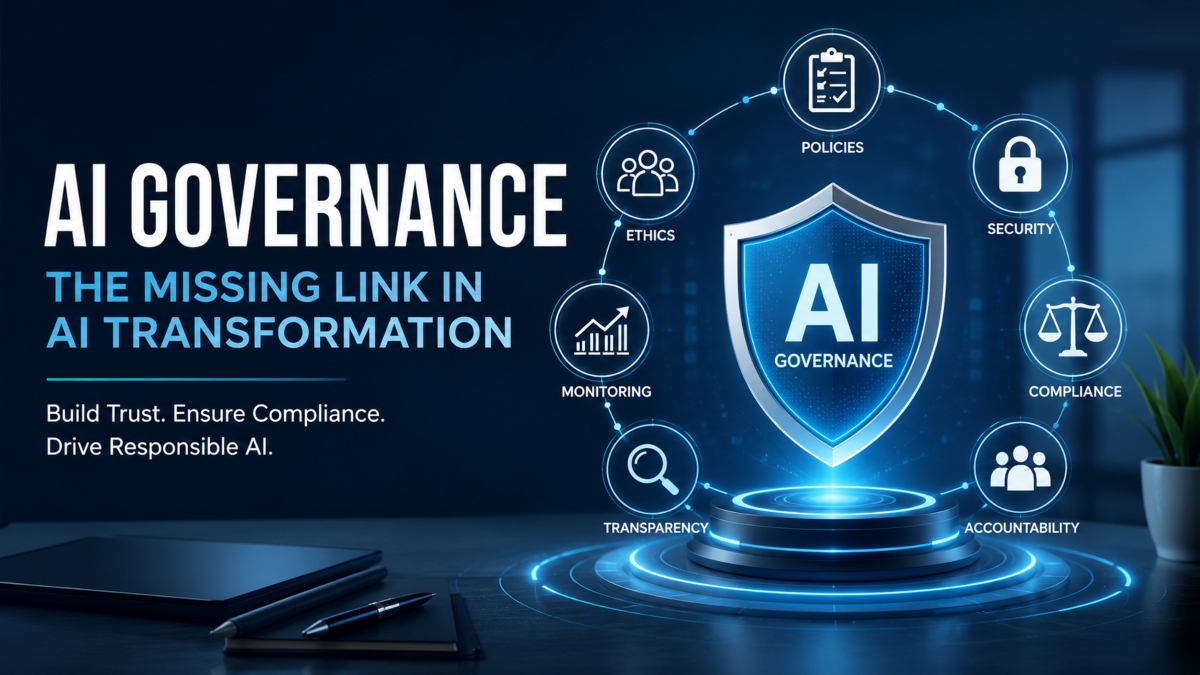
Many organizations approach AI transformation as a technology project focused on powerful models faster systems and smarter automation. While these capabilities matter they are only one part of the picture. Real success comes from having clear governance that guides how AI is developed deployed and monitored across the business. Without accountability even advanced AI can create security concerns compliance issues biased outcomes and costly mistakes. As regulations continue to grow organizations must prove that their AI systems operate responsibly and follow established standards. Strong governance builds trust improves decision making and helps teams manage risk before problems become larger. This article explains why governance sits at the center of successful AI transformation. You will learn what effective AI governance looks like why it matters for long term growth and the practical steps organizations can take to build a reliable and responsible AI strategy.
Why AI Transformation Is More Than a Technology Project
Artificial intelligence is changing how organizations operate at a remarkable pace. Businesses are using AI to improve customer service automate repetitive tasks strengthen data analysis and support faster decisions. While these improvements create new opportunities many organizations still view AI transformation as a technology initiative instead of a governance responsibility. This mindset often leads to rapid adoption without the policies controls and accountability needed to manage growing risks.
Why AI Adoption Is Growing Faster Than Organizational Oversight
Organizations across healthcare finance retail manufacturing and many other sectors continue to expand their use of AI. New tools are easier to access and can be integrated into existing workflows with minimal effort. As adoption accelerates governance often struggles to keep pace. Many businesses lack formal policies clear ownership and consistent oversight for AI systems. This governance gap increases the likelihood of compliance issues security concerns biased outputs and poor decision making.
Why Governance Determines Whether AI Creates Business Value
Technology alone cannot deliver lasting value without responsible governance. Clear decision making processes help teams understand when and how AI should be used while defined ownership ensures accountability throughout the AI lifecycle. Governance also establishes standards for data quality model monitoring and regulatory compliance. These practices reduce operational risks and build confidence among employees customers and regulators. Organizations that treat governance as a core part of AI transformation are better prepared to scale their AI initiatives responsibly while maintaining trust and supporting sustainable business growth.
What AI Governance Means
AI governance is the system of policies responsibilities and controls that guide how artificial intelligence is developed deployed and managed throughout its lifecycle. It helps organizations make sure AI systems operate responsibly while meeting business goals legal requirements and internal standards. Instead of focusing only on technical performance AI governance creates clear accountability for every stage of AI use. It defines who owns each AI system how risks are assessed how decisions are reviewed and how issues are resolved before they affect customers employees or the organization.
A strong governance framework also supports transparency by requiring proper documentation continuous monitoring and regular evaluations. This structured approach allows organizations to scale AI with greater confidence while reducing operational risks and maintaining trust with stakeholders.
AI Governance vs AI Ethics vs AI Compliance
Although these terms are often used together they serve different purposes within an AI strategy.
AI Governance establishes the rules processes and accountability for managing AI across the organization. It connects business objectives with operational controls and ensures AI systems remain reliable secure and responsible over time.
AI Ethics focuses on the principles that guide responsible AI use. It encourages fairness transparency human oversight and respect for individual rights. Ethics defines what organizations should strive to achieve while governance turns those principles into measurable actions.
AI Security protects AI systems data and infrastructure from cyber threats unauthorized access and misuse. It includes safeguards that help maintain the integrity availability and confidentiality of AI technologies.
AI Compliance ensures AI systems follow applicable laws regulations and industry standards. This includes meeting requirements for privacy documentation risk management and audit readiness.
Data Governance manages the quality availability security and proper use of data throughout its lifecycle. Since AI models rely on accurate and trustworthy data effective data governance supports reliable outcomes and reduces the risk of biased or inaccurate results.
Why Governance Has Become the Biggest Barrier to AI Transformation
Organizations are investing heavily in artificial intelligence to improve efficiency automate workflows and support better business decisions. While the technology continues to advance many AI initiatives fail to reach their full potential because governance has not kept pace. Successful AI transformation requires more than powerful models and quality data. It depends on clear accountability risk management and ongoing oversight that keeps AI systems reliable and compliant. Without these foundations organizations expose themselves to financial legal and operational risks that can slow adoption and reduce confidence in AI driven decisions.
Lack of Trust in AI Decisions
Trust remains one of the biggest obstacles to enterprise AI adoption. Business leaders want confidence that AI systems produce accurate fair and secure results before relying on them for important decisions. Security concerns continue to grow as AI systems process sensitive business and customer information that could become a target for cyber threats or unauthorized access. Bias is another major concern because AI models trained on incomplete or unbalanced data can produce unfair outcomes that affect hiring lending healthcare and other critical areas. Explainability also plays a key role. When organizations cannot clearly explain how an AI system reached a decision they face greater difficulty during audits investigations and customer disputes.
Growing Regulatory Pressure
Governments and regulators are introducing stricter requirements for responsible AI use. The EU AI Act establishes risk based obligations for organizations developing or deploying AI systems. Privacy laws such as GDPR and healthcare regulations including HIPAA require organizations to protect personal information and demonstrate responsible data handling. Many industries also enforce sector specific standards that require documentation risk assessments and ongoing monitoring. Organizations without strong governance frameworks may struggle to satisfy these requirements and could face legal penalties reputational damage and costly compliance failures.
Shadow AI and Third Party AI Risks
The growing availability of AI tools has increased the use of unauthorized applications across many organizations. Employees may adopt AI services without approval creating blind spots for security compliance and data protection. Third party AI vendors also introduce additional responsibilities because organizations remain accountable for how customer and business data is processed even when external services are involved. Effective governance establishes approval processes vendor evaluations and continuous monitoring to reduce data exposure and maintain responsible AI use across the entire organization.
The Governance Gap Holding Organizations Back
Many organizations recognize the importance of responsible AI, yet they struggle to translate good intentions into consistent business practices. Publishing ethical guidelines is a positive first step, but it does not guarantee that AI systems will operate safely, fairly, or in compliance with regulations. The real challenge is closing the gap between high level principles and everyday operations. Without a structured governance framework, AI initiatives often suffer from inconsistent decision making, unclear responsibilities, and limited oversight. As AI adoption grows, these gaps become more difficult to manage and can slow innovation instead of supporting it.
Why Ethics Alone Are Not Enough
AI ethics establishes the values organizations want to follow, such as fairness, transparency, privacy, and human oversight. While these principles provide useful direction, they do not explain how teams should apply them in real business situations. For example, an organization may state that its AI should be fair, but without defined testing methods, performance standards, and review procedures, there is no reliable way to confirm that goal is being achieved. Ethics provides the vision, while governance creates the structure needed to turn that vision into measurable actions.
Turning AI Principles Into Operational Controls
Effective AI governance transforms broad principles into clear operational processes that support responsible AI throughout its lifecycle. Every AI system should have defined ownership so teams know who is responsible for development, deployment, and ongoing management. Accountability ensures that decisions are documented and that identified risks are addressed promptly. Formal approval processes help evaluate AI systems before they are introduced into production, while established escalation paths provide a clear response when unexpected issues or failures occur. Continuous monitoring completes the governance process by tracking model performance, identifying drift, detecting emerging risks, and confirming that AI systems continue to meet business objectives, regulatory requirements, and internal standards over time.
The Building Blocks of an Effective AI Governance Framework
A successful AI governance framework creates a structured foundation that helps organizations deploy artificial intelligence responsibly while supporting innovation. Instead of reacting to problems after they occur, governance introduces consistent processes that reduce risk, improve transparency, and strengthen accountability throughout the AI lifecycle. Each component works together to ensure AI systems remain reliable, compliant, and aligned with business objectives. Organizations that invest in these building blocks are better prepared to scale AI with confidence while maintaining trust among customers, employees, and regulators.
Risk Classification and Impact Assessment
Every AI system carries a different level of risk depending on its purpose and the decisions it supports. An internal chatbot that answers employee questions presents a lower level of risk than an AI system used for medical diagnoses, loan approvals, or hiring decisions. Risk classification helps organizations identify which systems require stronger oversight and more detailed evaluations. Once AI applications are categorized by their potential impact, organizations can apply appropriate safeguards, testing requirements, and approval processes. Regular risk assessments also help identify new threats as AI models evolve or business requirements change.
Data Governance and Privacy Controls
Reliable AI depends on reliable data. Data governance establishes standards for collecting, storing, accessing, and managing information throughout its lifecycle. Organizations should verify that data is accurate, complete, and collected lawfully before it is used to train or operate AI models. Privacy controls protect sensitive information through access management, encryption, retention policies, and secure data handling practices. Strong data governance also supports compliance with privacy regulations and reduces the likelihood of unauthorized access or accidental data exposure.
Model Documentation and Audit Trails
Every AI model should include detailed documentation that explains its purpose, training data, assumptions, limitations, and performance results. Maintaining version histories allows organizations to understand how models have changed over time and identify the cause of unexpected behavior. Audit trails record important activities such as model updates, approvals, testing results, and deployment decisions. These records improve transparency, simplify regulatory reviews, and provide valuable evidence during investigations or internal audits.
Bias Detection and Fairness Monitoring
AI models can unintentionally produce biased outcomes when training data contains historical inaccuracies or unequal representation. Regular fairness testing helps organizations identify these issues before they affect business operations or customer experiences. Monitoring should continue after deployment because model performance may change as new data becomes available. Organizations should establish measurable fairness standards, evaluate results across different user groups, and retrain models whenever bias or performance drift is detected. Continuous monitoring helps maintain confidence in AI driven decisions while supporting responsible use.
Output Validation and AI Guardrails
Even highly capable AI models can generate inaccurate, misleading, or inappropriate responses. Output validation verifies that AI generated content meets quality, accuracy, and safety standards before it reaches users or influences business decisions. AI guardrails introduce automated controls that restrict harmful behavior, reduce hallucinations, prevent unauthorized actions, and filter sensitive information. Confidence scoring, human review for high risk decisions, and predefined usage limits provide additional protection while improving the reliability of AI systems in real world environments.
Incident Response Planning
No governance framework is complete without a clear plan for responding to AI related incidents. Organizations should prepare documented procedures for identifying, reporting, investigating, and resolving unexpected AI failures. Response plans should define communication responsibilities, recovery steps, rollback procedures, and post incident reviews. Practicing these procedures through regular testing helps teams respond more quickly and reduces disruption when problems occur. A structured response process also supports regulatory reporting requirements and strengthens organizational resilience.
Organizational Accountability and Governance Roles
Strong governance depends on clearly defined responsibilities across the organization. Every AI system should have assigned owners who oversee development, deployment, monitoring, and ongoing maintenance. Executive leadership provides strategic direction while legal, security, compliance, and technical teams work together to manage risks and maintain regulatory readiness. Governance committees can review high impact AI projects, approve deployments, and evaluate emerging risks. When accountability is clearly defined and supported by continuous oversight, organizations can scale AI responsibly while maintaining transparency, trust, and long term business value.
How to Build an AI Governance Strategy
Building an AI governance strategy requires more than creating policies or meeting compliance requirements. It involves establishing a structured process that supports responsible AI from planning through long term operation. A practical governance strategy helps organizations reduce risk, improve transparency, and ensure AI systems continue to support business goals as they grow. The following steps provide a roadmap for creating a governance program that can adapt to changing technologies and regulations.
Step 1 Inventory AI Systems
Begin by identifying every AI system used across the organization. This includes internally developed models, third party AI platforms, generative AI applications, and automated decision systems. Record each system’s purpose, data sources, business owner, and level of impact. A complete inventory creates visibility and prevents unknown AI tools from operating without oversight.
Step 2 Classify Risks
Evaluate each AI system based on its potential impact on customers, employees, business operations, and regulatory obligations. High risk systems that influence healthcare, finance, legal decisions, or personal data require stronger governance than lower risk applications. Risk classification helps organizations focus resources where they are needed most.
Step 3 Create Governance Policies
Develop clear policies that define how AI should be designed, deployed, and managed. These policies should cover responsible AI practices, privacy, security, data management, model approvals, documentation, and accountability. Well written policies provide consistent guidance for every team involved in AI development and operation.
Step 4 Deploy Technical Controls
Support governance with technical safeguards that operate throughout the AI lifecycle. These controls may include access management, automated logging, output validation, bias testing, model version tracking, and continuous performance monitoring. Technical controls help enforce governance standards while reducing manual effort.
Step 5 Test AI Systems
Before deployment, every AI system should undergo thorough testing to confirm accuracy, reliability, fairness, and security. Testing should include challenging scenarios, unexpected inputs, and attempts to identify weaknesses that could affect performance. Regular testing after deployment helps maintain consistent results as models evolve.
Step 6 Train Teams
Governance succeeds when employees understand their responsibilities. Provide ongoing training for technical teams, business leaders, compliance professionals, and end users. Training should explain governance policies, reporting procedures, risk awareness, and responsible AI practices so every stakeholder can contribute to safe AI adoption.
Step 7 Monitor Continuously
AI governance is an ongoing process rather than a one time project. Continuously monitor model performance, security events, regulatory changes, and operational risks. Review governance policies regularly, update controls when needed, and document all significant changes. Continuous oversight helps organizations maintain compliance, respond quickly to emerging issues, and support sustainable AI transformation over time.
Common AI Governance Mistakes That Slow Transformation
Many organizations invest heavily in artificial intelligence but overlook governance until problems begin to appear. This reactive approach often leads to project delays, higher costs, compliance concerns, and reduced confidence in AI systems. Avoiding common governance mistakes helps organizations scale AI more efficiently while maintaining trust and reducing operational risk.
Treating Governance as a Compliance Checklist
Some organizations view governance only as a way to satisfy legal or regulatory requirements. This limited approach overlooks the broader purpose of governance, which is to support responsible decision making, improve transparency, and manage risk throughout the AI lifecycle. Governance should be integrated into everyday business operations rather than treated as a task completed only during audits.
Ignoring Accountability
AI projects require clearly defined ownership from planning through deployment and ongoing management. When responsibilities are unclear, important decisions may be delayed or overlooked, increasing the likelihood of errors and compliance issues. Assigning accountable owners for AI systems helps organizations respond quickly to challenges and maintain consistent oversight.
Waiting Until AI Is Fully Deployed
Building governance after AI systems are already in production creates unnecessary complexity and expense. Organizations may need to redesign workflows, update documentation, or introduce new controls to address risks that could have been identified earlier. Incorporating governance during the planning and development stages reduces future costs and supports smoother implementation.
Forgetting Continuous Monitoring
AI models change over time as data evolves and business conditions shift. Without continuous monitoring, organizations may miss declining performance, emerging bias, security threats, or regulatory changes that affect AI operations. Regular reviews, ongoing testing, and performance tracking help ensure AI systems remain reliable, compliant, and aligned with business objectives throughout their lifecycle.
Business Benefits of Strong AI Governance
Strong AI governance does more than reduce risk. It creates a stable foundation that allows organizations to adopt artificial intelligence with greater confidence and achieve sustainable business growth. When governance is built into every stage of the AI lifecycle, businesses can improve decision making, strengthen compliance efforts, and increase trust among customers, employees, and partners. These advantages help organizations expand AI initiatives without sacrificing quality or accountability.
Better Regulatory Readiness
AI regulations continue to evolve across industries and regions. A well structured governance framework helps organizations stay prepared by maintaining clear documentation, consistent policies, and reliable audit records. This proactive approach makes it easier to demonstrate compliance with applicable laws and industry standards while reducing the likelihood of penalties, legal disputes, or costly operational disruptions.
Higher Customer Trust
Customers are more likely to embrace AI when they understand that organizations use it responsibly. Governance promotes transparency, fairness, and responsible data handling, giving customers greater confidence in AI supported products and services. Clear oversight also demonstrates that the organization values privacy, accuracy, and ethical decision making, which strengthens long term customer relationships and brand reputation.
Fewer AI Incidents
Governance introduces processes that identify risks before they become serious problems. Regular testing, continuous monitoring, and clearly defined accountability help reduce security issues, biased outcomes, inaccurate responses, and system failures. By preventing avoidable incidents, organizations can maintain reliable AI performance while reducing the time and resources spent resolving unexpected issues.
Faster Enterprise AI Adoption
Organizations with established governance frameworks can expand AI initiatives more efficiently because clear policies and approval processes are already in place. Teams understand their responsibilities, decision makers have greater confidence in AI systems, and new projects move through implementation with fewer delays. As a result, businesses can scale AI across departments while maintaining consistent oversight, reducing operational risk, and supporting long term innovation.
The Future of AI Governance
Artificial intelligence will continue to evolve, but long term success will depend on how well organizations govern its use rather than how quickly they adopt new technologies. As AI becomes more deeply integrated into business operations, governance will move from a supporting function to a core business capability. Organizations that establish clear policies, strong oversight, and continuous monitoring today will be better prepared to manage future risks while taking advantage of new opportunities. Governance will also become an essential factor for maintaining trust, improving operational resilience, and supporting responsible innovation across every stage of AI adoption.
Governance as a Competitive Advantage
Organizations with mature governance frameworks can introduce AI solutions with greater confidence because responsibilities, approval processes, and risk controls are already established. This allows teams to make faster decisions without compromising security, compliance, or quality. Strong governance also strengthens customer confidence, improves operational consistency, and helps businesses respond more effectively to changing market demands. As AI adoption increases, responsible governance will become an important factor that separates trusted organizations from their competitors.
Preparing for Evolving AI Regulations
Regulatory requirements for artificial intelligence will continue to expand as governments introduce new rules for transparency, accountability, privacy, and responsible AI use. Organizations that build flexible governance frameworks today will find it easier to adapt to future legal requirements without disrupting business operations. Regular policy reviews, ongoing employee training, continuous monitoring, and accurate documentation help organizations remain prepared for regulatory changes while supporting sustainable AI transformation. Businesses that invest in governance early will be better positioned to scale AI responsibly and maintain long term success.
Final Thoughts
AI transformation is most successful when governance grows alongside the technology itself. While advanced models and automation create new opportunities, they cannot deliver lasting value without clear oversight and accountability. A well designed governance framework defines responsibilities, supports informed decision making, and helps organizations manage risks before they become costly problems. It also strengthens trust by promoting transparency, protecting sensitive data, and supporting compliance with evolving regulations. As AI becomes part of more business processes, governance will remain essential for maintaining reliable performance and responsible use. Organizations that establish governance early are better prepared to scale AI confidently, avoid unnecessary expenses, reduce operational and regulatory risks, and adapt to future changes with greater flexibility. Treating governance as a strategic investment rather than an afterthought creates a stronger foundation for sustainable AI adoption and long term business success.
Frequently Asked Questions
What is AI governance?
AI governance is the system of policies, processes, and responsibilities that guide how artificial intelligence is developed, deployed, monitored, and managed. Its purpose is to ensure AI systems remain secure, transparent, compliant, and aligned with business goals while reducing operational and regulatory risks.
Why is AI transformation considered a governance problem?
AI transformation is considered a governance problem because organizations often adopt AI faster than they establish the controls needed to manage it. Without governance, businesses may face security vulnerabilities, biased outcomes, compliance failures, and unclear accountability, making it difficult to scale AI responsibly.
What is the difference between AI governance and AI ethics?
AI governance focuses on the rules, processes, and accountability needed to manage AI throughout its lifecycle. AI ethics defines the principles that guide responsible AI use, such as fairness, transparency, and human oversight. Governance turns those ethical principles into practical actions and measurable controls.
What are the biggest AI governance challenges?
Some of the most common AI governance challenges include regulatory compliance, data privacy, security risks, biased AI models, limited transparency, shadow AI, third party vendor management, and maintaining continuous oversight as AI systems evolve.
How does AI governance reduce business risk?
AI governance reduces business risk by establishing clear ownership, implementing security controls, monitoring AI performance, documenting decisions, and ensuring compliance with legal and industry requirements. These practices help prevent costly incidents, improve reliability, and strengthen organizational trust.
What should an AI governance framework include?
A comprehensive AI governance framework should include risk classification, data governance, privacy controls, model documentation, audit trails, fairness testing, output validation, incident response procedures, continuous monitoring, and clearly defined governance roles and responsibilities.
How does the EU AI Act affect businesses using AI?
The EU AI Act introduces risk based requirements for AI systems operating within the European Union. Organizations may need to conduct risk assessments, maintain technical documentation, implement human oversight, and meet transparency obligations. Failure to comply can result in significant financial penalties.
Who should own AI governance inside an organization?
AI governance should be a shared responsibility across the organization. Executive leadership provides strategic direction, while technology, legal, compliance, security, risk management, and business teams collaborate to oversee AI systems. Many organizations also establish dedicated governance committees or assign specific AI system owners.
How often should AI governance policies be reviewed?
Organizations should review AI governance policies regularly and update them whenever there are significant regulatory changes, new AI technologies, emerging security risks, or major business changes. Many organizations conduct formal reviews at least once a year while monitoring governance practices continuously.
Can small businesses benefit from AI governance?
Yes. Small businesses can benefit from AI governance by reducing security risks, protecting customer data, improving regulatory readiness, and creating consistent processes for responsible AI use. Establishing governance early also makes it easier to scale AI initiatives as the business grows.
Read More: Search Engine Marketing Agency