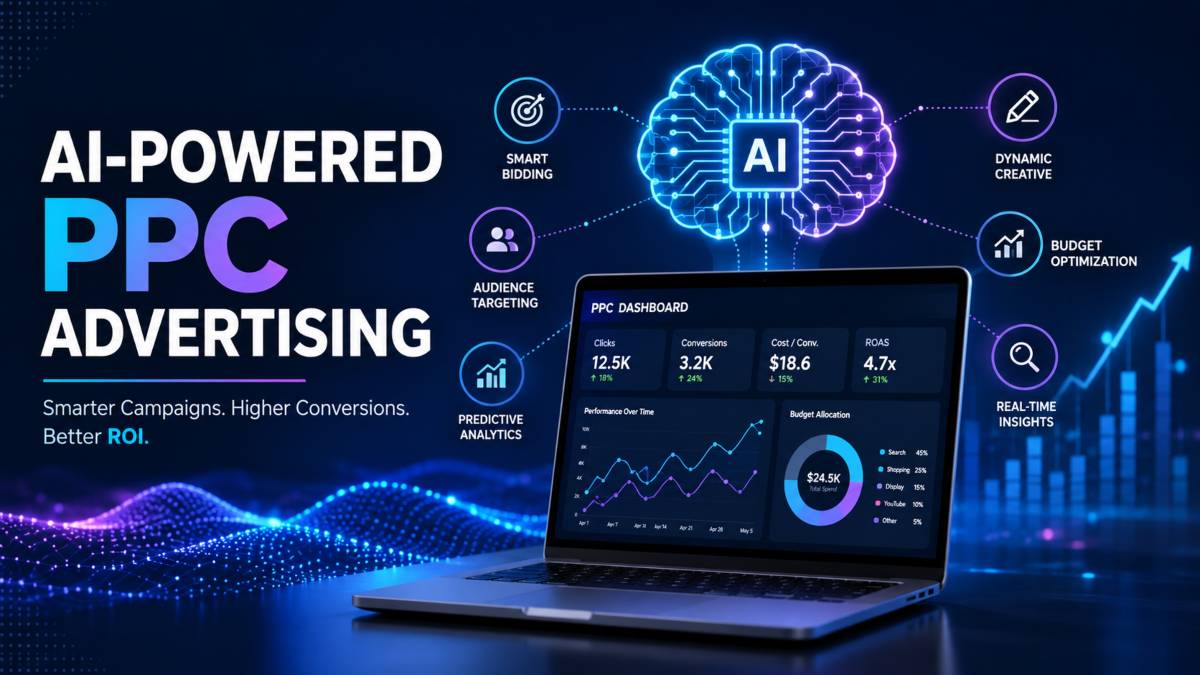
Scroll through any ad platform today and one thing is clear: the old way of running campaigns is fading out. AI in PPC campaigns is not some future idea waiting in the wings. It is already rewriting how ads are built, placed, and improved in real time.
There was a time when marketers sat for hours adjusting bids, testing copy, and chasing performance metrics like it was a full time sport. Now the heavy lifting has shifted. Algorithms read signals faster than any human can, making decisions in seconds based on behavior, intent, and patterns that would take days to spot manually.
This shift is not just about saving time. It is about sharper results. Campaigns run with AI can trim wasted spend, target the right audience with more precision, and push stronger returns without constant hands on work. The result feels less like guesswork and more like a system that learns, adapts, and keeps improving with every click.
What AI Means for PPC Advertising Today
AI has changed the pace of PPC advertising. What once moved step by step now runs in a constant loop of learning and adjustment. Campaigns no longer sit still waiting for manual updates. They react, adapt, and improve as data flows in.
From Manual Campaigns to Machine Learning Systems
Traditional PPC workflows were hands on. Marketers adjusted bids, tested ads, and reviewed reports at set intervals. Results often lagged behind decisions, and small delays could mean wasted budget.
Now the system works differently. Machine learning tools process signals like user behavior, device type, location, and timing in real time. Instead of waiting for a human to step in, the platform adjusts bids, rotates creatives, and shifts focus toward what is performing best at that exact moment.
This shift turns PPC into a living system. It learns from every click and uses that insight instantly.
Why Advertisers Are Moving Toward AI Tools
The appeal is simple. AI saves time where it matters most. Tasks that once took hours now happen automatically in the background.
Targeting also becomes sharper. AI identifies patterns in user behavior and places ads in front of people who are more likely to act. This means less wasted spend and more meaningful engagement.
Then there is conversion tracking. AI connects the dots between clicks and outcomes with greater accuracy. Marketers are no longer guessing what works. They see clearer signals and can trust the system to keep improving results over time.
Automated Bidding and Budget Optimization
Money used to leak out of PPC campaigns in quiet, frustrating ways. A bid set too high here, a missed opportunity there. Multiply that across hundreds of keywords and the cost adds up fast. AI changes that rhythm completely. It keeps a constant watch on performance and adjusts spending with a level of precision that manual work simply cannot match.
How Smart Bidding Works in Google Ads
At the center of this shift are smart bidding strategies. These systems rely on machine learning to decide how much to bid for each auction in real time. Instead of one fixed rule, the system reacts to a mix of signals such as device type, user location, and time of day.
A search at midnight on a mobile phone may carry a very different intent than one during office hours on a desktop. AI reads those signals instantly and adjusts the bid to match the likelihood of a conversion. Over time, the system builds a clearer picture of what works and leans into those patterns.
This turns bidding into something fluid rather than fixed. It is no longer about setting rules and hoping they hold. It is about letting the system respond to live conditions.
Impact on Cost and Conversions
The effect on budget control is hard to ignore. Campaigns using AI driven bidding have shown up to 56 percent reduction in wasted spend in cost per click focused setups. That means fewer clicks that go nowhere and more budget directed toward users who are ready to act.
Compared to manual bidding, the difference shows up in both efficiency and scale. Manual methods rely on periodic checks and adjustments, which leaves gaps where performance can slip. AI fills those gaps by reacting instantly.
The result is not just lower costs. It is stronger conversion rates, steadier performance, and a system that keeps learning with every interaction.
AI Powered Audience Targeting and Personalization
If bidding is the engine, targeting is the steering wheel. And right now, AI is gripping it tight. Modern PPC is no longer about broad audiences and hopeful clicks. It is about precision. Quiet, calculated, and built on data that never sleeps.
Predictive Targeting Using User Data
AI ad targeting works by reading patterns most marketers would never catch on their own. It pulls together behavior, demographics, and past interactions to understand not just who a user is, but what they are likely to do next.
Someone browsing late at night, revisiting the same product page, or clicking similar ads across platforms is sending signals. AI connects those dots. It predicts intent before the user even takes the final step.
This kind of targeting moves beyond guesswork. Campaigns no longer chase audiences blindly. They focus on users who already show signs of interest, which sharpens relevance and improves the chances of conversion.
Personalized Ads Across Channels
Now take that insight and stretch it across platforms. This is where personalization steps into full view. Tools like Meta Advantage+ use AI to tailor ads for different users across feeds, stories, and placements without manual input.
The same product can appear in multiple formats, each adjusted to match the user’s behavior and preferences. One person sees a bold visual. Another sees a softer message with a direct call to action. The system tests, learns, and refines continuously.
The payoff is clear. Campaigns using this level of personalization have reported up to 2X return on ad spend. Not because they shout louder, but because they speak directly to the right person at the right moment.
This is the new standard. Less noise, more relevance, and a message that feels like it was meant for one person even when it reaches thousands.
Dynamic Creative Optimization in PPC
Creative used to be the slowest part of PPC. One headline, one image, one call to action, then weeks of waiting to see what worked. Now that process moves at speed. Dynamic creative optimization turns ad building into a system that tests, learns, and improves without constant input.
How AI Generates and Tests Ad Variations
AI builds multiple versions of an ad by mixing headlines, visuals, and calls to action in different combinations. Instead of choosing one “best guess,” the system runs several variations at once and tracks how users respond.
Responsive search ads take this further. You provide a set of assets, and the platform assembles them in real time based on what is most likely to perform for each search. One user may see a direct, benefit focused headline. Another may see a softer, curiosity driven version.
This constant testing does not pause. Every impression feeds the system more data. It learns which combinations drive clicks and which ones fall flat, then shifts toward what works.
Performance Gains from DCO
The impact shows up quickly in performance metrics. Campaigns using dynamic creative optimization have reported up to 32 percent higher click through rates and 56 percent lower cost per click.
That lift comes from relevance. Ads are no longer static messages pushed to everyone. They adapt to match user intent and context at the moment of interaction.
Compared to manual creative testing, the difference is scale and speed. A human team might test a handful of variations over weeks. AI can test dozens in the same time frame and refine them continuously.
The result is a creative process that feels less like trial and error and more like a system that sharpens itself with every impression.
Predictive Analytics and Audience Forecasting
PPC once ran on hindsight. You launched a campaign, gathered data, then adjusted after the fact. AI flips that model. It looks forward. It reads patterns early and signals where the next conversion is likely to come from.
Identifying High Intent Users
Predictive analytics in advertising focuses on spotting intent before it becomes action. AI studies past behavior, browsing habits, purchase history, and engagement signals to build a profile of users who are most likely to convert.
Instead of targeting broad segments, campaigns can zero in on people already leaning toward a decision. A user who compares products, revisits pages, or clicks similar ads carries a different weight than a casual browser. AI recognizes that difference and adjusts targeting to focus on those stronger signals.
This approach sharpens efficiency. Budgets move toward users who matter most, and campaigns spend less time chasing cold traffic.
Reducing Guesswork in Campaign Planning
Planning used to involve testing, waiting, and refining over time. The early phase of a campaign often meant uncertainty while data slowly built up.
AI cuts through that delay. By using historical data and pattern recognition, it can predict which audiences, keywords, and creatives are likely to perform before the campaign fully ramps up.
This shortens the learning phase. Instead of weeks of trial and adjustment, campaigns start with a stronger foundation and reach stable performance faster.
The result is a planning process that feels more informed from day one, with fewer blind spots and a clearer path to results.
Future Trends in AI and PPC Campaigns 2026 and Beyond
The next phase of PPC is not just smarter. It feels almost self running. AI is moving past optimization and stepping into creation, context awareness, and full campaign control. What looks advanced today will feel basic very soon.
AI Generated Video and Creative Assets
Ad creation is speeding up in a way that would have seemed unrealistic a few years ago. AI can now take a single product image and turn it into a complete video ad. It selects visuals, adds motion, writes copy, and structures the message without a full creative team behind it.
This changes the pace of production. Brands can launch fresh creatives quickly and test new ideas without long timelines. It also lowers the barrier for smaller teams who want high quality output without heavy resources.
Context Based Advertising and Voice Integration
Ads are becoming more aware of their environment. AI can adjust messaging based on context such as user mood, browsing patterns, or the type of content being viewed. A calm browsing session may trigger softer messaging, while a high intent search may push a more direct call to action.
Voice is also entering the mix. Voice driven ads are starting to match how people search and interact with devices. AI can shape audio content that feels natural, matching tone and delivery to user behavior.
This creates a more fluid experience where ads feel less like interruptions and more like part of the interaction.
Cross Platform Campaign Automation
Managing campaigns across multiple platforms has always been complex. Each channel had its own rules, formats, and performance signals. AI is starting to unify that process.
With cross platform automation, campaigns can run under a single system that manages budgets, creatives, and targeting across different channels at once. Data flows between platforms, and decisions are made with a broader view of performance.
The result is a more connected strategy. Instead of managing isolated campaigns, marketers oversee a system that coordinates everything in sync, adjusting in real time to keep performance on track.
Benefits and Limitations of AI in PPC
AI has changed how PPC campaigns run, but it is not a magic switch that solves everything. It brings clear gains, along with a few tradeoffs that marketers need to understand before handing over full control.
Key Benefits
The first win is efficiency. Tasks that once demanded constant attention now run in the background. Bidding, targeting, and testing happen without the need for daily manual input, freeing up time for strategy and creative thinking.
Scalability is another major advantage. Campaigns can expand across keywords, audiences, and platforms without a sharp rise in workload. What used to require a full team can now be managed with fewer hands, while still maintaining strong performance.
Then there is return on investment. AI directs spend toward users who are more likely to convert, cutting wasted clicks and improving overall results. Campaigns become more focused, and budgets work harder with less friction.
Challenges Marketers Should Watch
AI depends heavily on data. If the input is weak or incomplete, the output suffers. Poor tracking or limited data can lead to decisions that miss the mark.
There is also a learning curve. Understanding how to guide AI systems takes time. Marketers need to know what signals matter and how to interpret results, rather than relying on the system blindly.
Finally, there is reduced manual control. Some decisions happen behind the scenes, which can feel uncomfortable for those used to direct management. The key is balance, using AI as a tool while still keeping a close eye on performance and direction.
Best Practices for Using AI in PPC Campaigns
AI can run a campaign with speed and precision, but it still needs direction. The difference between average results and strong performance often comes down to how well the system is set up and guided from the start.
Start with Strong Conversion Tracking
Everything begins with tracking. If conversions are not measured correctly, AI has no clear signal to learn from. Set up accurate tracking for key actions such as purchases, sign ups, or leads.
When the system knows what success looks like, it can adjust bids, targeting, and creatives with purpose. Without that clarity, it may chase the wrong outcomes and waste budget.
Feed High Quality Data into AI Systems
AI performs best when it has clean and relevant data. This includes audience insights, keyword performance, and user behavior. The more accurate the data, the better the system can identify patterns and make smart decisions.
First party data plays a strong role here. It gives AI a clearer view of your audience and helps refine targeting over time. Poor data, on the other hand, leads to weak results and missed opportunities.
Monitor and Adjust, Do Not Fully Step Away
Automation does not mean absence. Campaigns still need oversight. Review performance regularly, check trends, and step in when needed.
AI handles the heavy lifting, but strategy still belongs to the marketer. Adjust goals, test new ideas, and guide the system based on business priorities. The best results come from a balance between automation and human judgment.
Conclusion
AI has moved from a supporting role to the core of how PPC campaigns run. It handles bidding, targeting, and creative testing with a level of speed and accuracy that manual work cannot match. What once required constant effort now runs as a system that learns and improves with every interaction.
That shift does not mean marketers step aside. It means they work smarter. The real advantage comes from using AI with a clear plan, strong data, and steady oversight.
The future of PPC belongs to those who adapt early and use these tools with purpose. Not blindly, but with control and direction. Start small, learn how the system behaves, and build from there. The results will follow.