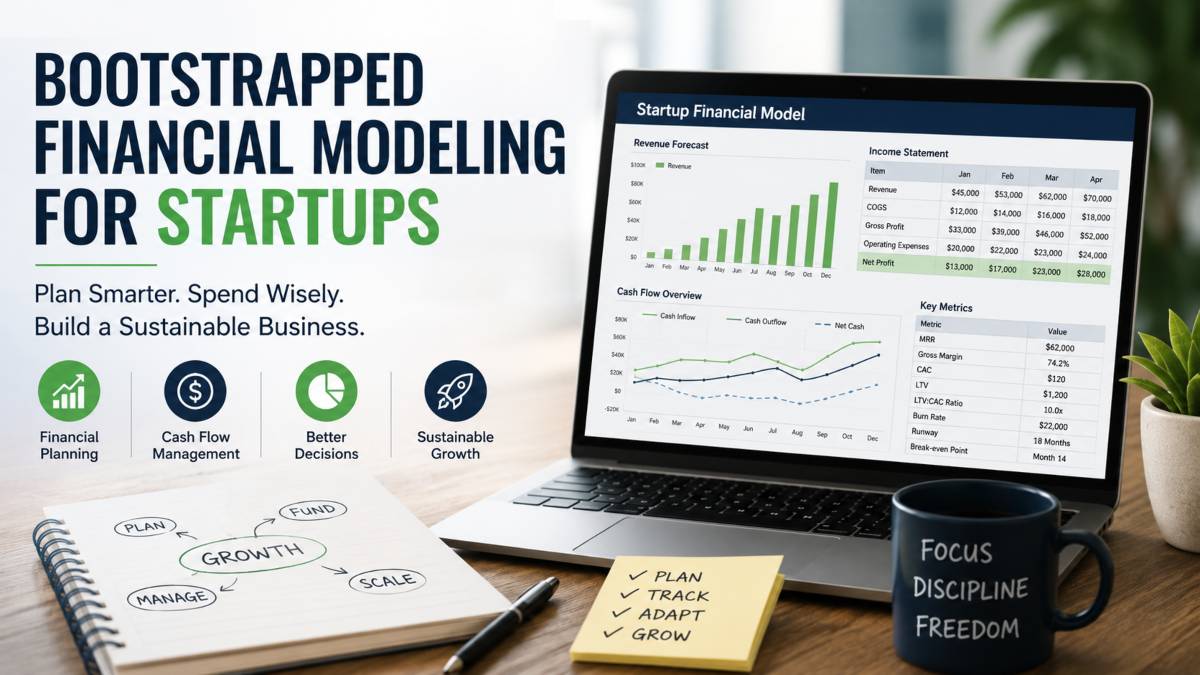
Building a startup without outside investors takes careful planning and smart financial decisions. Every dollar matters, which makes startup bootstrapped financial modeling an essential part of running a self funded business. A well structured financial model helps founders estimate future revenue, monitor expenses, manage cash flow, and understand when the business can become profitable.
Instead of relying on large funding rounds, bootstrapped startups depend on customer income and disciplined spending. This approach allows business owners to make informed choices based on realistic numbers rather than guesswork. A reliable financial model also helps reduce unexpected cash shortages and supports steady business growth.
This guide explains the fundamentals of startup bootstrapped financial modeling, the financial statements every founder should understand, the key metrics worth tracking, and the steps to build a practical model. You will also learn common mistakes to avoid, useful tools to simplify forecasting, and ways to keep your financial plan accurate as your startup grows.
What Is Startup Bootstrapped Financial Modeling?
Startup bootstrapped financial modeling is the process of creating a financial plan that estimates how a self funded business will earn, spend, and manage money over time. Instead of relying on venture capital or large investment rounds, the model focuses on using available resources wisely while keeping the business financially healthy. It gives founders a clear picture of expected revenue, operating costs, cash flow, and future profitability so they can make informed business decisions with greater confidence.
What Does Bootstrapped Mean for a Startup?
A bootstrapped startup is built using the founder’s personal savings, business revenue, or small contributions from family and friends. Since outside investment is limited or unavailable, every financial decision carries more weight. Business owners must control expenses, generate consistent income, and keep enough cash available to support daily operations.
This approach creates a revenue first mindset. Rather than chasing rapid expansion, founders focus on attracting paying customers, improving products or services, and building a business that can support itself. Success depends on steady progress, careful spending, and healthy profit margins instead of aggressive fundraising.
Why Financial Modeling Matters for Bootstrapped Businesses
Financial modeling gives founders a practical framework for making smarter business decisions. By forecasting revenue and expenses, they can estimate future cash balances, identify profitable opportunities, and prepare for slower sales periods before problems appear.
Since capital is limited, careful planning helps avoid unnecessary spending and keeps essential business activities funded. A financial model also allows founders to test different business scenarios, compare expected results, and adjust plans as real financial data becomes available.
As the startup grows, the model becomes a valuable planning tool for setting realistic goals, calculating runway, measuring break even progress, and maintaining steady growth without placing unnecessary pressure on the business.
How Bootstrapped Financial Modeling Differs From VC Backed Models
Every startup needs a financial model, but the structure and priorities can vary depending on how the business is funded. A bootstrapped startup focuses on building a stable company using its own revenue, while a VC backed startup often plans around future investment rounds and faster expansion. Understanding these differences helps founders create forecasts that match their business goals and available resources.
Growth Expectations
Bootstrapped startups usually follow a steady and realistic growth path. Revenue forecasts are based on actual customer demand, sales performance, and available resources. This helps founders avoid unrealistic projections and keeps business planning grounded in real numbers.
VC backed startups often forecast faster growth because outside funding allows them to invest heavily in product development, marketing, and team expansion. While this can increase market share quickly, it also comes with higher financial pressure.
Cash Flow Versus Rapid Expansion
For a bootstrapped business, cash flow is one of the most important financial priorities. Founders need enough cash to cover operating costs, pay suppliers, and continue serving customers. A strong financial model tracks monthly cash movement to reduce the risk of running short on funds.
VC backed companies may accept larger short term losses while working toward rapid expansion. Their financial models often focus on revenue growth and market penetration before profitability becomes the main objective.
Spending Strategy
Bootstrapped founders usually keep expenses under control by choosing affordable tools, working with smaller teams, and delaying large purchases until revenue can support them. This careful approach allows the business to grow without placing unnecessary pressure on cash reserves.
Companies supported by venture capital often invest earlier in hiring, advertising, product development, and infrastructure. These investments are expected to support faster business growth over time.
Financial Metrics That Matter Most
Bootstrapped startups pay close attention to profitability, cash runway, gross margin, and break even progress. Customer acquisition cost, lifetime value, and monthly recurring revenue also help founders measure business performance and identify areas for improvement.
VC backed startups monitor many of the same metrics, but greater attention is often given to customer growth, market share, and overall company valuation because these numbers influence future fundraising opportunities.
| Area | Bootstrapped Startup | VC Backed Startup |
|---|---|---|
| Funding | Founder savings and business revenue | Venture capital investment |
| Growth strategy | Steady and sustainable expansion | Faster expansion supported by external funding |
| Profit goals | Reach profitability as early as possible | Profit may come after strong growth |
| Cash management | Careful budgeting and close cash monitoring | Higher spending supported by investment capital |
| Hiring approach | Small team with gradual hiring | Larger teams built earlier to support growth |
| Risk tolerance | Lower risk with controlled spending | Higher risk in pursuit of faster expansion |
Core Components of a Startup Bootstrapped Financial Model
A startup bootstrapped financial model works best when it combines several financial reports with a set of performance metrics. Each component serves a different purpose, but together they provide a complete picture of the business. Founders can use this information to monitor financial health, estimate future performance, and make informed decisions based on real numbers instead of assumptions alone.
Income Statement
The income statement shows whether the business is making money during a specific period. It begins with revenue, which represents the income generated from product sales or services. For subscription businesses, this often includes recurring customer payments, while ecommerce and service companies record sales based on completed transactions.
The next item is the cost of goods sold, commonly known as COGS. These are the direct costs required to deliver a product or service. Examples include manufacturing costs, payment processing fees, shipping charges, or contractor expenses directly related to customer work.
After subtracting COGS from revenue, the result is gross profit. This figure shows how much money remains before covering everyday business expenses. A healthy gross profit gives founders more flexibility to invest in growth while keeping finances stable.
Operating expenses include costs such as employee salaries, software subscriptions, office expenses, marketing, insurance, utilities, and professional services. Although these costs do not directly produce sales, they are necessary to keep the business running.
Once all expenses have been deducted, the remaining amount becomes net profit. Positive net profit means the company earns more than it spends, while a negative figure signals that expenses are higher than revenue. Tracking this number each month helps founders understand whether the business is moving toward long term profitability.
Cash Flow Statement
A profitable business can still experience financial problems if cash is not available when bills are due. This is why the cash flow statement is one of the most valuable reports for a bootstrapped startup.
Cash inflows include customer payments, service income, product sales, loan proceeds, or any additional money entering the business. These figures show how much cash becomes available during each reporting period.
Cash outflows represent money leaving the business. This includes payroll, rent, software subscriptions, supplier payments, marketing costs, taxes, and other operating expenses. Keeping these payments under control helps preserve healthy cash reserves.
The difference between cash received and cash spent determines the monthly cash balance. Monitoring this balance helps founders identify periods where extra cash may be needed or where spending should be adjusted.
Runway planning uses the available cash balance to estimate how long the business can continue operating before additional income becomes necessary. This calculation allows founders to plan hiring decisions, marketing budgets, and product investments with greater confidence.
Balance Sheet
The balance sheet provides a snapshot of the company’s financial position at a specific point in time. Although early stage startups often have simple balance sheets, this report remains an important part of financial planning.
Assets include everything the business owns that has financial value. Common examples include cash, equipment, inventory, accounts receivable, and business technology.
Liabilities represent financial obligations that must be paid. These may include business loans, unpaid supplier invoices, taxes owed, or credit balances.
Equity reflects the founder’s ownership in the business after liabilities are deducted from total assets. As profits grow and earnings remain in the company, equity usually increases over time, showing stronger financial health.
Metrics Dashboard
A financial model becomes much more useful when key performance indicators are displayed in one easy to read dashboard. These metrics allow founders to monitor business performance without reviewing every financial report individually.
Monthly recurring revenue, often called MRR, measures predictable subscription income generated each month. It helps subscription businesses estimate future revenue with greater accuracy.
Gross margin shows how much revenue remains after direct production costs have been removed. A higher percentage generally indicates better operating efficiency.
Customer acquisition cost, or CAC, measures how much the business spends to gain each new customer. Keeping this figure under control supports healthier profits.
Lifetime value, known as LTV, estimates the total revenue expected from an average customer during the entire business relationship. Comparing LTV with CAC helps determine whether customer acquisition efforts are financially sustainable.
The LTV to CAC ratio shows how much value each customer produces compared with the cost of acquiring them. Many founders consider a ratio above three to one a healthy benchmark.
Burn rate measures how much cash the business spends each month after income has been considered. This metric becomes especially important when revenue temporarily slows.
Runway estimates how many months the available cash can support business operations at the current spending level. A longer runway gives founders more flexibility when making strategic decisions.
The break even point identifies when total revenue matches total business expenses. Reaching this milestone shows that the company can support its operations without relying on additional funding, making it an important goal for every bootstrapped startup.
How to Build a Startup Bootstrapped Financial Model
Creating a startup bootstrapped financial model does not require advanced accounting knowledge or expensive software. What matters most is using realistic numbers and updating them as your business grows. A well organized model helps founders understand where money comes from, where it goes, and what changes may affect future performance. By following a structured process, you can build a financial model that supports daily decisions and long term business goals.
Define Financial Assumptions
Every financial model begins with assumptions because these numbers influence every forecast that follows. Start by setting your pricing structure. This may include monthly subscriptions, one time purchases, hourly rates, or product bundles. Use prices that reflect your market and customer demand.
Next, estimate how you expect to attract customers. List your acquisition channels, such as organic search, referrals, social media, email marketing, or paid advertising. Estimate how many visitors or leads each channel can generate each month.
Conversion rates are equally important. Calculate the percentage of leads that become paying customers. If you already have sales data, use actual performance instead of guesses. New businesses can begin with conservative estimates and adjust them as more information becomes available.
If your business uses subscriptions, estimate customer churn. This represents the percentage of customers who stop using your product or service during a given period. Lower churn usually leads to more stable recurring revenue.
Separate your expenses into fixed costs and variable costs. Fixed costs include recurring expenses such as rent, software subscriptions, insurance, and salaries. Variable costs change with sales volume and may include payment processing fees, shipping, commissions, or production expenses. Organizing costs this way makes future planning much easier.
Build Revenue Forecasts
Revenue forecasting estimates how much income your business may generate over time. A practical approach for bootstrapped startups is bottom up forecasting. Instead of starting with a large market estimate, begin with realistic sales activities that your business can achieve.
Estimate how many new customers you expect each month and multiply that figure by your average selling price or average revenue per customer. Repeat this process across future months while adjusting for customer retention and expected growth.
For a Software as a Service business, revenue forecasts often begin with monthly recurring revenue. For example, if twenty customers subscribe to a fifty dollar monthly plan, recurring revenue begins at one thousand dollars before accounting for cancellations or upgrades. As new customers join and existing customers remain, recurring revenue increases steadily.
Service businesses can estimate revenue by calculating billable hours or completed projects each month. Multiplying expected work by average pricing creates a realistic income forecast.
Electronic commerce businesses can estimate revenue by forecasting monthly orders, average order value, and repeat purchases. Combining these figures creates a practical sales projection that can be updated as actual sales data becomes available.
Estimate Operating Costs
Accurate expense forecasting is just as important as estimating revenue. Begin with software costs, including accounting platforms, customer relationship management systems, project management tools, website hosting, and productivity applications.
Payroll often represents one of the largest business expenses. Include founder salaries if applicable, employee wages, taxes, benefits, and any planned future hires.
Marketing costs may include advertising, content creation, search optimization, email marketing software, and promotional campaigns. Review spending regularly to confirm each activity supports business growth.
Many early stage startups also work with contractors instead of hiring full time employees. Include freelance designers, developers, writers, consultants, or virtual assistants when estimating expenses.
Office costs depend on how your business operates. Remote companies may only pay for internet services and home office equipment, while businesses with physical locations should include rent, utilities, maintenance, and office supplies.
Create Cash Flow Projections
Cash flow projections estimate when money enters and leaves the business. This helps founders prepare for periods where expenses arrive before customer payments.
Payment timing is an important consideration. Some customers pay immediately, while others may have payment terms that extend for several weeks. Delayed payments can reduce available cash even when sales remain strong.
One time expenses should also appear in your forecast. These may include company registration fees, legal services, branding, equipment purchases, or website development. Since these costs do not occur every month, recording them separately improves forecast accuracy.
Many businesses experience seasonal changes throughout the year. Retail stores may receive higher sales during holiday periods, while other industries perform better during specific months. Including these patterns creates forecasts that better reflect real business conditions.
Calculate Startup Metrics
Financial metrics help founders evaluate business performance using measurable data.
Gross margin measures how much revenue remains after direct costs have been deducted.
Gross Margin = (Revenue minus Cost of Goods Sold) divided by Revenue multiplied by one hundred
Customer acquisition cost measures how much it costs to gain each new customer.
CAC = Total Sales and Marketing Costs divided by Number of New Customers
Lifetime value estimates the total revenue expected from an average customer during the customer relationship.
LTV = Average Revenue Per Customer multiplied by Gross Margin multiplied by Average Customer Lifetime
Burn rate measures how much cash the business spends each month after income has been considered.
Burn Rate = Monthly Cash Outflows minus Monthly Cash Inflows
Runway estimates how long existing cash can support business operations.
Runway = Current Cash Balance divided by Monthly Burn Rate
The break even point identifies when revenue becomes equal to total business expenses.
Break Even Point = Total Fixed Costs divided by Contribution Margin Per Unit
Tracking these figures regularly gives founders a clear picture of financial health and business progress.
Build Best, Base, and Worst Case Scenarios
No financial forecast is perfect because market conditions can change quickly. Scenario planning helps founders prepare for different outcomes before they happen.
The best case scenario assumes stronger sales, lower customer churn, and higher customer retention. This version helps estimate how quickly the business could grow if performance exceeds expectations.
The base case scenario represents the most realistic forecast using current data and reasonable assumptions. This version usually becomes the primary planning model.
The worst case scenario assumes slower revenue growth, increased customer churn, unexpected operating costs, or delayed sales. Planning for these possibilities allows founders to respond quickly without making rushed financial decisions.
Comparing all three scenarios helps identify financial risks and determine how much flexibility the business has under different conditions.
Update the Model Monthly
A financial model should remain an active planning tool rather than a document created once and forgotten. At the end of each month, compare actual business results with your original forecasts. This process reveals where estimates were accurate and where adjustments are needed.
As your startup collects more customer and financial data, replace early assumptions with real performance figures. Updated forecasts become more reliable and support stronger business decisions.
Regular reviews also help founders decide when to increase marketing budgets, hire new team members, introduce new products, or reduce unnecessary expenses. By keeping the financial model current, business owners can respond with confidence as market conditions and customer demand change over time.
Best Tools for Startup Bootstrapped Financial Modeling
Choosing the right tools can make financial planning easier and more accurate. Many bootstrapped founders begin with simple spreadsheets before moving to dedicated accounting or forecasting platforms as their business grows. The best choice depends on your budget, business model, and reporting needs. Regardless of the tool you select, keeping financial data organized and updated is the key to building reliable forecasts.
Spreadsheet Solutions
Google Sheets is a popular choice for early stage startups because it is free, cloud based, and easy to share with team members. Founders can build custom financial models, create revenue forecasts, monitor monthly expenses, and update projections from any device. Collaboration features also make it simple for multiple people to review and edit the same financial model.
Microsoft Excel remains one of the most powerful spreadsheet applications for financial planning. It offers advanced formulas, data analysis features, pivot tables, and chart creation tools that support detailed financial models. Many founders prefer Excel when working with larger datasets or creating more advanced forecasting models.
Accounting Software
QuickBooks helps startups organize bookkeeping, record income and expenses, manage invoices, and generate financial reports. Since financial records remain updated throughout the year, founders can use accurate business data when preparing forecasts and reviewing company performance.
Xero offers similar features with a user friendly interface and strong integration options. It allows business owners to monitor cash flow, reconcile bank transactions, track bills, and generate reports that support financial planning. Both platforms reduce manual work and improve the accuracy of financial records.
Forecasting Platforms
Businesses that need more advanced planning can benefit from dedicated forecasting software.
LivePlan helps founders create business forecasts, financial plans, and performance reports through guided templates that simplify the planning process.
Fathom connects with accounting software to produce financial reports, performance dashboards, and visual forecasts using current business data.
Baremetrics is designed for subscription businesses and tracks important recurring revenue metrics, customer retention, and subscription performance.
ChartMogul also focuses on subscription businesses by monitoring recurring revenue, customer growth, churn, and other important performance indicators that support long term planning.
Financial Model Templates
Financial model templates provide a useful starting point for founders who want to save time. Free templates available for Google Sheets and Microsoft Excel can cover basic revenue forecasting, cash flow planning, and expense tracking. Paid templates often include automated calculations, professional dashboards, and detailed financial reports that require less manual work.
Whichever template you choose, adjust it to match your own pricing structure, operating costs, revenue model, and business goals. A customized financial model provides far more value than using a generic template without making changes.
Common Financial Modeling Mistakes Bootstrapped Founders Should Avoid
A financial model is only as useful as the information behind it. Even a well designed spreadsheet can produce poor results if the numbers are unrealistic or outdated. Many bootstrapped founders make similar mistakes during the early stages of building their business. Recognizing these issues can help you create more reliable forecasts and make stronger financial decisions.
Unrealistic Revenue Forecasts
Many founders overestimate how quickly customers will arrive and how much revenue the business will generate. While optimism is valuable, financial projections should be based on realistic sales data, market demand, and customer behavior. Inflated revenue estimates can create unrealistic budgets and lead to unnecessary spending. A better approach is to start with conservative assumptions and revise them as actual sales figures become available.
Ignoring Cash Flow
Profit does not always mean cash is available when bills need to be paid. Customers may take weeks to pay invoices while expenses such as payroll, software subscriptions, and rent must be paid on time. Ignoring cash flow can create financial pressure even when sales appear healthy. Reviewing cash inflows and cash outflows every month helps founders avoid shortages and maintain stable business operations.
Overspending Too Early
Early success often encourages founders to increase spending before the business has established consistent revenue. Hiring too many employees, purchasing expensive software, or increasing advertising budgets without clear financial support can reduce available cash quickly. Keeping operating costs under control allows the business to remain flexible while revenue continues to grow. Every major expense should support a clear business objective and fit within the available budget.
Forgetting Scenario Planning
No business performs exactly as expected every month. Sales may slow, customer retention may change, or unexpected expenses may appear without warning. Building only one financial forecast leaves little room for preparation. Creating best case, base case, and worst case scenarios helps founders understand how different situations may affect revenue, expenses, cash flow, and profitability. This preparation makes future decisions more informed and less stressful.
Failing to Update Financial Data
A financial model should evolve as the business grows. Leaving forecasts unchanged for months reduces their accuracy and limits their usefulness. Comparing actual business performance with projected results allows founders to identify trends, improve assumptions, and correct forecasting errors. Monthly reviews also support better budgeting, hiring decisions, pricing adjustments, and growth planning. A financial model that reflects current business performance becomes a reliable guide for future decisions.
Benefits of Startup Bootstrapped Financial Modeling
A well prepared financial model does much more than estimate future revenue. It helps founders understand how everyday business decisions affect profitability, cash availability, and long term growth. For bootstrapped startups, where resources are often limited, a reliable financial model provides the clarity needed to build a stronger and more resilient business.
Better Cash Management
Cash is one of the most valuable resources for a self funded startup. A financial model helps founders estimate future cash inflows and expenses so they can prepare for upcoming obligations. Monitoring cash balances also makes it easier to avoid shortages, schedule larger purchases at the right time, and maintain enough funds to support daily operations. This level of planning reduces financial surprises and supports smoother business management.
Smarter Hiring Decisions
Growing a team is an important milestone, but hiring too soon can place unnecessary pressure on the business. A financial model allows founders to estimate salary costs, employee benefits, and other related expenses before adding new staff. By reviewing projected revenue alongside operating costs, business owners can decide when hiring is financially practical and whether contractors or part time professionals may be a better option during the early stages.
Stronger Pricing Strategy
Pricing has a direct influence on revenue and profitability. Financial modeling helps founders test different pricing options and measure how each one affects sales, gross profit, and overall business performance. It also highlights whether current prices can comfortably cover operating expenses while producing healthy profit margins. These calculations support pricing decisions based on financial data rather than assumptions.
Easier Funding Decisions Later
Many founders begin as self funded businesses but may consider outside investment in the future. Maintaining an organized financial model makes this process much easier. Accurate forecasts, clear financial reports, and consistent business metrics demonstrate that the company is managed with discipline. Even if additional funding is never required, having reliable financial records improves strategic planning and supports informed business discussions.
Greater Business Stability
A startup that regularly reviews its financial model is better prepared for changing market conditions and unexpected expenses. Founders can identify potential risks early, adjust spending, and revise growth plans before small issues become larger problems. Consistent financial planning also supports steady expansion, healthier profit margins, and stronger decision making, helping the business remain stable as it grows over time.
Final Thoughts
Startup bootstrapped financial modeling is more than a planning exercise. It gives founders a practical way to understand their business, manage available resources, and prepare for future opportunities. A well built financial model brings together revenue forecasts, operating costs, cash flow, and key performance metrics so every important decision is supported by reliable data. Whether you are launching a new business or growing an existing one, this level of planning can reduce uncertainty and help you stay focused on steady progress.
A financial model should never remain unchanged. As customer demand, expenses, and market conditions shift, your forecasts should reflect those changes. Reviewing actual results each month and comparing them with projected figures helps improve accuracy and keeps your plans relevant. Small updates made consistently are far more valuable than major revisions completed only once or twice a year.
Disciplined financial planning gives bootstrapped founders greater confidence when setting budgets, adjusting pricing, expanding operations, or preparing for future funding opportunities. With a realistic financial model and regular updates, you can make informed decisions that support sustainable business growth for the long term.
Frequently Asked Questions
What is startup bootstrapped financial modeling?
Startup bootstrapped financial modeling is the process of creating a financial plan for a business that grows without relying on major outside investment. It helps founders estimate future revenue, track expenses, monitor cash flow, and measure profitability over a specific period. A financial model also supports better budgeting, hiring, and pricing decisions by showing how changes in the business may affect overall performance. For self funded startups, it serves as a practical guide for managing limited resources while working toward steady and sustainable growth.
How is a bootstrapped financial model different from a VC backed model?
A bootstrapped financial model focuses on careful spending, healthy cash flow, and reaching profitability through customer revenue. Growth projections are usually based on realistic sales expectations and available resources. A VC backed financial model often assumes additional investment, faster business expansion, and larger operating budgets. While both models estimate future financial performance, a bootstrapped approach places greater attention on financial stability, efficient resource management, and maintaining enough cash to support daily operations.
What should every startup financial model include?
A complete startup financial model should contain an income statement, cash flow statement, and balance sheet. It should also include revenue forecasts, operating expenses, fixed costs, variable costs, and important performance metrics. Many founders add separate sections for pricing assumptions, customer growth, hiring plans, and different business scenarios. Together, these components provide a clear view of the company’s financial position and help support informed business decisions.
How often should founders update their financial model?
Most founders should review and update their financial model every month. Regular updates allow projected figures to be compared with actual business results, making it easier to improve future forecasts. Monthly reviews also help identify changes in revenue, expenses, customer behavior, and cash flow before they become larger financial concerns. Businesses experiencing rapid growth or major operational changes may benefit from reviewing their financial model even more frequently.
Which financial metrics matter most for bootstrapped startups?
Several financial metrics help founders understand business performance. Monthly recurring revenue is useful for subscription businesses because it measures predictable income. Gross margin shows how much revenue remains after direct costs. Customer acquisition cost measures the expense of gaining each new customer, while lifetime value estimates the revenue generated by an average customer over time. Burn rate tracks monthly cash usage, runway estimates how long available cash can support operations, and the break even point identifies when revenue covers total business expenses. Monitoring these figures supports stronger financial decisions.
Can I build a startup financial model using Google Sheets?
Yes. Google Sheets is one of the most practical tools for building a startup financial model. It allows founders to create revenue forecasts, expense budgets, cash flow projections, and financial dashboards without paying for specialized software. Since files are stored online, team members can review and update the model from different locations. As the business grows, the spreadsheet can be expanded with additional reports, formulas, and performance metrics, making it a flexible solution for many early stage startups.
Read More: TheJavaSea.me Leaks AIO TLP370