
Walk into any modern business and you will find one thing in abundance: data. Sales figures, customer feedback, website clicks, support tickets. It piles up fast. Yet more data does not mean better decisions. In many cases, it creates confusion. Teams spend hours sorting through numbers without a clear sense of what actually matters.
This is where AI earns its place. Not as a buzzword, but as a working system that cuts through the clutter. It reads patterns, spots trends, and surfaces insights that would take humans far longer to uncover. What once felt like noise starts to form a clear signal.
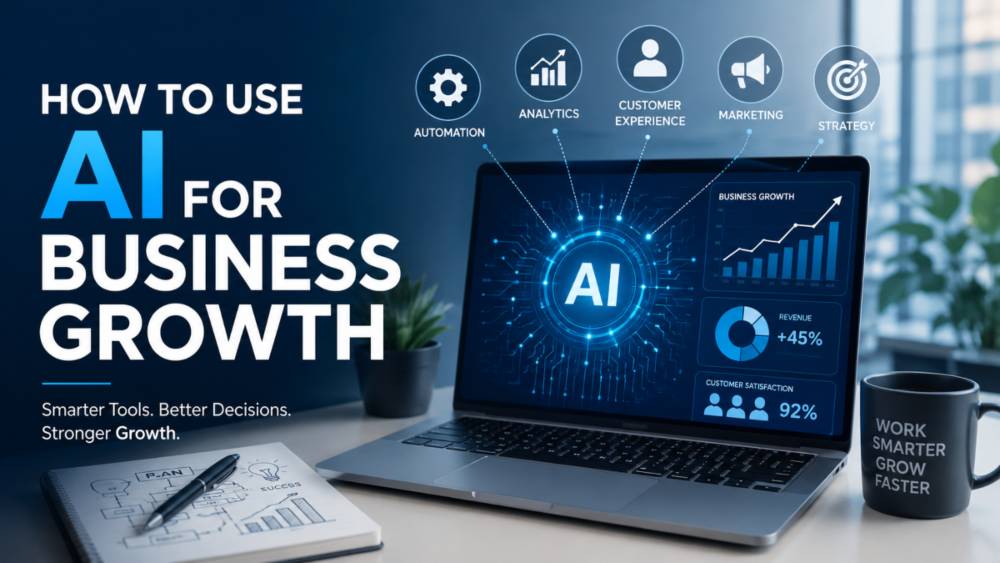
For businesses focused on growth, that shift is powerful. AI can handle routine tasks, guide smarter decisions, and help teams act with speed and confidence. The real value lies in using it with intent. When applied to the right problems, AI becomes less about technology and more about direction. This guide breaks down how to put it to work in ways that actually move a business forward.
What AI Means for Modern Business
AI in Simple Terms
At its core, AI is not as complex as it sounds. Think of it as a system that looks at large amounts of data, finds patterns, and uses those patterns to make predictions or take action. It learns from past information and improves over time.
In practical terms, AI does two things very well. First, it recognizes patterns that humans might miss, especially when dealing with huge datasets. Second, it automates tasks that would otherwise take hours of manual effort. This could be anything from sorting emails to recommending products to customers.
Instead of replacing human thinking, AI supports it. It handles the repetitive and data-heavy work so people can focus on decisions, creativity, and strategy.
Why Businesses Are Turning to AI
Businesses are adopting AI because it helps them operate with more speed and less friction. Tasks that once required entire teams can now be completed in a fraction of the time. This leads to noticeable gains in productivity.
Decision-making also becomes sharper. With AI analyzing trends and patterns, leaders can act based on real signals rather than guesswork. This reduces delays and improves outcomes.
Another major shift is the reduction of manual workload. Routine processes like data entry, customer queries, and reporting can run with minimal human input. As a result, teams can redirect their energy toward work that drives growth and innovation.
Key Benefits of AI for Business Growth
Automating Repetitive Work
Every business runs on a layer of routine work that quietly drains time. Data entry, scheduling, invoice processing, email sorting. These tasks are necessary, but they rarely move the needle. AI steps in to handle this load with consistency and speed.
By automating admin work and connecting workflows across tools, businesses can reduce human error and free up hours each week. What used to require constant attention can now run in the background. This shift allows teams to focus on higher value work like strategy, client relationships, and product development.
Better Decision Making with Data
Good decisions depend on clear signals. AI helps cut through the noise by analyzing patterns across large datasets. It can spot trends in customer behavior, sales performance, and market shifts that are easy to miss manually.
Forecasting also becomes more reliable. Instead of relying on gut feeling, businesses can use AI to project demand, plan inventory, and adjust strategy with more confidence. The result is faster decisions backed by evidence rather than guesswork.
Improved Customer Experience
Customers expect quick, relevant, and smooth interactions. AI makes this possible at scale. Chatbots can handle common questions instantly, reducing wait times and keeping support available around the clock.
Beyond speed, AI can tailor responses based on customer history and preferences. This creates a more personal experience without requiring constant human input. When customers feel understood and supported, they are more likely to stay and return.
Scalable Marketing Execution
Marketing often demands a steady stream of content and consistent campaign management. AI helps meet this demand without stretching teams too thin. It can assist with writing blog posts, creating product descriptions, and generating social media content.
Campaign support also improves. AI can analyze performance data, suggest adjustments, and help target the right audience at the right time. This makes it easier to scale marketing efforts while keeping quality and relevance intact.
How to Start Using AI in Your Business
Define Clear Business Goals
Before bringing AI into your workflow, get specific about what you want to fix or improve. Vague intentions lead to wasted time. Clear goals create direction. Look at where your business slows down. It could be delays in customer support, gaps in marketing output, or inefficiencies in internal processes.
Once you spot these bottlenecks, translate them into measurable outcomes. For example, reduce response time, increase lead conversion, or cut manual processing hours. When goals are clear, it becomes easier to choose the right approach and measure progress without confusion.
Start Small with Pilot Projects
It is tempting to apply AI across the entire business at once. That usually leads to frustration. A better approach is to start with a focused test. Choose one area where the impact can be seen quickly, such as automating customer inquiries or assisting with content creation.
Pilot projects allow you to test how AI performs in a real setting without major risk. You can learn what works, adjust your approach, and build confidence before expanding. Quick wins matter here. They create momentum and help teams see the value early on.
Choose the Right AI Tools
Not every tool fits every business. The goal is not to collect as many tools as possible, but to select ones that solve specific problems. If your challenge is customer support, look for AI that handles queries efficiently. If your focus is marketing, choose tools that assist with content and audience targeting.
Too many tools can create confusion and slow down workflows. Keep your stack simple and focused. Each tool should have a clear purpose and fit naturally into your existing processes.
Use Quality Data for Better Results
AI relies on the data it receives. If the input is messy or outdated, the output will reflect that. Clean, relevant data is essential for reliable results. Take time to organize your data sources, remove duplicates, and keep information up to date.
When your data is strong, AI can deliver insights and actions you can trust. This reduces errors and builds confidence in the system. Over time, better data leads to better performance, making AI a dependable part of your business operations.
Practical Ways to Use AI Across Business Functions
AI becomes useful when it is applied to real work, not kept as a concept. Across different parts of a business, it can take on tasks that slow teams down and turn them into smooth, repeatable processes. The result is less friction and more room to focus on growth.
Operations and Workflow Automation
Daily operations often involve tasks that follow the same steps again and again. Think of data entry, order processing, scheduling, and internal reporting. AI can take over these routines and complete them with speed and consistency.
It can also connect different systems so information flows without manual input. When tools speak to each other, teams avoid duplicate work and reduce errors. This kind of automation keeps operations running cleanly and allows businesses to handle more work without adding extra pressure on staff.
Marketing and Content Creation
Marketing thrives on consistency, but producing content at scale can strain any team. AI helps fill that gap by assisting with blog writing, product descriptions, and social media posts. It can generate drafts, suggest ideas, and adapt tone based on the audience.
This does not replace human input. It speeds up the process. Marketers can focus on refining messages, shaping campaigns, and maintaining brand voice while AI handles the heavy lifting in the background. The end result is a steady flow of content without burnout.
Customer Support and Engagement
Customer expectations are simple: fast responses and clear answers. AI helps meet those expectations by handling common questions through chatbots and automated replies. Customers get instant support, even outside business hours.
AI can also assist with responding to reviews and messages in a way that feels consistent and relevant. By using past interactions as context, it can tailor replies that feel more personal. This keeps engagement strong while reducing the workload on support teams.
Data Analysis and Forecasting
Every business collects data, but not every business knows how to use it well. AI can scan large datasets and uncover patterns that guide smarter decisions. It can identify shifts in customer behavior, track performance trends, and point out areas that need attention.
Forecasting becomes more reliable as well. AI can estimate future demand, highlight risks, and compare performance against competitors. With this level of insight, businesses can plan ahead instead of reacting late.
Creative and Strategic Thinking
AI is not limited to structured tasks. It can also act as a partner in creative and strategic work. Teams can use it to generate ideas for products, explore branding directions, or outline new campaigns. It can offer fresh angles that might not come up in a typical brainstorming session.
It is also useful for spotting risks. By analyzing patterns and past outcomes, AI can flag potential issues before they grow. This gives businesses a chance to adjust early and move forward with more confidence.
Common Mistakes to Avoid When Using AI
AI can bring real gains, but only when it is used with clarity and discipline. Many businesses rush in, expect quick fixes, and end up disappointed. The difference between success and wasted effort often comes down to avoiding a few common missteps.
Using AI Without Clear Purpose
One of the biggest mistakes is adopting AI without a defined goal. When there is no clear problem to solve, tools get used randomly and results stay unclear. Businesses may experiment with different features but struggle to connect them to real outcomes.
AI works best when tied to a specific need. Whether it is reducing response time or improving lead conversion, the purpose should guide every decision. Without that direction, even the best tools lose value.
Relying on Poor Data
AI depends on the quality of the data it receives. If the input is outdated, incomplete, or inconsistent, the output will reflect those flaws. This can lead to wrong insights and poor decisions.
Businesses often overlook this step and expect AI to fix messy data. It cannot. Clean and relevant data is the foundation. Taking time to organize and maintain it will improve results across every use case.
Expecting Instant Results
There is a belief that AI delivers immediate transformation. While some improvements can appear quickly, lasting results take time. Systems need to learn, teams need to adjust, and processes need to evolve.
Rushing the process can lead to frustration. It is better to treat AI as a long term investment that improves with consistent use and refinement.
Ignoring Human Oversight
AI is powerful, but it is not flawless. Relying on it without review can create risks, especially in areas like customer communication or decision making.
Human oversight keeps things on track. Teams should review outputs, correct errors, and guide the system when needed. When AI and human judgment work together, the results are far more reliable.
How to Sustain Growth with AI
Getting started with AI is one thing. Keeping it useful over time is another. Businesses that see lasting results treat AI as an ongoing part of how they operate, not a one time setup. That means investing in people, processes, and a mindset that can adjust as things shift.
Train Your Team
AI only works well when the people using it understand its role. Teams need to see it as a support system that helps them work smarter, not something that replaces them. This shift in mindset is key for adoption.
Training should focus on practical use. Show teams how AI fits into their daily tasks and how it can save time or improve outcomes. As confidence grows, so does the willingness to use it more effectively. Skill development keeps the system useful instead of underused.
Keep Systems Updated
AI tools are not static. They improve, change, and require regular attention. Businesses need to monitor how these systems perform and make adjustments when needed.
This could mean refining inputs, updating workflows, or switching tools if something better fits the task. Regular checks help maintain performance and avoid slow decline. A system that worked well six months ago may need tuning today.
Maintain Strong Data Practices
Data is the fuel behind AI. If it is accurate and consistent, results will be reliable. If not, problems will follow. Businesses need clear processes for collecting, storing, and updating data.
Consistency matters just as much as accuracy. When data is organized and easy to access, AI can deliver insights that teams can trust. This builds confidence and supports better decisions over time.
Build a Flexible Business Culture
Technology moves fast, and rigid systems struggle to keep up. Businesses that succeed with AI stay open to change. They test new ideas, learn from results, and adjust without hesitation.
Encouraging experimentation helps teams discover better ways to use AI. Not every attempt will work, and that is part of the process. A flexible culture allows businesses to evolve, making AI a steady driver of growth rather than a short term tool.
Conclusion
AI is not a shortcut. It is a tool that, when used with intent, gives businesses an edge that compounds over time. The real shift is not in the technology itself, but in how it changes the way work gets done. Tasks become lighter. Decisions become clearer. Time stops slipping through the cracks.
Businesses that use AI well do not chase trends. They focus on practical use. They apply it where it solves real problems, support their teams in using it, and keep refining how it fits into daily operations. That steady approach is what turns small gains into real growth.
In the end, AI is leverage. It helps businesses move faster, think sharper, and operate with less waste. The ones that treat it as a working part of their strategy, not just an experiment, are the ones that pull ahead.