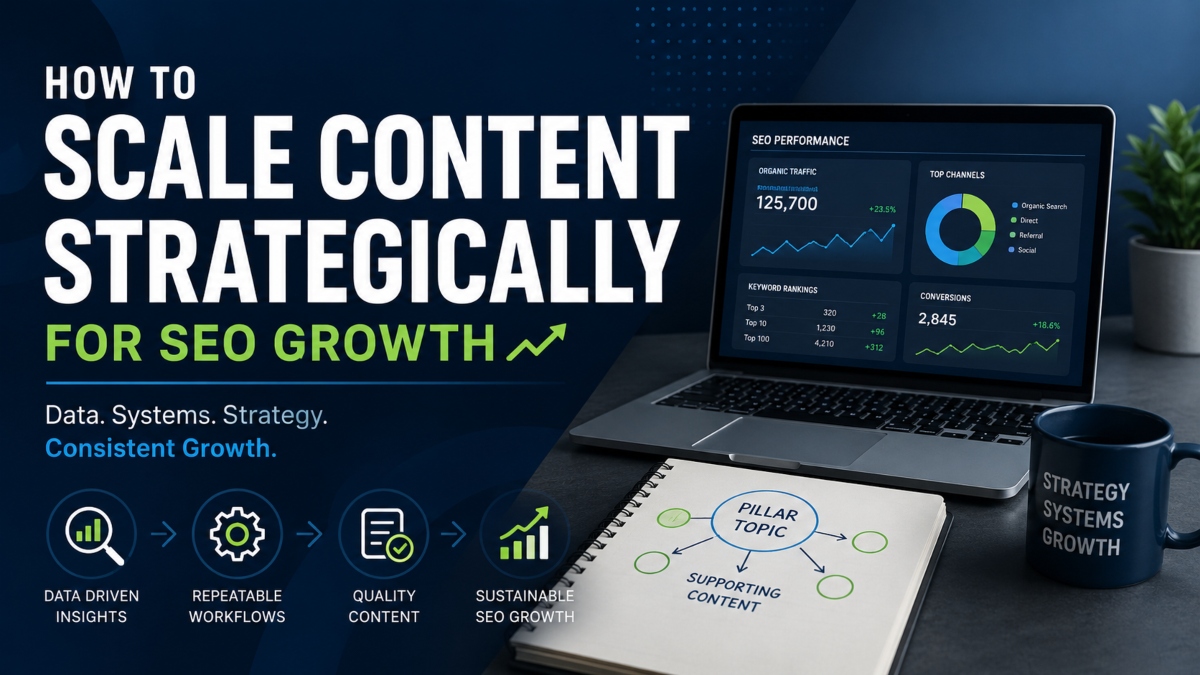
Publishing more content no longer guarantees better rankings or stronger traffic. Brands that win in 2026 are not simply producing more blog posts. They are building smarter systems powered by audience behavior, search trends, and real performance data. That shift has completely changed how businesses approach content growth.
Scaling digital content with audience and SEO data is now about creating repeatable systems that turn search demand into consistent traffic, engagement, and conversions. Instead of relying on random topic ideas or guesswork, businesses use audience intent and SEO performance signals to guide every stage of content production.
Modern scalable content marketing depends on understanding what users actually want to read, search, and interact with. Search intent, keyword clusters, engagement metrics, and conversion data help marketers identify which topics deserve attention and which formats perform best. This creates a more focused SEO content strategy where every article supports a larger growth plan.
Content workflows also play a major role in scaling efficiently. Teams now build structured processes around topic research, content briefs, optimization, publishing, and performance tracking. Combined with automation tools and topic clusters, businesses can increase output without lowering quality or losing consistency.
The biggest difference is that successful brands no longer treat content as isolated blog posts. They treat it as an interconnected system designed around audience intent, organic visibility, and measurable business goals.
What Scaling Digital Content Actually Means
Scaling content is no longer about publishing as many articles as possible and hoping something ranks. Businesses that grow organic traffic consistently use structured systems powered by audience behavior, search demand, and performance data. The goal is simple. Increase content output without lowering quality, relevance, or conversion potential.
Strong SEO content scaling depends on processes that can produce reliable results repeatedly instead of relying on random ideas or rushed publishing schedules.
Moving Beyond One Off Blog Posts
Many businesses still treat content like isolated projects. One week they publish a trend article, the next week a generic guide, and after that something completely unrelated. This scattered approach usually creates inconsistent traffic and weak audience engagement.
Modern scalable content production works differently. Instead of chasing disconnected topics, businesses build connected content ecosystems around search intent and topic relevance. A single pillar topic can support multiple supporting articles, guides, case studies, FAQs, and comparison pages.
This structure helps search engines understand topical authority while giving readers a smoother content experience. More importantly, it creates a foundation businesses can expand continuously over time.
Building Repeatable Content Systems
The brands producing large volumes of successful content rarely operate through improvisation. They rely on organized content operations built around repeatable workflows.
These systems usually include keyword research, audience mapping, content briefs, optimization checklists, publishing calendars, and performance tracking. Writers, editors, SEO teams, and strategists work from standardized processes that maintain consistency across every piece of content.
Templates also help speed up production without turning content robotic. Businesses can repeat proven structures for guides, tutorials, landing pages, and comparison articles while still adapting messaging for different audiences and search queries.
This allows companies to publish faster while maintaining clarity, quality, and SEO structure.
Why Data Driven Publishing Matters
Data driven publishing removes much of the guesswork from content marketing. Instead of choosing topics based on assumptions, businesses use search demand, engagement metrics, keyword clusters, and conversion data to guide editorial decisions.
Audience behavior reveals what users actually care about, while SEO data highlights where ranking opportunities exist. Together, these signals help businesses focus resources on topics with stronger traffic and conversion potential.
This approach makes SEO content scaling more sustainable because every new article supports a broader strategy instead of existing as standalone content with limited long term value.
Why Audience Data Should Guide Your Content Strategy
Many businesses still build content strategies around keywords alone. They chase search volume, publish articles quickly, and hope rankings turn into traffic. The problem is that traffic without audience relevance rarely produces strong engagement or conversions. That is why audience engagement data now sits at the center of modern SEO strategies.
The strongest content strategies are built around understanding what users want, how they behave, and where they sit in the buying journey. Search engines have also become better at rewarding content that satisfies user intent instead of simply repeating keywords.
Understanding Audience Intent
Search intent analysis helps businesses understand the reason behind a search query. Someone searching for “best SEO tools” usually wants comparisons and recommendations, while a person searching “how to improve bounce rate” wants practical guidance and solutions.
These differences matter because content that mismatches audience intent often struggles to rank and engage readers. Businesses scaling content successfully create pages tailored to specific user goals instead of publishing broad generic articles.
Audience data also reveals what different customer groups expect from content. Enterprise buyers often prefer strategic reports, detailed case studies, and ROI focused insights. Smaller businesses and beginners may respond better to tutorials, templates, checklists, and actionable guides.
When brands understand audience intent clearly, content becomes more targeted, useful, and conversion focused.
Using Engagement Metrics to Shape Content
Traffic numbers alone do not tell the full story. Businesses scaling content successfully rely on audience engagement data to understand how readers interact with pages after they arrive.
Bounce rate helps identify whether visitors leave quickly without engaging further. A high bounce rate may signal weak targeting, poor readability, slow loading speed, or content that fails to answer user questions clearly.
Scroll depth reveals how far readers move through a page. If users consistently stop halfway through an article, businesses can identify sections losing attention and improve structure or clarity.
Time on page offers another strong signal. Longer engagement often suggests the content matches user expectations and keeps readers interested. Short session times may indicate the opposite.
These metrics help businesses refine content formats, article structures, and messaging based on actual audience behavior instead of assumptions.
Matching Content to Funnel Stages
Not every visitor is ready to buy immediately. Strong customer journey content matches user intent at different stages of the funnel.
TOFU content, or top of funnel content, focuses on awareness. Blog posts, educational guides, and industry trend articles help attract users early in their research process.
MOFU content, or middle of funnel content, supports evaluation and comparison. Case studies, tutorials, webinars, and solution focused guides help users understand their options more clearly.
BOFU content, or bottom of funnel content, targets users ready to take action. Product comparisons, pricing pages, demos, and customer success stories help drive conversions.
Businesses using funnel based content mapping create smoother customer journeys because every piece of content serves a specific purpose. Combined with search intent analysis and audience engagement data, this approach turns content into a structured growth system instead of random publishing.
Using SEO Data to Build a Scalable Content Engine
Businesses that scale content successfully rarely rely on random brainstorming sessions. They use SEO data to build structured systems that continuously generate relevant topics, uncover ranking opportunities, and support steady organic traffic growth. Instead of treating content as isolated articles, they create connected ecosystems built around search demand and audience behavior.
This approach transforms content production into a scalable engine capable of producing long term traffic and conversions.
Keyword Clusters and Topic Hubs
One of the biggest shifts in modern SEO is the move away from isolated keywords toward keyword clusters and topic clusters. Search engines now reward websites that demonstrate authority across entire subject areas instead of targeting disconnected search terms one by one.
A keyword cluster groups closely related search queries under one broader topic. Businesses can then build a pillar page that covers the main topic while supporting articles target more specific subtopics.
For example, a pillar page about “Content Marketing Strategy” could connect to supporting articles covering SEO workflows, audience targeting, content distribution, analytics tracking, and AI writing tools. Each article strengthens the authority of the larger topic hub while helping readers move naturally through related content.
This structure improves internal linking, strengthens topical relevance, and increases opportunities for ranking across multiple search queries at the same time.
Search Query Reports and Conversion Data
Search query reports offer direct insight into what audiences actually search for before visiting a website. Instead of guessing which topics matter, businesses can identify search terms already driving impressions, clicks, and conversions.
Organic search data reveals which pages attract traffic, while paid campaign data often uncovers high intent keywords tied directly to conversions. Businesses can use these insights to build new content around proven search demand instead of chasing trends with uncertain value.
Conversion data also helps prioritize content more strategically. A keyword generating leads or product signups may deserve far more attention than a high traffic term with weak engagement. This makes SEO content production more focused and revenue driven.
Competitor Gap Analysis
Competitor research remains one of the fastest ways to identify missed content opportunities. Gap analysis helps businesses uncover keywords and topics competitors rank for while identifying areas where existing content feels thin, outdated, or poorly structured.
Instead of copying competitor pages directly, strong brands create deeper and more useful content around those same topics. This may include clearer explanations, updated examples, stronger visuals, better formatting, or more complete topic coverage.
Competitor analysis also helps businesses discover content formats that perform well in specific industries, including guides, case studies, FAQs, templates, or comparison pages.
Building an SEO Driven Editorial Calendar
An SEO content calendar turns raw data into a structured publishing strategy. Instead of publishing random articles every week, businesses organize topics according to search demand, funnel stages, seasonal trends, and audience priorities.
Topic clusters become easier to scale because supporting articles can be planned around each pillar page in advance. For example, a business building a topic hub around “SEO Content Strategy” might schedule articles about keyword mapping, content audits, internal linking, audience intent, and optimization workflows over several months.
This creates a connected publishing system where every article strengthens the visibility of the larger content ecosystem. Over time, these structured topic hubs become powerful drivers of organic traffic growth and topical authority.
Building a Scalable Content Workflow
Scaling content successfully is not only about writing faster. It is about creating systems that remove bottlenecks, improve consistency, and allow teams to publish high quality content repeatedly without chaos. Businesses that rely on scattered communication, unclear processes, or last minute publishing often struggle to maintain quality as output increases.
A scalable SEO strategy depends on structured workflows that guide content from research to publishing and performance tracking. When every stage follows a repeatable process, teams spend less time fixing problems and more time producing valuable content.
Set Clear Goals and KPIs
Every content workflow should begin with measurable goals. Without clear direction, teams often produce content that attracts traffic but fails to support larger business objectives.
Some businesses focus on organic traffic growth, while others care more about lead generation, newsletter signups, product demos, or customer engagement. Clear KPIs help teams understand what success actually looks like before production begins.
Strong workflows also connect goals directly to audience intent and funnel stages. A TOFU article may focus on impressions and traffic, while a BOFU landing page may target conversions and qualified leads. This structure keeps content aligned with business priorities instead of publishing for volume alone.
Standardize Content Briefs and Templates
One of the biggest reasons content production slows down is inconsistency. Writers receive incomplete instructions, editors interpret goals differently, and SEO requirements vary from one article to another. Standardized briefs solve this problem.
Good content briefs include target keywords, search intent, audience profile, internal linking suggestions, content structure, competitor references, and conversion goals. This gives writers a clear roadmap before drafting begins.
Templates also help speed up production while maintaining consistency across large content libraries. Businesses can create repeatable structures for tutorials, comparison pages, case studies, list articles, and pillar pages without making content feel robotic.
This approach allows content production systems to scale more smoothly because teams spend less time rebuilding structure from scratch for every project.
Create Repeatable Publishing Processes
Publishing workflows become difficult when every article follows a completely different process. Businesses scaling content successfully usually create fixed production stages that every piece moves through.
A repeatable workflow may include topic approval, keyword research, content briefing, drafting, editing, SEO review, formatting, publishing, and performance tracking. Clear ownership at each stage reduces confusion and keeps projects moving efficiently.
Editorial calendars also play a major role here. Instead of reacting to random ideas weekly, businesses can plan topic clusters and publishing schedules months in advance. This creates stronger consistency while reducing rushed production cycles.
Repeatable systems also make onboarding easier for freelancers, writers, and new team members because expectations remain clear across every project.
Automate Distribution and Reporting
Manual distribution often becomes a hidden bottleneck for growing content teams. Publishing the article is only part of the process. Businesses also need systems for promotion, reporting, and performance monitoring.
Content workflow automation helps reduce repetitive tasks through scheduling tools, email distribution systems, analytics dashboards, and social publishing platforms. Teams can automatically distribute articles across newsletters, LinkedIn, social channels, and internal communication systems without manually handling every step.
Automation also improves reporting efficiency. Instead of collecting data manually from multiple platforms, businesses can centralize traffic, engagement, ranking, and conversion metrics into shared dashboards. This allows teams to monitor content performance faster and make quicker optimization decisions.
Measure and Improve Performance
A scalable workflow only works if businesses consistently measure results and refine the system over time. Publishing alone is not enough. Teams need to understand which topics, formats, and structures produce the strongest outcomes.
Performance tracking should include rankings, organic traffic, time on page, conversion rates, engagement signals, and internal link performance. Underperforming pages can then be updated, expanded, merged, or repurposed instead of ignored.
The most successful brands treat content workflows like living systems. They refine templates, adjust processes, improve automation, and double down on formats producing stronger engagement. Over time, these improvements reduce manual friction while helping teams publish higher quality content at a much larger scale.
How to Optimize Content for SEO Without Losing Audience Value
One of the biggest mistakes in modern content marketing is treating SEO and reader experience like separate goals. Many businesses still overload articles with keywords, awkward phrasing, and robotic formatting because they believe search engines reward technical optimization above everything else. In reality, strong rankings usually come from content that satisfies readers first.
Search engines have become far better at measuring quality signals such as engagement, relevance, readability, and user satisfaction. That means successful optimization now depends on balancing search visibility with a smooth reading experience. A strong content optimization strategy should help content rank while still feeling natural, useful, and easy to consume.
Write for Humans First
The strongest content always starts with the reader, not the algorithm. Businesses focused only on keyword placement often create articles that technically rank for search terms but fail to hold audience attention.
Human focused writing answers questions clearly, removes unnecessary filler, and delivers useful information quickly. Readers should feel like the content understands their problem instead of forcing keywords into every paragraph.
Search intent matters heavily here. Someone searching for a beginner guide expects clarity and simplicity, while a professional audience may expect deeper analysis and more technical detail. Matching tone, depth, and structure to audience expectations creates stronger engagement signals, which also supports SEO performance naturally.
Use Semantic SEO Structure
Modern SEO depends heavily on context and topical relevance rather than exact keyword repetition. Semantic SEO writing helps search engines understand relationships between topics, subtopics, and user intent.
A strong SEO friendly blog structure uses clear headings, logical sections, internal linking, and related terminology throughout the article. Instead of repeating the same keyword excessively, businesses should naturally include supporting phrases and connected concepts that strengthen topical authority.
Content hierarchy also matters. Clear H1, H2, and H3 formatting helps both readers and search engines navigate the page more easily. Well structured articles increase readability while improving crawlability and featured snippet opportunities.
Topic clusters and supporting articles strengthen this process even further because search engines can connect related pages into larger content ecosystems.
Add Trust Building Examples and Data
Readers trust content that feels grounded in evidence and practical experience. Businesses scaling content successfully often include statistics, case studies, examples, screenshots, expert commentary, or real performance outcomes to strengthen credibility.
Specific examples also improve reader engagement because abstract advice becomes easier to understand when connected to real situations. A statement about improving conversions feels far stronger when paired with measurable results or a practical workflow example.
Trust signals support SEO indirectly as well. Readers spend more time engaging with useful and credible content, which increases positive engagement metrics over time.
Improve Readability and User Experience
Even strong information loses value when content feels difficult to read. Long walls of text, cluttered layouts, and overly technical language often push readers away before they reach the most useful sections.
Short paragraphs, clear spacing, subheadings, bullet points, and conversational writing improve readability significantly. Businesses should also focus on mobile friendly formatting because a large percentage of users now consume content through phones and tablets.
User experience also includes page speed, navigation, and content flow. Readers should move naturally from one section to the next without confusion or friction.
The best optimized content never feels aggressively optimized. It feels useful, structured, readable, and aligned with exactly what the audience wanted to find.
Combining Paid Media and SEO Insights for Faster Growth
Many businesses treat paid advertising and SEO as separate marketing channels. In reality, the strongest growth strategies often come from combining both data sources into one connected content system. Paid campaigns generate fast feedback, while SEO builds sustainable long term visibility. Together, they create a smarter and more efficient content strategy.
Using paid and organic search data together allows businesses to identify what audiences respond to before investing months into large scale content production. This reduces guesswork and helps teams focus on topics with stronger conversion potential.
Using Paid Search as a Testing Ground
Paid search campaigns provide immediate audience feedback. Businesses can quickly test headlines, landing page messaging, keyword intent, and content angles without waiting months for organic rankings to develop.
This makes paid media an excellent testing environment for content ideas. If certain keywords consistently drive clicks, engagement, or conversions through paid campaigns, there is a strong chance those same topics can perform well organically too.
Paid campaigns also reveal which messaging resonates with different audience segments. Businesses can compare user behavior across industries, demographics, or funnel stages and then apply those insights directly to SEO content planning.
Instead of relying entirely on assumptions, marketers can use real performance data to guide editorial decisions more confidently.
Turning High Converting Keywords Into Organic Content
One of the smartest ways to scale SEO content is by identifying keywords already producing results in paid campaigns. High converting search terms often reveal strong audience intent because users searching those phrases are already taking meaningful actions.
Businesses can then build conversion focused content around those same topics through blog articles, landing pages, guides, case studies, comparison pages, and topic clusters.
For example, if paid campaigns reveal strong conversion rates around a keyword like “best CRM software for startups,” businesses can create supporting organic content covering comparisons, tutorials, onboarding tips, pricing breakdowns, and customer success examples.
This strategy increases the value of existing keyword research while creating stronger alignment between paid and organic channels.
Reducing Content Waste Through Data
Content waste becomes a major problem when businesses publish large volumes of articles without validating audience demand first. Teams often spend weeks producing content that never ranks, engages readers, or supports conversions.
SEO performance insights and paid campaign data help reduce this issue significantly. Instead of publishing random topics, businesses can focus resources on search terms, formats, and audience segments already producing measurable engagement.
This creates a more efficient workflow where every piece of content supports broader traffic, conversion, and revenue goals. Over time, businesses produce less low value content and invest more heavily in topics proven to perform across multiple channels.
Metrics That Matter When Scaling Content
Scaling content successfully is not only about publishing more pages. Businesses also need clear systems for measuring performance, identifying weak points, and improving results over time. Without accurate tracking, even large content libraries can become difficult to manage and impossible to optimize properly.
The strongest content scaling strategies rely on data that reveals how content performs across traffic, engagement, conversions, and production efficiency. These insights help businesses understand which topics deserve expansion and which areas need improvement.
Organic Traffic and Rankings
Organic traffic remains one of the clearest indicators of SEO growth. Businesses should monitor how many users reach their content through search engines and which pages attract the highest visibility over time.
Keyword rankings also provide valuable insight into topical authority and search performance. Instead of tracking only a handful of keywords, businesses should monitor performance across entire topic clusters and pillar pages.
Steady ranking growth often signals that search engines view the website as a trusted source within specific subject areas. Sudden drops may reveal technical problems, weak content quality, or stronger competitor activity.
SEO reporting dashboards help simplify this process by centralizing ranking trends, traffic growth, impressions, and click through data into one view.
Engagement and Conversion Metrics
Traffic alone means very little if visitors leave quickly or fail to take meaningful actions. That is why engagement and conversion data matter just as much as rankings.
Businesses should monitor time on page, bounce rate, scroll depth, return visits, and click activity to understand how audiences interact with content. Strong engagement usually signals that content matches search intent and delivers useful information.
Conversion metrics reveal whether content contributes to larger business goals such as email signups, demo requests, purchases, or lead generation. A page attracting moderate traffic but producing strong conversions may hold far more value than a high traffic article with weak engagement.
These content performance metrics help businesses identify which formats, topics, and funnel stages generate the strongest outcomes.
Content Output and Production Speed
Scaling content also requires measuring operational efficiency. Businesses should track how many high quality pages they publish monthly and how long content moves through production workflows.
Slow approval processes, inconsistent briefs, or unclear responsibilities often create bottlenecks that limit scalability. Monitoring production speed helps teams identify workflow problems before they reduce output quality or consistency.
The goal is not simply producing more articles faster. It is creating systems that maintain quality while increasing publishing capacity steadily over time.
Updating and Repurposing Old Content
Scaling content does not always mean creating new articles from scratch. Updating older content often produces faster SEO gains with less effort.
Businesses should monitor aging pages for declining rankings, outdated information, weak engagement, or changing search intent. Existing articles can often regain visibility through refreshed data, improved formatting, updated keywords, or stronger internal linking.
Repurposing also helps maximize value from existing assets. A detailed guide can become shorter blog posts, social content, email campaigns, webinars, or downloadable resources.
This approach strengthens content scaling strategies because businesses continue extracting value from successful content instead of constantly restarting the production cycle.
Common Mistakes Businesses Make When Scaling Content
Many businesses struggle with scaling because they focus too heavily on output while ignoring quality, structure, and audience relevance. Publishing more content does not automatically create better SEO performance. In many cases, poor execution creates larger SEO workflow problems that damage rankings and reduce engagement over time.
One of the most common content scaling mistakes is publishing too much low quality content. Businesses sometimes push large volumes of articles live without proper research, editing, or optimization. Thin pages filled with repetitive information rarely hold attention or build trust with readers. Search engines have also become much better at identifying weak content that exists only to target keywords.
Ignoring audience intent creates another major issue. Some businesses focus entirely on search volume while forgetting why users search in the first place. A page may attract clicks initially, but if it fails to answer user questions clearly, engagement drops quickly. High bounce rates and weak session times often signal this disconnect.
Chasing random keywords without a larger strategy also hurts scalability. Publishing disconnected topics creates fragmented content libraries with little topical authority. Strong SEO growth usually comes from connected topic clusters and structured internal linking systems rather than isolated keyword targeting.
Weak internal linking is another overlooked problem. Businesses often publish articles without connecting them to related content. This limits user navigation, reduces topical relevance, and weakens the overall authority of the content ecosystem. Strong internal linking helps both readers and search engines understand relationships between pages.
Another serious issue is operating without a measurement system. Businesses cannot improve what they do not track. Without analytics dashboards, ranking reports, engagement metrics, and conversion tracking, teams struggle to identify what content actually produces results.
Finally, many companies now depend too heavily on fully automated AI generated content. While AI can speed up production, publishing large volumes of unedited machine written articles often creates content quality issues. Readers still expect clarity, originality, accuracy, and human perspective. Businesses that combine automation with strong editorial oversight usually perform far better than those relying entirely on automated publishing.
Final Thoughts
Scaling content successfully is no longer about publishing endless articles and hoping search traffic appears. Sustainable growth comes from building systems that combine audience understanding, SEO data, structured workflows, and consistent optimization. Businesses that treat content like a connected ecosystem usually outperform brands relying on random publishing schedules and scattered keyword targeting.
The strongest content strategies are built around repeatable processes. Topic clusters, editorial calendars, performance tracking, and workflow automation allow teams to increase output while maintaining quality and relevance. At the same time, audience behavior data helps businesses understand what readers actually want, which formats perform best, and where conversion opportunities exist.
SEO data adds another layer of precision by revealing ranking opportunities, search intent patterns, and content gaps competitors leave behind. When these insights work together, content becomes more strategic, scalable, and measurable.
The goal is not simply creating more content. The goal is creating smarter content that supports organic visibility, audience engagement, and business growth over time.
Start by auditing your current content process and identifying workflow bottlenecks that slow production or reduce quality. Build topic clusters around audience intent instead of isolated keywords, and track audience engagement metrics closely to understand which content actually delivers results.