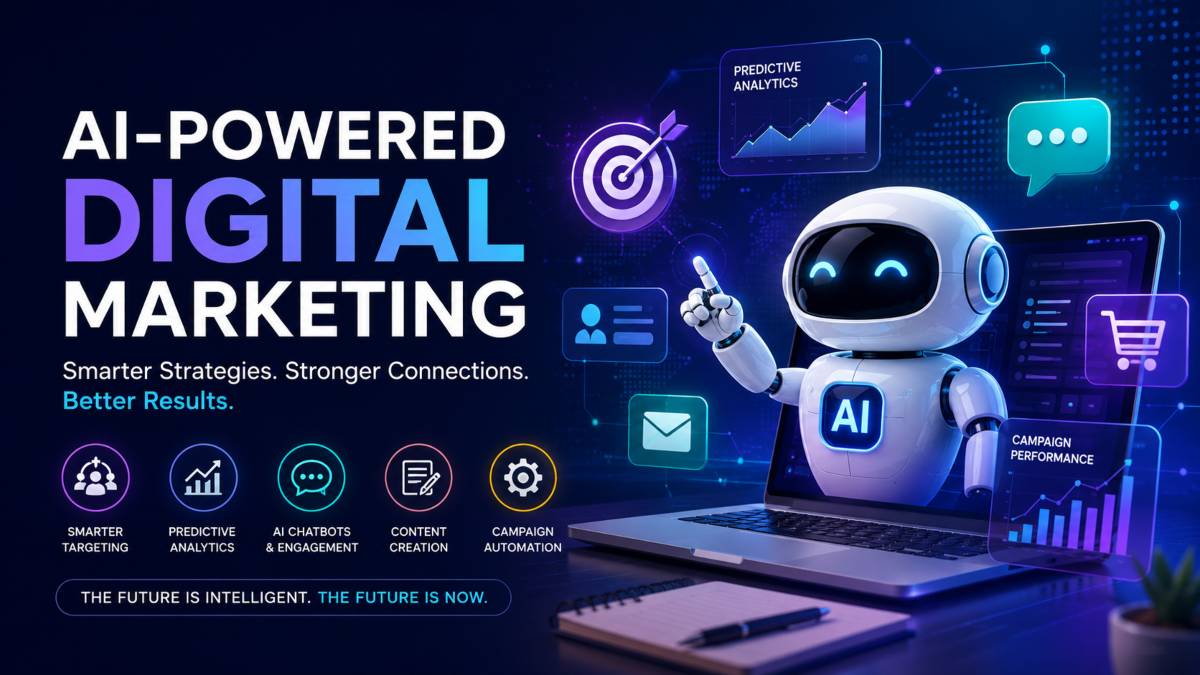
Artificial intelligence is changing how businesses connect with customers online. What once required hours of manual work can now be completed in minutes with the help of smart tools and data driven systems. From content creation to customer support, AI is helping marketing teams work faster, make better decisions, and deliver more relevant experiences.
At the same time, customer expectations continue to rise. People want brands to understand their needs, provide useful recommendations, and respond quickly across every channel. This growing demand has pushed businesses to adopt automation and personalization as key parts of their marketing efforts.
AI powered digital marketing strategies make this possible. By analyzing customer behavior, predicting trends, optimizing campaigns, and improving communication, AI helps businesses reach the right audience at the right time. These technologies are no longer limited to large companies. Businesses of all sizes can now use AI tools to improve efficiency and increase marketing performance.
This guide covers the most important AI marketing strategies shaping 2026. You will learn how businesses use predictive analytics, AI chatbots, content optimization, advertising automation, and emerging search strategies to stay competitive. Whether you are building a new marketing plan or improving an existing one, understanding these developments can help you prepare for the next stage of digital growth.
What Are AI Powered Digital Marketing Strategies?
AI powered digital marketing strategies use artificial intelligence to improve how businesses attract, engage, and convert customers. These strategies rely on data, automation, and smart algorithms to support marketing activities that once required significant manual effort. Instead of relying only on guesswork, marketers can use AI to make decisions based on real customer behavior and performance data.
How AI Is Changing Digital Marketing
Artificial intelligence is transforming digital marketing in several ways. One of the most important technologies behind this shift is machine learning. Machine learning systems analyze large amounts of data and identify patterns that help marketers understand customer preferences, buying habits, and engagement trends.
Natural language processing allows AI tools to understand and generate human language. This technology powers chatbots, virtual assistants, content tools, and customer support systems that can communicate with users in a natural way.
Marketing automation is another major advantage. AI can handle repetitive tasks such as email scheduling, audience segmentation, lead scoring, and campaign management. This gives marketing teams more time to focus on strategy and creative work.
Predictive decision making helps businesses anticipate future customer actions. By studying past behavior and market trends, AI can forecast outcomes and help marketers make smarter choices before launching campaigns.
Why Businesses Are Investing in AI Marketing
Businesses are investing in AI marketing because it helps them achieve better results with fewer resources. AI improves audience targeting by identifying the people most likely to engage with a product or service. This leads to more relevant campaigns and stronger conversion rates.
AI also speeds up execution by automating time consuming tasks and reducing manual work. Customers benefit as well through personalized experiences, faster responses, and more relevant recommendations.
Another major advantage is the potential for higher returns. When campaigns are optimized using real time data and intelligent analysis, businesses can improve performance while making better use of their marketing budgets.
Precision Targeting and Hyper Personalization
One of the most valuable advantages of artificial intelligence in marketing is its ability to deliver highly personalized experiences. Modern consumers expect brands to understand their interests and provide content that matches their needs. AI makes this possible by analyzing large amounts of customer data and turning it into actionable marketing decisions.
Rather than sending the same message to every customer, businesses can use AI personalization to create experiences tailored to specific individuals. This approach helps brands connect with the right audience and improve campaign performance across multiple channels.
How AI Analyzes Customer Behavior
AI uses customer behavior analysis to understand how people interact with a brand. It gathers and processes information from various touchpoints to identify patterns and preferences.
Purchase history is one of the most valuable data sources. AI can review previous purchases to determine what products or services a customer is most likely to buy in the future. This allows businesses to create targeted offers and promotions.
Browsing activity also provides useful insights. AI tracks the pages users visit, the products they view, and the content they spend time reading. These signals help marketers understand customer interests and intent.
Engagement patterns add another layer of understanding. AI can analyze email opens, link clicks, website interactions, and social media engagement to identify what content resonates most with different audiences.
Benefits of Hyper Personalized Marketing
Hyper personalization goes beyond traditional audience segmentation. It focuses on delivering highly relevant experiences based on individual behavior and preferences.
One key benefit is relevant content delivery. Customers receive information, offers, and recommendations that match their interests, making marketing messages more useful and appealing.
Better engagement rates are another advantage. When content feels personal and timely, people are more likely to interact with it, resulting in stronger relationships between brands and customers.
Hyper personalization can also increase conversion potential. By presenting the right message at the right moment, businesses can guide customers toward taking action, whether that means making a purchase, signing up for a service, or requesting more information.
Hyper Personalization Trends for 2026
As AI technology continues to advance, hyper personalization is becoming more sophisticated. Real time personalization allows brands to adjust content instantly based on current customer actions and preferences.
Behavioral prediction is also gaining momentum. AI can identify likely future actions before they happen, helping marketers create proactive campaigns instead of reactive ones.
Dynamic recommendations are another growing trend. From product suggestions to personalized content feeds, AI can continuously update recommendations based on changing customer interests, creating a more relevant and engaging experience.
Using Predictive Analytics to Stay Ahead of Market Trends
Successful marketing is no longer just about reacting to customer behavior. Businesses that can anticipate what customers want before they take action often gain a stronger position in the market. This is where predictive analytics marketing becomes valuable. By combining artificial intelligence with large datasets, marketers can identify future opportunities and make more informed decisions.
As competition increases and consumer preferences change quickly, predictive marketing helps businesses plan with greater confidence and accuracy.
What Is Predictive Analytics in Marketing?
Predictive analytics in marketing uses historical data, machine learning, and statistical models to forecast future outcomes. Instead of focusing only on what happened in the past, predictive systems estimate what is likely to happen next.
These insights help marketers understand customer behavior, identify buying patterns, and recognize trends before they become obvious. The result is a more proactive approach to campaign planning and audience engagement.
As part of modern marketing analytics, predictive tools allow businesses to make decisions based on data rather than assumptions.
How AI Forecasts Customer Actions
Artificial intelligence processes large amounts of information much faster than traditional analysis methods. AI examines customer interactions, purchase records, website activity, email engagement, and other behavioral signals to identify patterns.
Once these patterns are recognized, machine learning models can estimate future actions. For example, AI may predict which customers are most likely to make a purchase, stop using a service, or respond to a specific promotion.
As more data becomes available, these predictions continue to improve, helping marketers make smarter decisions and optimize campaign performance.
Practical Uses of Predictive Marketing
Predictive marketing supports a wide range of business objectives.
Demand forecasting helps businesses estimate future customer demand. This allows companies to prepare inventory, marketing campaigns, and resources more efficiently.
Lead scoring identifies prospects with the highest likelihood of converting into customers. Sales and marketing teams can then focus their efforts on the most promising opportunities.
Customer retention becomes easier when AI detects warning signs that a customer may leave. Businesses can take action early by offering personalized incentives or support.
Budget allocation is another important application. Predictive models help marketers determine which channels, campaigns, or audience segments are most likely to generate positive results, leading to better spending decisions.
Why Predictive Planning Matters in 2026
In 2026, marketing teams are expected to move beyond simple reporting and focus more on future planning. Predictive planning allows businesses to test potential outcomes before launching campaigns, reducing risk and improving efficiency.
As AI marketing strategies become more advanced, companies that use predictive analytics will be better positioned to adapt to market changes, respond to customer needs, and identify growth opportunities ahead of competitors. This shift makes predictive analytics a valuable part of any modern marketing strategy.
Conversational Marketing With AI Chatbots
Customers expect quick answers, personalized interactions, and support whenever they need it. Waiting hours for a response is no longer acceptable for many consumers. This shift has made conversational marketing an important part of modern digital marketing strategies. AI chatbots help businesses communicate with customers in real time while providing consistent support across websites, apps, and messaging platforms.
By combining artificial intelligence with natural language processing, chatbots can understand customer questions, provide useful responses, and guide users through different stages of the buying journey.
How AI Chatbots Improve Customer Experiences
AI chatbots improve customer experiences by delivering instant assistance around the clock. Instead of waiting for a support agent, customers can receive answers within seconds. This speed helps reduce frustration and keeps users engaged.
Modern chatbots can also personalize conversations based on customer behavior and previous interactions. For example, a chatbot may recommend products based on browsing history or provide information related to a customer’s interests.
Another benefit is consistency. Every customer receives accurate information and support regardless of the time of day. This helps businesses maintain a high standard of service while handling large volumes of inquiries.
Key Chatbot Statistics Marketers Should Know
The growing adoption of AI chatbots for marketing is supported by strong performance data.
Companies that use AI in customer interactions have reported higher customer satisfaction levels, with some studies showing satisfaction increases of more than 20 percent. This demonstrates the value of faster and more personalized support.
AI customer engagement has also improved significantly. Research shows businesses using chatbots can achieve more than double the engagement compared to traditional communication methods.
Chatbots are also influencing purchasing decisions. A growing number of consumers now complete purchases directly through chatbot interactions, showing that conversational experiences can contribute to revenue generation as well as customer support.
Best Use Cases for Marketing Teams
Marketing teams can use AI chatbots in several practical ways.
Lead qualification allows chatbots to collect information from potential customers and identify high quality prospects before passing them to sales teams.
Product recommendations help customers discover products or services that match their needs, improving the shopping experience and increasing sales opportunities.
Customer support remains one of the most common applications. Chatbots can answer frequently asked questions, provide troubleshooting guidance, and resolve simple issues quickly.
Appointment booking helps businesses automate scheduling processes, making it easier for customers to reserve consultations, demos, or meetings.
Building Trust Through AI Conversations
Trust plays a major role in successful conversational marketing. Customers are more likely to engage with AI systems when responses are accurate, helpful, and transparent.
Businesses should clearly communicate when customers are interacting with a chatbot and provide easy access to human support when needed. Combining AI efficiency with human assistance creates a smoother customer experience.
As chatbot technology continues to improve, businesses that focus on helpful and personalized conversations can strengthen customer relationships, improve satisfaction, and create more meaningful engagement across digital channels.
AI Content Creation and Dynamic Content Optimization
Content remains one of the most important parts of digital marketing, but creating high quality content consistently can be time consuming. Businesses need blog posts, emails, social media updates, videos, landing pages, and other assets to stay visible online. This is where AI content creation has become a valuable asset for marketing teams.
Artificial intelligence helps marketers produce content faster, optimize performance, and adapt messaging to different audiences. When used correctly, AI can support every stage of the content lifecycle, from planning and research to optimization and distribution.
How AI Supports Modern Content Marketing
AI content marketing relies on machine learning and language models to assist with content production and strategy. Marketers can use AI to generate topic ideas, create outlines, draft content, and identify keyword opportunities.
AI also helps analyze audience behavior and content performance. By examining engagement metrics, search trends, and user interests, AI can recommend content topics that are more likely to attract traffic and generate engagement.
Another major advantage is scalability. Marketing teams can create and update larger volumes of content without significantly increasing workloads. This allows businesses to maintain a consistent publishing schedule while responding quickly to market changes.
AI can also support content repurposing. A single blog post can be transformed into social media posts, email campaigns, video scripts, and other formats, helping brands get more value from existing content.
Top AI Content Marketing Tools for 2026
A growing number of AI marketing tools are helping businesses improve content creation and marketing performance.
ChatGPT is widely used for brainstorming, content outlines, article drafting, keyword research, and content planning. It helps marketers speed up the writing process while generating fresh ideas.
Jasper is designed for long form content creation and brand focused messaging. Many businesses use it to maintain consistent brand voice across multiple channels.
Grammarly helps improve readability, grammar, clarity, and writing quality. It can also suggest edits that make content easier to understand.
Canva AI supports visual content creation by helping marketers generate graphics, presentations, social media visuals, and branded design assets.
Lumen5 converts written content into engaging videos, allowing businesses to expand their content strategy across multiple media formats.
AI Powered SEO Content Optimization
AI SEO tools help marketers improve content visibility in search engines. These tools analyze keyword opportunities, search intent, content structure, and competitor performance to identify areas for improvement.
AI can recommend relevant keywords, optimize headings, improve readability, and identify content gaps. It can also help marketers build topic clusters that strengthen topical authority and improve search performance.
Many businesses now use AI to monitor rankings, track user behavior, and adjust content strategies based on performance data. This allows teams to make faster improvements and maintain content relevance over time.
Balancing AI Efficiency With Human Expertise
While AI can speed up content production, human expertise remains essential. AI tools can generate ideas and draft content, but they cannot fully replace industry knowledge, creativity, strategic thinking, and personal experience.
The most successful content strategies combine AI efficiency with human oversight. Marketers should review all AI generated content for accuracy, relevance, tone, and brand consistency before publishing.
By using AI as a support tool rather than a complete replacement, businesses can create content that is both efficient and valuable. This balanced approach helps brands produce high quality content while maintaining authenticity and building trust with their audiences.
AI Driven Advertising and Campaign Automation
Managing digital advertising campaigns has become more complex as businesses compete across multiple platforms and channels. Marketers must monitor budgets, adjust bids, test creative assets, and track performance constantly. Artificial intelligence helps simplify this process by automating many tasks while improving campaign efficiency.
AI advertising uses machine learning and data analysis to optimize campaigns in real time. Instead of relying solely on manual adjustments, marketers can use AI to make faster and more accurate decisions based on live performance data. This allows businesses to reach the right audience while making better use of their advertising budgets.
How AI Optimizes Advertising Campaigns
AI campaign optimization focuses on improving performance through continuous analysis and adjustment. AI systems review large amounts of data, including audience behavior, click patterns, conversion rates, and engagement metrics.
Using these insights, AI can identify which ads perform best, which audiences respond most positively, and which placements generate the strongest results. This allows marketers to improve campaign performance without manually reviewing every data point.
AI can also automate A B testing by comparing multiple versions of advertisements and selecting the highest performing option based on actual user behavior.
Real Time Bid Management and Budget Allocation
One of the most valuable applications of AI advertising is real time bid management. AI systems can adjust bids instantly based on factors such as user intent, competition levels, device type, location, and historical performance.
This helps advertisers avoid overspending while increasing visibility among audiences that are more likely to convert.
Budget allocation also becomes more efficient. AI can identify top performing channels and campaigns, then shift spending toward opportunities with stronger return potential. As a result, businesses can maximize results without increasing advertising costs.
Autonomous Advertising and Agentic AI
Autonomous advertising is becoming a major trend in digital marketing automation. Advanced AI systems can manage many campaign activities with minimal human involvement.
Agentic AI takes automation a step further by handling complex decisions independently. These systems can monitor performance, adjust targeting, optimize bids, and recommend strategic actions based on campaign objectives.
As AI technology continues to improve, marketers can spend less time on routine management tasks and more time focusing on creative strategy and business growth.
Measuring ROI From AI Campaigns
Tracking return on investment remains essential for every marketing campaign. AI makes this process easier by collecting and analyzing performance data across multiple channels.
Marketers can monitor key metrics such as conversion rates, customer acquisition costs, click through rates, and revenue generated from advertising efforts. AI can also identify patterns that reveal which strategies produce the strongest outcomes.
By providing clearer performance insights and continuous optimization, AI driven advertising helps businesses improve campaign results, reduce wasted spending, and achieve stronger returns from their marketing investments.
Emerging AI Marketing Trends Shaping 2026
Artificial intelligence continues to reshape digital marketing at a rapid pace. While automation and personalization remain important, several new developments are changing how businesses attract customers, create content, and manage campaigns. Understanding these AI marketing trends 2026 can help organizations stay competitive and prepare for future changes in search, advertising, and customer engagement.
From AI powered search experiences to autonomous workflows, marketers are entering a period where data and intelligent systems influence almost every stage of the customer journey.
Generative Engine Optimization (GEO)
Generative Engine Optimization, often called GEO, focuses on helping content appear in AI generated answers. As more users turn to AI assistants and conversational search tools for information, businesses need to think beyond traditional search rankings.
Optimizing content for AI generated responses requires creating clear, accurate, and authoritative content that AI systems can easily understand and reference. Content should answer questions directly while providing useful context and supporting details.
Content depth has become increasingly important. Comprehensive resources that cover a topic thoroughly are more likely to be recognized as valuable by AI systems. Businesses should focus on topical authority rather than producing large quantities of shallow content.
Structured content formats also play an important role. Well organized headings, concise explanations, FAQs, schema markup, and logical content hierarchies make it easier for AI systems to process and surface information.
Answer Engine Optimization (AEO)
AEO is another important development in modern search marketing. Rather than focusing only on ranking in search results, Answer Engine Optimization focuses on becoming the source of answers provided by AI powered search experiences.
Search behavior is changing as users ask more detailed questions using natural language. Instead of searching with short phrases, people increasingly use long tail conversational queries that resemble everyday conversations.
To improve AI search visibility, businesses should create content that directly answers specific questions. Clear definitions, step by step explanations, and concise responses can increase the chances of appearing in featured answers.
Strong expertise, trustworthy information, and regularly updated content also contribute to better visibility within AI powered search environments.
Zero Party Data Strategies
Growing privacy expectations are encouraging businesses to rethink how they collect customer information. Zero party data refers to information that customers willingly share with a brand.
This approach supports privacy first marketing by giving users more control over the information they provide. Rather than relying heavily on third party tracking, businesses can gather valuable insights directly from their audience.
Interactive quizzes, surveys, preference centers, and polls are becoming popular tools for collecting zero party data. These methods help brands understand customer interests while building stronger relationships.
Direct customer preferences provide highly accurate information that can improve personalization, audience segmentation, and marketing performance without creating privacy concerns.
Pod Based Marketing Teams
Many organizations are moving toward pod based marketing teams to improve speed and efficiency. Instead of separating departments into isolated groups, pod structures bring together specialists from different disciplines within a single team.
A typical pod may include strategists, content creators, analysts, designers, and technical experts working toward shared goals. This structure enables faster execution because decisions can be made without waiting for multiple departments to coordinate.
Collaboration also improves because team members share information more openly and work closely throughout campaign development. Access to real time data helps teams make informed decisions and adjust strategies quickly when conditions change.
Agentic AI and Autonomous Workflows
One of the most significant developments in artificial intelligence is the rise of Agentic AI. These advanced systems can perform tasks, make decisions, and manage workflows with limited human involvement.
In marketing, Agentic AI can support campaign management by monitoring performance, adjusting targeting, optimizing budgets, and identifying growth opportunities automatically. This reduces the amount of manual work required from marketing teams.
Autonomous workflows also allow businesses to respond faster to market changes and customer behavior. Instead of waiting for manual reviews, AI systems can take action based on predefined goals and performance indicators.
As this technology continues to mature, businesses will discover new opportunities to improve productivity, scale marketing efforts, and create more efficient operations. Companies that begin experimenting with these capabilities today will be better prepared for the next phase of AI driven marketing.
How to Implement AI Powered Digital Marketing Strategies
Adopting artificial intelligence can help businesses improve efficiency, strengthen customer engagement, and achieve better marketing results. However, successful implementation requires a clear plan. Jumping into multiple AI tools without a defined strategy can create confusion and limit results. A structured approach helps businesses identify the best opportunities and build confidence in AI driven processes.
The goal is not to automate everything at once. Instead, businesses should focus on solving specific marketing challenges and expanding their use of AI over time.
Define Clear Marketing Goals
The first step is identifying what you want AI to accomplish. Clear goals help guide tool selection, performance measurement, and long term planning.
For example, a business may want to improve lead generation, increase customer engagement, reduce campaign management time, or improve content production efficiency. Having measurable objectives makes it easier to evaluate success and determine whether AI is delivering value.
Specific goals also prevent teams from investing in technology that does not support their marketing priorities.
Start With a Small AI Pilot Project
Rather than introducing AI across every department at once, begin with a focused pilot project. This allows teams to test new technology in a controlled environment and learn how it fits existing workflows.
A pilot project might involve using AI for email marketing, chatbot support, content creation, or campaign analysis. Starting small reduces risk while providing valuable experience and performance data.
Once results are validated, businesses can expand AI adoption into additional areas of their marketing operations.
Select the Right AI Marketing Tools
The market offers a wide range of AI marketing tools, each designed for different purposes. Some focus on content creation, while others specialize in analytics, automation, customer support, or advertising management.
Businesses should evaluate tools based on ease of use, integration capabilities, available features, and overall fit with existing processes. Free trials and demonstrations can help teams compare options before making a commitment.
Choosing tools that solve specific business challenges often produces better results than selecting platforms based solely on popularity.
Train Teams and Build Internal Adoption
Technology alone does not guarantee success. Employees need training and support to use AI tools effectively.
Providing education on AI capabilities, workflows, and best practices helps build confidence and encourages adoption. Team members should understand how AI supports their work rather than viewing it as a replacement for human expertise.
Open communication and regular feedback can also help identify challenges and improve implementation efforts.
Measure Results and Scale Gradually
Tracking performance is essential for long term success. Businesses should monitor key metrics related to their original goals and compare results before and after implementing AI.
Analyzing performance data helps teams identify what is working, where improvements are needed, and which opportunities deserve additional investment. As positive results become clear, organizations can gradually expand AI usage across more marketing functions.
Actionable Implementation Checklist
Goal Setting
- Identify specific marketing challenges
- Define measurable objectives
- Establish success benchmarks
Tool Selection
- Compare available AI solutions
- Test platforms through trials or demos
- Choose tools that fit business needs
Testing Framework
- Launch a focused pilot project
- Set a testing timeline
- Document outcomes and lessons learned
KPI Tracking
- Monitor engagement metrics
- Measure conversion performance
- Track efficiency improvements
Optimization Cycle
- Review performance regularly
- Adjust strategies based on results
- Expand successful AI initiatives gradually
A structured implementation process helps businesses reduce risk, improve adoption, and maximize the value of AI powered digital marketing strategies over time.
Common Mistakes to Avoid When Using AI in Marketing
Artificial intelligence can improve marketing performance, but success depends on how it is used. Many businesses adopt AI with high expectations, only to encounter challenges because of poor implementation or unrealistic assumptions. Understanding the most common mistakes can help marketers get better results while avoiding unnecessary risks.
AI works best when combined with strong strategy, quality data, and human oversight. Businesses that treat it as a support tool rather than a complete replacement for human decision making are often more successful.
Over Reliance on Automation
Automation can save time and improve efficiency, but relying on it too heavily can create problems. AI can handle repetitive tasks and process large amounts of information, but it may not fully understand context, brand values, or customer emotions.
Marketing campaigns still require human judgment, creativity, and strategic thinking. Businesses should review automated processes regularly to ensure content, messaging, and customer interactions remain aligned with their goals.
Ignoring Data Quality
AI systems depend on data to make decisions. If the data is inaccurate, outdated, incomplete, or biased, the results will also be unreliable.
Poor data quality can lead to inaccurate audience targeting, weak recommendations, and ineffective marketing campaigns. Businesses should regularly audit their data sources and maintain clean, accurate records to improve AI performance.
Publishing Unedited AI Content
AI can generate content quickly, but it should not be published without review. Automated content may contain factual errors, unclear wording, outdated information, or messaging that does not match a brand’s voice.
Every piece of AI generated content should be checked for accuracy, readability, and relevance before publication. Human editing helps maintain quality and builds trust with readers.
Neglecting Customer Privacy
Customers are becoming more aware of how their personal information is collected and used. Businesses that ignore privacy concerns risk damaging customer trust and facing compliance issues.
Marketers should be transparent about data collection practices and follow privacy regulations. Collecting information responsibly helps create stronger customer relationships and supports long term marketing success.
Tracking the Wrong Metrics
Many businesses focus on vanity metrics that look impressive but provide little business value. High website traffic or social media engagement may not translate into revenue or customer growth.
Instead, marketers should focus on metrics connected to business goals, such as conversion rates, customer acquisition costs, lead quality, retention rates, and return on investment. Measuring the right data helps teams understand whether their AI initiatives are delivering meaningful results.
The Future of AI Powered Digital Marketing
Artificial intelligence is becoming a core part of modern marketing strategies. As technology continues to improve, businesses will have access to smarter tools that can analyze data, automate workflows, and create more personalized customer experiences. Companies that adapt early will be better positioned to meet changing customer expectations and remain competitive in increasingly crowded markets.
The future of digital marketing will not be defined by AI alone. Success will come from combining intelligent technology with human creativity, strategic thinking, and customer understanding.
What Businesses Should Prepare For
Businesses should expect AI capabilities to become more advanced and accessible. Marketing teams will have access to systems that can process larger amounts of data, identify opportunities faster, and support decision making with greater accuracy.
Customer expectations will also continue to evolve. Consumers will expect faster responses, more relevant recommendations, and seamless experiences across every digital touchpoint. Organizations that invest in AI readiness today will be better prepared to meet these demands in the years ahead.
AI Search, Automation, and Personalization
Search behavior is changing as more users rely on AI powered search assistants and conversational platforms to find information. Businesses will need to create content that answers questions clearly and demonstrates expertise across key topics.
Automation will continue to streamline campaign management, audience targeting, and content distribution. At the same time, personalization will become even more precise as AI systems gain a deeper understanding of customer preferences and behavior.
Together, AI search, automation, and personalization will shape how brands attract, engage, and retain customers.
Building a Sustainable AI Marketing Framework
Long term success requires more than adopting the latest tools. Businesses need a sustainable framework that supports responsible AI use, continuous learning, and ongoing optimization.
This includes maintaining high quality data, protecting customer privacy, training teams on new technologies, and regularly evaluating performance. Companies should also establish clear processes that balance automation with human oversight.
A strong AI marketing framework allows businesses to adapt to future changes while maintaining consistency, trust, and long term growth. Those who build this foundation now will be in a stronger position as AI continues to reshape the marketing landscape.
Final Thoughts
AI powered digital marketing strategies are changing how businesses connect with customers, manage campaigns, and drive growth. From precision targeting and predictive analytics to conversational marketing, content optimization, and AI driven advertising, these technologies help marketers make smarter decisions and improve performance across every stage of the customer journey.
As new developments such as GEO, AEO, zero party data strategies, and Agentic AI continue to gain momentum, businesses have more opportunities than ever to improve efficiency and create better customer experiences. However, technology alone is not enough. The most successful organizations combine automation with human judgment, creativity, and strategic thinking. AI can process data and automate tasks, but people remain essential for building relationships, creating meaningful content, and making informed business decisions.
Businesses do not need to transform their entire marketing operation overnight. Starting with a small project, testing different tools, and measuring results can provide valuable experience while reducing risk. Over time, these efforts can lead to stronger campaigns, improved customer engagement, and more efficient workflows.
Companies that begin experimenting with AI today will be better prepared for future changes in search, marketing, and customer behavior. Building AI capabilities now can create lasting advantages that help businesses stay competitive and continue growing in the years ahead.
Read More: How Small Businesses Can Increase Sales Using CRM Automation