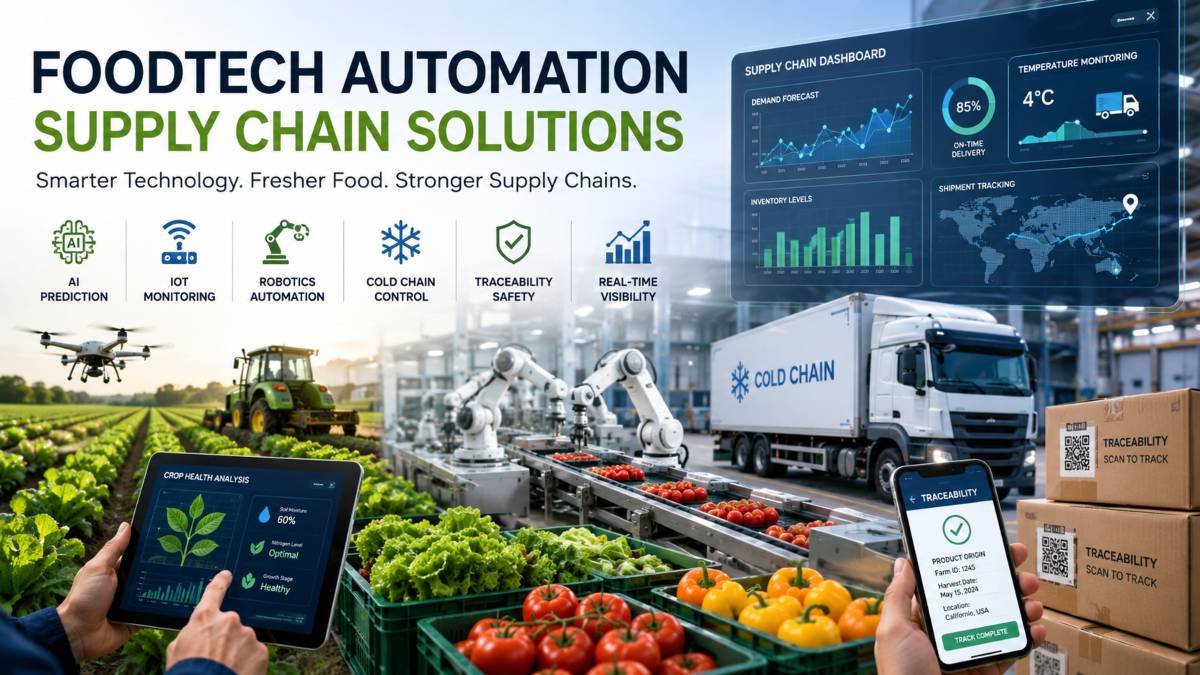
Foodtech automation supply chain solutions help food businesses manage every step of the journey from farms to consumers with greater accuracy and speed. By using artificial intelligence, IoT sensors, robotics, and smart automation, companies can monitor products, improve planning, reduce waste, and keep food fresh throughout the supply chain. These technologies replace many manual tasks with connected systems that support better decision making.
Modern food supply chains must handle changing demand, strict food safety rules, and products with a short shelf life. Smart technology helps businesses respond faster while keeping operations organized and reliable. In this guide, you will learn how foodtech automation works, the main technologies behind it, the benefits it offers, common business applications, and what the future looks like for AI powered food supply chains.
What Is Foodtech Automation in the Supply Chain?
Foodtech automation in the supply chain is the use of artificial intelligence, IoT devices, robotics, and connected software to manage and improve how food moves from farms to consumers. These technologies collect and analyze data throughout the supply chain so businesses can make faster and more accurate decisions. Instead of relying on manual processes, companies can automate routine tasks, monitor products in real time, and respond quickly when conditions change.
The food supply chain includes every stage involved in producing and delivering food. It begins with farming, continues through processing and packaging, moves into storage and transportation, and ends when products reach stores or restaurants. Automation connects each of these stages through shared data, giving businesses a clear view of inventory, product quality, and delivery status. This connected workflow helps reduce delays, improve food safety, and lower waste.
Definition of Foodtech Automation
Foodtech automation combines digital technologies with food production and logistics to improve efficiency across the entire supply chain. Artificial intelligence supports demand forecasting, IoT sensors monitor storage conditions, robotics handle repetitive tasks, and software keeps information updated across different systems. The result is a smoother workflow from crop production to the final customer.
How Automation Connects Every Stage
Automation links farms, processing plants, warehouses, distribution centers, and retail stores through a single flow of information. Sensors collect data from fields, machines sort and package products with greater accuracy, warehouse systems monitor inventory, and logistics software tracks deliveries from one location to another. Retailers receive timely updates on stock levels, allowing them to replenish products before shortages occur. This connected approach improves visibility, supports food quality, and helps businesses deliver fresh products more consistently.
Why Food Supply Chains Need Automation
Food supply chains handle thousands of products every day, many of which have a very short shelf life. Fresh fruits, vegetables, dairy products, seafood, and meat require careful handling from production to delivery. Even small delays or poor storage conditions can reduce product quality and increase waste. As customer expectations continue to grow, food businesses need smarter systems that can respond quickly and keep operations running smoothly.
Automation gives businesses better control over every stage of the supply chain. By combining artificial intelligence, IoT devices, robotics, and connected software, companies can monitor products in real time, improve planning, and make informed decisions based on accurate data. This helps reduce waste, improve food safety, and keep products moving efficiently from farms to stores.
Major Challenges in Traditional Food Supply Chains
Traditional food supply chains depend on manual work and disconnected systems, which often slow operations. Perishable products require fast transportation and proper storage, but changing weather conditions can affect harvests and delivery schedules without warning. Food waste also becomes a major concern when inventory is not managed accurately or products remain in storage for too long.
Manual documentation creates another challenge because paperwork takes time and increases the chance of errors. Supply disruptions caused by transportation delays, equipment failures, or supplier issues can interrupt deliveries and leave shelves empty. Businesses must also meet strict food safety and compliance requirements, which require accurate records throughout the entire supply chain.
How Automation Solves These Problems
Automation helps food businesses respond more quickly when conditions change. Artificial intelligence analyzes large amounts of data to improve demand forecasting and inventory planning, helping companies prepare for seasonal changes and customer demand with greater confidence.
Connected sensors monitor storage temperatures, humidity, and product movement throughout transportation and warehousing. This reduces food waste by identifying problems before products are damaged. Real time visibility also allows managers to track shipments, monitor inventory, and identify delays as they happen. With fewer manual tasks and better planning, businesses can lower operating costs while improving efficiency across the entire food supply chain.
Core Technologies Powering Foodtech Automation
Foodtech automation supply chain solutions bring together several advanced technologies that work as one connected system. Artificial intelligence, IoT devices, robotics, smart packaging, and digital platforms help food businesses improve planning, production, transportation, and product quality. These technologies collect information throughout the supply chain and turn it into actions that reduce delays, improve food safety, and support better business decisions. As more companies adopt food supply chain automation, these tools are becoming essential for handling growing demand while reducing waste and operating costs.
AI Demand Forecasting and Yield Prediction
Artificial intelligence helps food businesses predict future demand and estimate crop yields with greater accuracy. Instead of relying only on previous sales or seasonal patterns, AI analyzes satellite images, weather forecasts, historical production data, market trends, and field conditions. This gives producers and distributors a clearer picture of what to expect before crops are harvested.
Satellite data provides regular updates about crop growth, plant health, and land conditions across large farming areas. Weather models add another layer of information by predicting rainfall, temperature changes, and other environmental conditions that affect production. Together, these data sources help farmers estimate harvest volumes earlier in the growing season.
Procurement teams use these predictions to purchase the right amount of raw materials and avoid unnecessary spending. Inventory forecasting also becomes more accurate because businesses know how much stock they are likely to receive and how quickly it will move through the supply chain. Better planning helps reduce shortages, excess inventory, and food waste while improving customer satisfaction.
IoT Sensors for Smart Farming
The Internet of Things allows farms to collect real time information through connected sensors placed across fields and growing facilities. These sensors measure soil conditions, weather patterns, water levels, and crop health throughout the growing season.
Soil sensors track nutrients, temperature, and moisture levels, helping farmers understand exactly what their crops need. Moisture monitoring systems prevent both overwatering and underwatering by supplying water only when necessary. This supports healthier crops while reducing water use and operating expenses.
Resource optimization becomes easier because connected systems help farmers use fertilizers, irrigation, and equipment more efficiently. Every decision is based on current field conditions instead of estimates. The result is stronger crop quality, more consistent harvests, and better preparation for the rest of the food supply chain.
Robotics in Harvesting and Food Processing
Robotics has become an important part of foodtech automation, especially where speed, consistency, and accuracy are essential. Modern harvesting machines can identify ripe fruits and vegetables using cameras and artificial intelligence, allowing them to collect crops at the right time with minimal product damage.
Inside food processing facilities, robotic systems perform repetitive tasks such as washing, cutting, packaging, and palletizing products. Automated harvesting also helps reduce labor shortages during busy seasons while keeping production schedules on track.
Quality grading systems use cameras and computer vision to inspect products for size, color, shape, and surface defects. Sorting systems then separate products according to quality standards before they continue to packaging or distribution. These automated inspections improve consistency and help businesses deliver products that meet customer expectations.
Cold Chain Automation
Many food products must remain within specific temperature ranges from production to final delivery. Cold chain automation helps businesses monitor storage and transportation conditions continuously to protect product quality.
Temperature monitoring devices record storage conditions throughout warehouses, refrigerated trucks, and distribution centers. If temperatures move outside acceptable limits, the system immediately sends alerts so corrective action can be taken before products spoil.
Humidity sensors provide another layer of protection by monitoring moisture levels that affect fresh produce, dairy products, meat, and seafood. Shipment alerts notify logistics teams about delays or environmental changes during transportation, allowing them to respond quickly.
Shelf life protection improves because businesses receive accurate information about product conditions throughout the journey. This reduces spoilage, lowers waste, and helps consumers receive fresher food.
Food Traceability Systems
Food traceability systems create a digital history for every product as it moves through the supply chain. Information is recorded at each stage, beginning with production and continuing through processing, storage, transportation, and retail.
Digital records include production dates, supplier information, processing details, storage conditions, and shipping records. This information remains available whenever businesses need to verify product history.
Batch tracking makes it possible to identify exactly which products belong to a specific production run. If a food safety issue occurs, companies can locate affected products quickly instead of recalling large amounts of inventory unnecessarily.
Recall management becomes faster because businesses already have detailed records available. Food safety also improves because companies can identify problems earlier and respond before products reach more consumers.
Smart Packaging Technologies
Packaging has become much more than a protective layer. Smart packaging technologies help businesses monitor product quality throughout transportation and storage.
Time temperature indicators change appearance when products experience conditions that may reduce freshness. These indicators give suppliers and retailers a simple way to verify whether products remained within safe storage conditions.
Freshness monitoring systems detect changes that may indicate declining product quality before visible spoilage appears. This helps businesses remove affected products while protecting customer confidence.
Packaging optimization software also recommends suitable packaging materials and designs based on product type, shipping distance, and storage requirements. Better packaging reduces product damage, lowers waste, and improves transportation efficiency.
Supply Chain Visibility Platforms
Supply chain visibility platforms bring information from farms, suppliers, warehouses, transportation providers, and retail locations into one system. Managers can view current operations through live dashboards that display inventory levels, shipment status, production schedules, and supplier performance.
Supplier monitoring helps businesses evaluate delivery reliability, product quality, and available inventory. Early warning notifications allow purchasing teams to respond before shortages affect production.
Risk detection tools analyze weather conditions, transportation delays, supplier performance, and other external factors that could interrupt operations. These systems help businesses prepare for possible disruptions before they become costly problems.
Route optimization software calculates efficient delivery routes based on traffic conditions, delivery schedules, vehicle capacity, and product freshness requirements. This reduces travel time, lowers fuel costs, and helps food reach customers while it is still at its best. Together, these technologies create a connected foodtech automation supply chain that improves visibility, supports better planning, and keeps food moving safely from farms to consumers.
How AI Improves Food Supply Chain Decision Making
Artificial intelligence helps food businesses make smarter decisions by turning large amounts of information into useful actions. Instead of waiting for problems to appear, companies can identify possible risks early and respond before they affect production or deliveries. This allows foodtech automation supply chain systems to improve planning, reduce waste, and keep products moving smoothly from farms to consumers.
AI also supports better coordination between growers, suppliers, warehouses, logistics providers, and retailers. Every part of the supply chain can access updated information, making it easier to adjust plans when demand, weather, or transportation conditions change.
From Reactive Operations to Predictive Planning
Traditional supply chains often respond only after a problem has already occurred. Artificial intelligence changes this approach by using forecast driven planning. It studies weather conditions, historical sales, seasonal trends, and production data to estimate future supply and customer demand.
Demand prediction helps businesses produce and order the right amount of food, reducing excess inventory and lowering the chance of stock shortages. AI also sends risk alerts when it detects possible delays, supplier issues, equipment problems, or changing weather conditions. These early warnings give managers more time to act before operations are affected.
Procurement optimization is another important benefit. Purchasing teams can order ingredients and raw materials based on expected demand instead of estimates. This improves inventory control while reducing unnecessary spending and storage costs.
Real Time Data Across the Entire Network
Artificial intelligence connects information from every stage of the food supply chain into one system. Farm data such as crop growth, soil conditions, and harvest estimates helps businesses prepare for future production. Logistics data provides updates on shipment locations and delivery schedules, allowing managers to respond quickly if delays occur.
Warehouse information keeps inventory records accurate by tracking stock levels, storage conditions, and product movement in real time. Retail demand data shows which products are selling faster, helping businesses replenish inventory before shelves become empty. By bringing all this information together, AI gives food companies a clear view of their operations and supports faster, more confident decision making.
Benefits of Foodtech Automation Supply Chain Solutions
Foodtech automation supply chain solutions help businesses improve daily operations while building a stronger and more reliable food network. By combining artificial intelligence, IoT devices, robotics, and connected software, companies can make better decisions based on real time information instead of manual reports. This allows every stage of the supply chain to work more smoothly, from production and storage to transportation and retail.
Automation also helps businesses respond quickly to changing customer demand and unexpected events. With better planning, accurate inventory data, and connected systems, food companies can reduce delays, improve product quality, and control operating expenses. These improvements benefit both daily operations and long term business performance.
Operational Benefits
One of the biggest advantages of food supply chain automation is the reduction of food waste. Artificial intelligence can predict customer demand more accurately, helping businesses produce and order the right amount of inventory. Smart monitoring systems also detect storage or transportation issues before products spoil, allowing companies to protect valuable stock.
Automation supports faster deliveries by improving warehouse operations and selecting efficient transportation routes. Logistics teams receive live updates about traffic conditions, shipment status, and delivery schedules, helping them keep products moving without unnecessary delays.
Lower logistics costs are another important benefit. Better route planning reduces fuel consumption and vehicle usage while improving delivery efficiency. Companies also spend less time correcting manual errors because many routine tasks are completed automatically.
Inventory control becomes much more accurate with connected software that tracks stock levels across warehouses and retail locations. Managers know exactly what products are available, what needs to be reordered, and which items require immediate attention. This reduces excess inventory and lowers the chance of stock shortages.
Higher productivity follows naturally because employees spend less time on repetitive administrative work. Teams can focus on quality control, customer service, and business growth while automated systems handle routine processes such as inventory updates, order processing, and shipment tracking.
Business Benefits
Foodtech automation supply chain solutions also create important business advantages. Better customer satisfaction comes from reliable deliveries, fresher products, and accurate order fulfillment. Customers receive the products they expect at the right time, which helps build trust and strengthen long term relationships.
Improved food safety is another major benefit. Connected sensors monitor storage conditions throughout production, transportation, and warehousing. If temperature or humidity changes threaten product quality, businesses receive immediate notifications and can respond before products reach customers.
Automation also supports regulatory compliance by keeping accurate digital records throughout the supply chain. Production details, storage conditions, shipment history, and supplier information remain organized and easy to access during inspections or audits.
Supplier collaboration becomes stronger because all parties can share information through connected systems. Purchase orders, inventory updates, and delivery schedules are available in real time, reducing communication delays and improving coordination across the supply chain.
These improvements contribute to increased profitability. Businesses reduce waste, lower operating expenses, improve inventory management, and deliver better customer experiences. Together, these results help food companies build a more efficient supply chain while supporting steady business growth.
Foodtech Automation Use Cases
Foodtech automation supply chain solutions support many areas of the food industry. From growing crops to delivering finished products, automation helps businesses improve speed, accuracy, and product quality. Artificial intelligence, IoT devices, robotics, and connected software allow every stage of the supply chain to work with real time information. As a result, companies can reduce waste, improve inventory management, and deliver fresh products more consistently.
Agriculture
Modern agriculture uses foodtech automation to improve farming practices and crop management. Precision farming combines artificial intelligence with satellite images, weather information, and field sensors to help farmers make better decisions throughout the growing season. Instead of treating every field the same, farmers can adjust irrigation, fertilizer use, and harvesting schedules according to actual crop conditions.
Crop monitoring systems collect information about soil moisture, plant health, and weather changes in real time. This allows farmers to identify possible problems early and protect crop quality before harvest begins. Better planning at the farm level creates a stronger foundation for the entire food supply chain.
Food Manufacturing
Food manufacturing facilities use automation to improve production speed and maintain consistent product quality. Automated production systems handle tasks such as mixing, filling, packaging, and labeling with high accuracy. These systems reduce manual work while helping factories maintain steady output throughout the day.
Quality inspection has also become more accurate through artificial intelligence and computer vision technology. Cameras inspect products for size, color, packaging quality, and possible defects before they move to the next stage. This helps manufacturers deliver products that meet quality standards while reducing unnecessary waste.
Warehousing
Warehouses depend on automation to manage inventory more efficiently. Smart inventory systems monitor stock levels, product locations, and storage conditions across the facility. Managers always have current information about available inventory, making it easier to plan shipments and avoid shortages.
Automated picking systems use robotics and software to locate and collect products for customer orders. This speeds up order preparation, improves accuracy, and reduces the time needed to move products through the warehouse.
Logistics
Logistics companies use food supply chain automation to improve transportation efficiency and product freshness. Fleet optimization software monitors vehicle locations, fuel usage, delivery schedules, and driver performance. This information helps businesses manage transportation resources more efficiently.
Route planning systems analyze traffic conditions, delivery priorities, and travel distances to select suitable delivery paths. Better planning reduces delays and helps temperature sensitive products reach their destination while maintaining quality.
Retail
Retail businesses use foodtech automation supply chain technology to keep shelves stocked with the right products. Stock replenishment systems monitor inventory levels and automatically identify when additional products are needed. This helps stores avoid empty shelves while reducing excess inventory.
Demand forecasting allows retailers to predict customer buying patterns using historical sales, seasonal trends, and local demand. At the same time, expiry monitoring systems track product freshness and identify items that should be sold first. These tools reduce food waste, improve inventory control, and help customers receive fresher products during every visit.
ERP, EDI, and Supply Chain Software in Foodtech
Foodtech automation supply chain systems depend on more than artificial intelligence and smart devices. Enterprise Resource Planning, Electronic Data Interchange, and supply chain management software provide the digital foundation that keeps information connected across the entire business. These systems help food companies manage purchasing, inventory, production, logistics, and compliance from one central platform. When integrated with automation technologies, they reduce manual work, improve data accuracy, and support faster business decisions.
Why ERP Matters
Enterprise Resource Planning software connects different business departments through a shared database. Instead of storing information in separate systems, ERP keeps purchasing, inventory, production, finance, and logistics connected in one place. This allows every department to work with the same information.
Procurement becomes more efficient because purchasing teams can monitor supplier availability, compare inventory levels, and order raw materials based on current business needs. This reduces unnecessary purchases and helps maintain a steady supply of ingredients.
Inventory management also improves because ERP software tracks stock levels across warehouses and production facilities in real time. Managers know when products should be reordered and can avoid both shortages and excess inventory.
Production planning becomes more accurate by matching manufacturing schedules with available materials and expected customer demand. This helps factories use equipment and labor more efficiently while reducing delays.
ERP systems also support compliance by storing production records, batch information, supplier details, and quality control documents in one secure location. During inspections or audits, businesses can quickly access the records required to meet food safety regulations.
How EDI Automates Food Supply Chains
Electronic Data Interchange, commonly known as EDI, allows businesses to exchange documents electronically instead of relying on paper records or manual data entry. This improves communication between food manufacturers, suppliers, distributors, and retailers.
Purchase orders can be created and shared automatically, reducing processing time and lowering the chance of manual errors. Supplier communication also becomes faster because inventory updates, shipping notices, and delivery confirmations move between systems without unnecessary delays.
Invoice automation speeds up billing by generating electronic invoices that match purchase orders and delivery records. This shortens payment cycles and reduces administrative work for both buyers and suppliers.
Order tracking provides real time updates throughout the delivery process. Businesses can monitor shipment progress, receive delivery confirmations, and respond quickly if transportation delays occur. Together, ERP, EDI, and supply chain software create a connected environment that helps food companies improve efficiency, maintain accurate records, and support reliable food supply chain automation.
Challenges of Implementing Foodtech Automation
Foodtech automation supply chain solutions offer many advantages, but successful implementation requires careful planning and preparation. Every food business has its own production methods, technology stack, and operational goals. Moving from manual processes to automated systems often involves changes across multiple departments. Companies must prepare their technology, workforce, and business processes before they can achieve the full value of automation.
A well planned implementation reduces disruption and helps businesses build a reliable system that supports future growth. Understanding the technical and organizational challenges allows companies to make informed decisions before investing in new technology.
Technical Challenges
Many food businesses still rely on legacy systems that were built years ago. These older platforms may not support modern automation tools or real time data sharing. Connecting artificial intelligence, robotics, IoT devices, and supply chain software with existing systems often requires additional development and testing.
Data integration is another common challenge. Information from farms, production facilities, warehouses, logistics providers, and retail locations often exists in different formats and separate databases. Bringing all this information together into one connected platform requires careful planning to maintain data accuracy and consistency.
IoT infrastructure must also be reliable. Sensors, communication networks, cloud platforms, and monitoring systems need stable connections to collect and exchange information without interruption. Weak network coverage or hardware failures can reduce system performance and limit the value of automation.
Cybersecurity is equally important because connected systems handle valuable business information. Companies must protect production records, supplier data, customer information, and operational systems from unauthorized access. Strong security practices, regular software updates, and controlled user access help reduce these risks.
Organizational Challenges
Technology alone cannot transform a food supply chain. Employees must understand how to use new software, automated equipment, and digital reporting tools. Staff training helps workers build confidence and reduces mistakes during daily operations.
Change management is another important part of implementation. Employees may need to adjust their daily routines as manual processes are replaced with automated workflows. Clear communication and practical training help teams adapt more smoothly.
Initial investment can also influence project planning. Businesses must budget for software, hardware, system integration, employee training, and ongoing maintenance. A clear implementation plan helps companies manage costs while introducing automation in stages.
Vendor selection is equally important because technology partners provide the software, equipment, and technical support needed for long term success. Businesses should choose vendors with experience in the food industry, reliable customer support, and solutions that can grow alongside future business needs.
Future Trends in Foodtech Supply Chain Automation
Foodtech automation supply chain technology continues to evolve as businesses look for smarter ways to improve efficiency, food safety, and supply chain visibility. New digital tools are helping companies make faster decisions, reduce waste, and improve coordination from farms to retail stores. As artificial intelligence becomes more advanced, future food supply chains will rely on connected systems that can monitor operations, recommend actions, and support daily decision making with very little manual effort.
Businesses are also investing in technologies that improve product quality, strengthen traceability, and reduce environmental impact. These innovations are expected to shape the next generation of food supply chain automation across production, logistics, warehousing, and retail.
Emerging Technologies
AI agents are becoming more capable of handling routine business tasks without constant human supervision. They can monitor inventory, analyze supply chain data, recommend purchasing decisions, and notify managers when unusual activity requires attention. This allows teams to focus on planning and customer service while routine processes run automatically.
Digital twins create virtual versions of farms, warehouses, factories, and transportation networks. Businesses can test production schedules, storage capacity, and delivery plans inside a digital environment before making changes in real operations. This helps reduce costly mistakes and improves planning accuracy.
Autonomous logistics is expected to play a larger role as self operating vehicles, warehouse robots, and intelligent delivery systems become more common. These technologies can move products more efficiently while reducing manual work across the supply chain.
Computer vision allows cameras powered by artificial intelligence to inspect food products, monitor packaging quality, and identify defects during production. Faster inspections help businesses maintain consistent product quality while reducing unnecessary waste.
Edge computing allows information collected by sensors and connected devices to be processed closer to where it is created. This reduces response time and helps businesses react quickly when storage conditions or equipment performance change.
Blockchain traceability provides secure digital records that follow food products from production to retail. Every transaction and product movement is recorded, helping businesses improve transparency and strengthen food safety.
Sustainable automation is also becoming an important priority. Smart systems reduce energy use, improve resource management, lower food waste, and support environmentally responsible operations. As these technologies continue to mature, foodtech automation supply chain solutions will become even more intelligent, connected, and efficient for businesses across the food industry.
Final Thoughts
Foodtech automation supply chain solutions are changing how food businesses manage production, storage, transportation, and delivery. By using artificial intelligence, IoT devices, robotics, and connected software, companies can improve planning, reduce food waste, strengthen food safety, and maintain better control over every stage of the supply chain. These technologies also help businesses respond more quickly to changing demand while keeping operations organized and efficient.
As customer expectations continue to grow and food supply chains become more complex, automation is becoming an important part of long term business success. Companies that invest in modern technology today are better prepared to manage future challenges, improve operational performance, and deliver fresh products with greater consistency.
Every business has different goals and operational needs, so the right automation strategy will vary from one company to another. Taking time to evaluate current processes, identify areas for improvement, and choose suitable technology solutions can lead to measurable improvements. Whether you operate a farm, food manufacturing facility, warehouse, distribution network, or retail business, foodtech automation can help build a smarter, more connected, and more reliable supply chain.
Frequently Asked Questions
What is foodtech automation in the supply chain?
Foodtech automation in the supply chain is the use of artificial intelligence, IoT devices, robotics, and smart software to manage food production, storage, transportation, and delivery. These technologies connect every stage of the food supply chain through shared data, helping businesses improve planning, reduce manual work, monitor product quality, and deliver food more efficiently. The goal is to create a connected system that supports faster decisions, better visibility, and safer food handling from farms to consumers.
How does AI improve food supply chains?
Artificial intelligence improves food supply chains by analyzing large amounts of information to support better decision making. It helps businesses predict customer demand, estimate crop yields, monitor inventory, and identify possible supply issues before they affect operations. AI also supports route planning, warehouse management, and food safety monitoring, helping companies reduce waste and improve operational efficiency.
What technologies are used in food supply chain automation?
Food supply chain automation combines several digital technologies. These include artificial intelligence for forecasting and planning, IoT sensors for monitoring storage and field conditions, robotics for harvesting and production, computer vision for quality inspection, smart packaging for freshness monitoring, ERP software for business management, EDI for electronic document exchange, and blockchain systems for product traceability. Together, these technologies create a connected and efficient supply chain.
What are the benefits of automated food supply chains?
Automated food supply chains help businesses reduce food waste, improve inventory control, and speed up deliveries. They also support better product quality, lower operating costs, stronger food safety practices, and more accurate demand forecasting. With connected systems and real time information, businesses can improve customer satisfaction while making better use of their resources.
How does cold chain automation reduce food waste?
Cold chain automation uses connected sensors to monitor temperature and humidity during storage and transportation. If storage conditions move outside safe limits, the system sends immediate alerts so businesses can respond before products spoil. This protects food quality, extends shelf life, and reduces losses caused by improper handling or transportation delays.
What is food traceability automation?
Food traceability automation creates digital records that follow products throughout the supply chain. Information such as production details, processing dates, storage conditions, supplier records, and shipment history is stored electronically. If a food safety issue occurs, businesses can quickly identify affected products and take appropriate action while reducing unnecessary product recalls.
How do ERP and EDI support food supply chains?
ERP software connects purchasing, inventory, production, logistics, and finance into one business system. EDI allows companies to exchange purchase orders, invoices, shipping notices, and other documents electronically. Together, these systems improve communication, reduce manual data entry, increase accuracy, and help businesses manage food supply chain operations more efficiently.
What challenges come with foodtech automation?
Foodtech automation requires careful planning before implementation. Common challenges include connecting older software with modern systems, integrating data from different sources, building reliable IoT infrastructure, protecting business information, training employees, managing organizational changes, selecting suitable technology partners, and budgeting for software, equipment, and ongoing maintenance. Addressing these areas early helps businesses achieve better results from their automation projects.
Read More: Contact DesignMode24 com